2.1 PFlop/s GEMM on B200, and what the 98% hides
CuTile Rust reaches 2.1 PFlop/s on the B200, 98% of cuBLAS, but the ownership model constrains which kernels can hit that number.
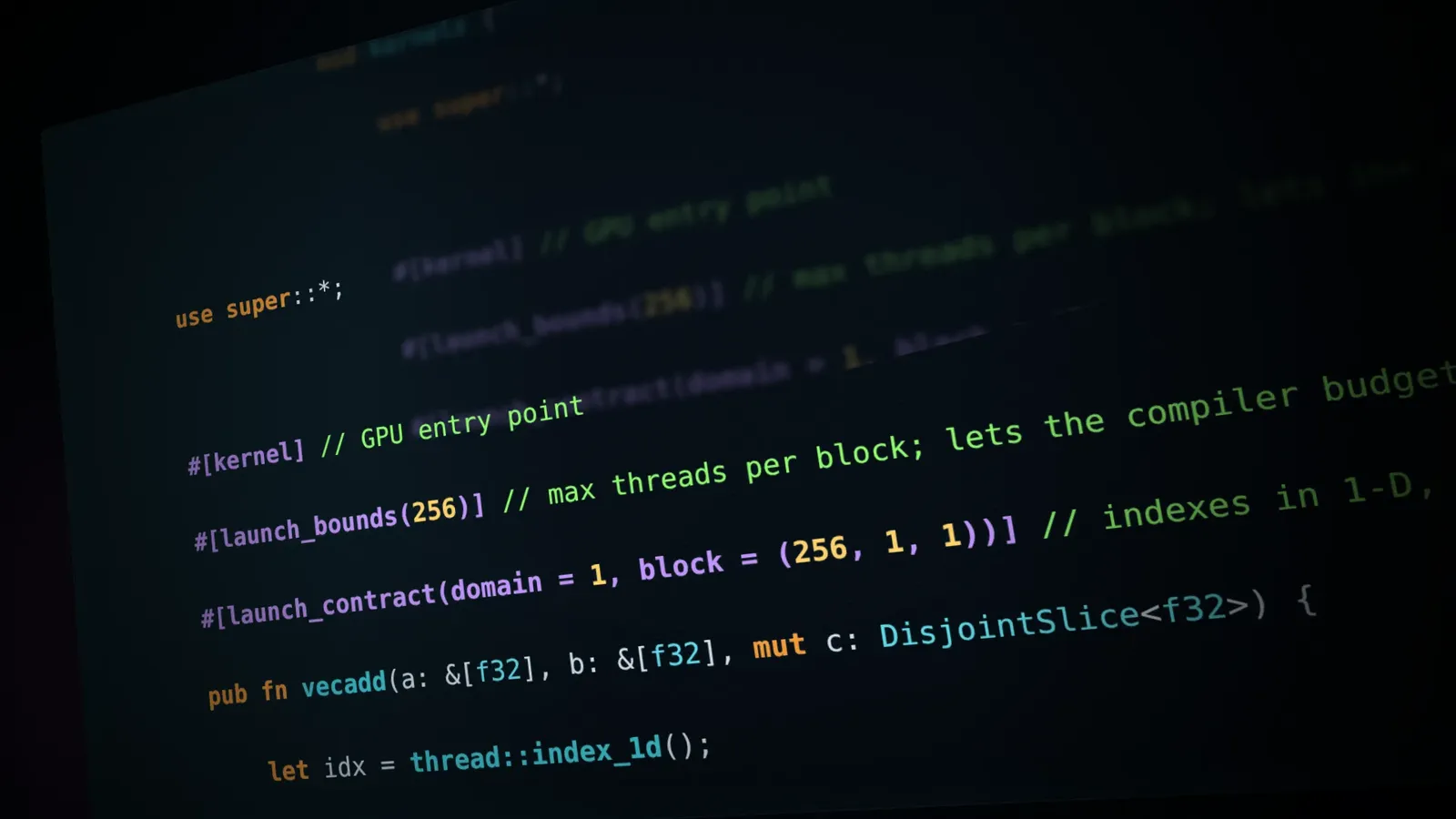
That is the GEMM throughput cuTile Rust hits on the B200, 98% of cuBLAS, per the arXiv paper "Fearless Concurrency on the GPU." The number does not prove the Rust frontend is free. The ownership model splits mutable outputs into disjoint pieces before launch, and the compiler moves bounds checks it cannot eliminate into host-side preconditions. A kernel that needs overlapping writes or dynamic bounds pays for that in launch overhead the cuBLAS baseline never sees.


The constraint falls on the kernel author, not the fab. You can write the kernel in Rust and still hit cuBLAS parity, but only within the tile partitioning the compiler can verify. The SIMT track, cuda-oxide, is still alpha and requires a pinned nightly toolchain with a custom LLVM backend. The buyer who wants Rust kernels today gets the Tile path; the SIMT path is a roadmap item, not a shipping toolchain.
Power, thermal, and occupancy figures for the Rust-compiled kernels are absent from the paper. The cost of host-side launch preconditions at high kernel launch rates is not measured, and that is where the ownership contract adds latency a raw CUDA C++ launch does not.

The 98% figure is measured within the tile partitioning the compiler can verify; kernels that need overlapping writes or dynamic bounds fall outside that envelope. The buyer who wants Rust kernels today gets the Tile path on stable Rust; the SIMT path is alpha and requires a pinned nightly toolchain.


The paper does not report power, thermal, or occupancy data for Rust-compiled kernels, nor the latency cost of host-side launch preconditions at high kernel launch rates.
The ownership model's disjoint partitioning of mutable outputs is the cost of the safety guarantee. Kernels that fit the tile model hit cuBLAS parity; kernels that do not either pay in host-side preconditions or drop to SIMT, which is not yet shipping.
2.1 PFlop/s GEMM on B200 (98% of · 7 TB/s element-wise on B200 · 171 tokens/s Qwen3-4B on RTX 5090 · 82 tokens/s Qwen3-32B on B200, batch-1 · Stable Rust 1.89+, CUDA 13.3, no custom LLVM · cuda-oxide: nightly toolchain, Pliron IR, LLVM
After SemiAnalysis-adjacent HN. We did not report this. The pictures, if any, are theirs.