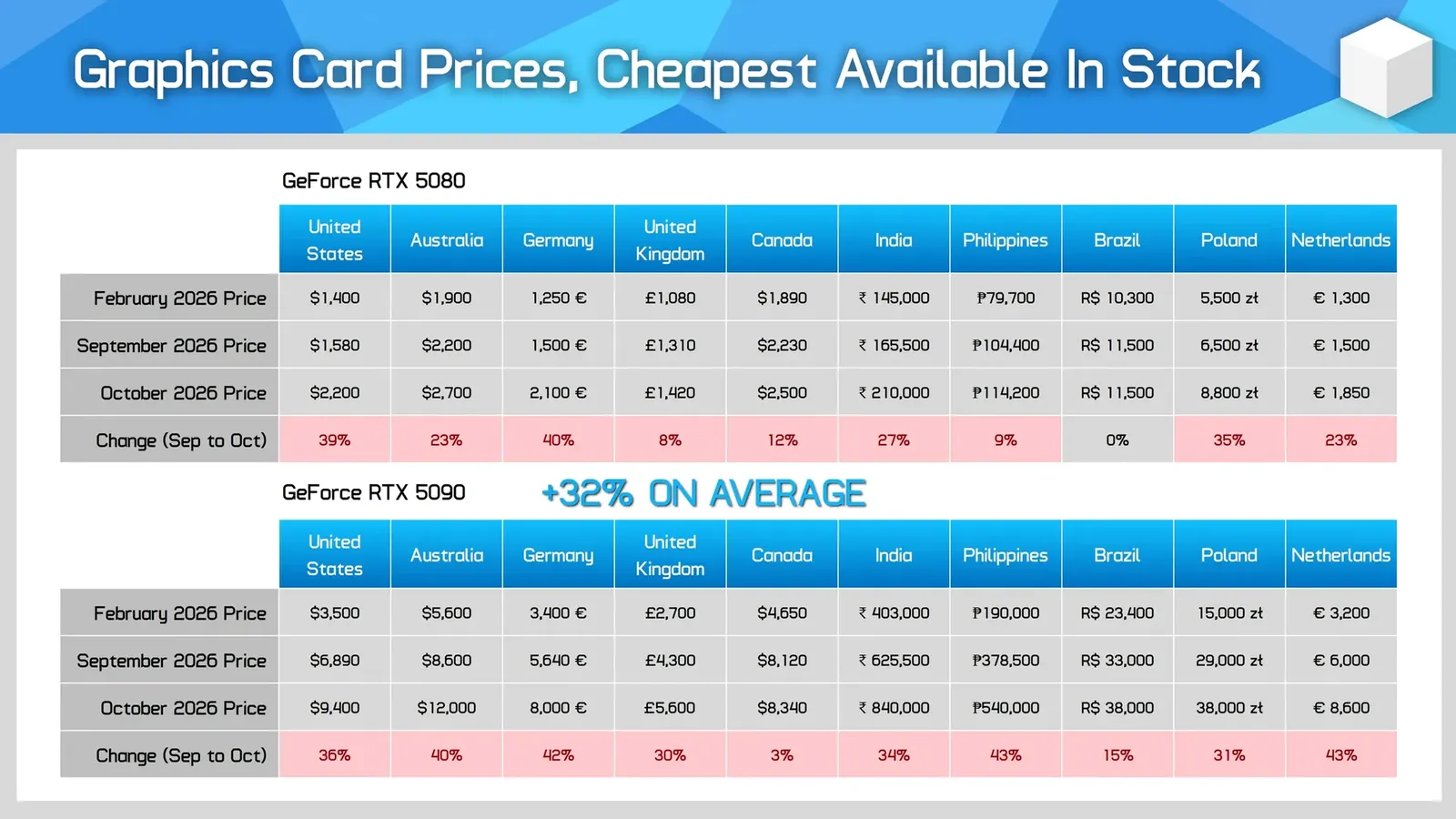
Reported RTX 5090 markup traces to GDDR7 supply
The NVIDIA RTX 5090 product page lists 21,760 CUDA cores and 32 GB of GDDR7 but prints no price, leaving the reported 370 percent markup unconfirmed by the vendor.
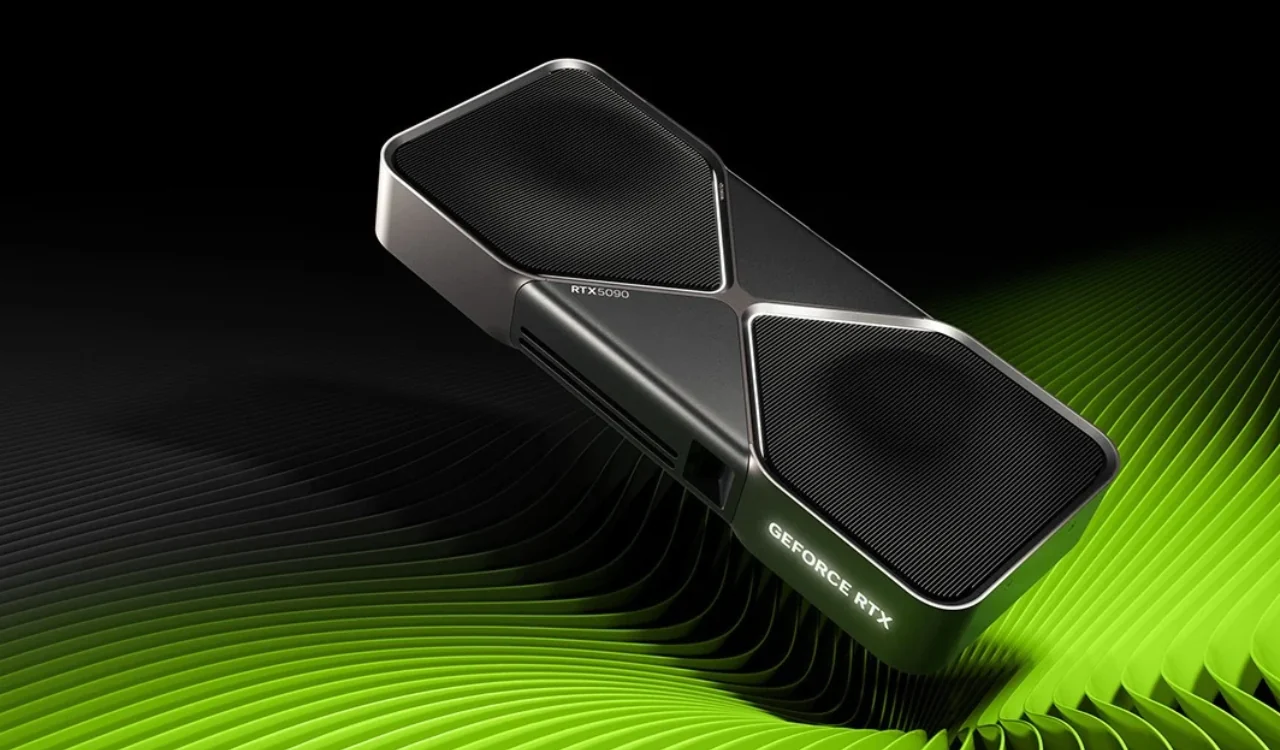
| GeForce RTX 5090 | |
|---|---|
| CUDA Cores | 21,760 |
| Memory | 32 GB GDDR7 |
| Memory Interface | 512-bit |
| Boost Clock | 2.41 GHz |
| Tensor Cores | 3,352 (5th gen) |
| RT Cores | 318 TFLOPS (4th gen) |
| Architecture | Blackwell |
| CUDA Capability | 12.0 |
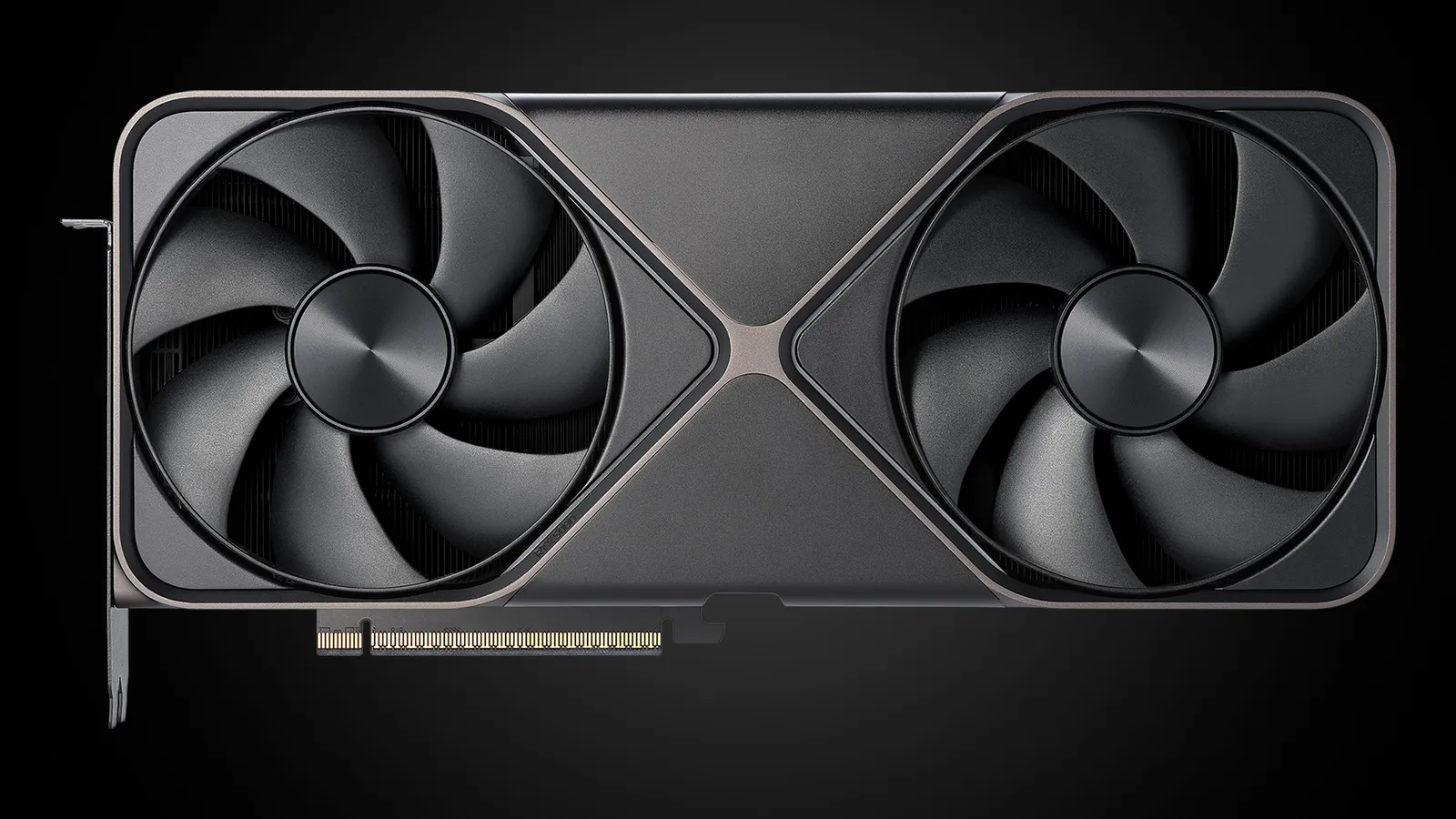
The NVIDIA product page for the GeForce RTX 5090 lists 21,760 CUDA cores on the Blackwell architecture, 32 GB of GDDR7 on a 512-bit bus, and a boost clock of 2.41 GHz with a base clock of 2.01 GHz. The page also names 3,352 fifth-generation Tensor Cores and 318 TFLOPS of fourth-generation ray-tracing throughput. The Founders Edition cooler uses a 3D vapor chamber with integrated heat pipes and active fins in a dual-slot design. The price field reads "Starting at $XXX.00." The availability line reads "Available January XX." No dollar figure, no calendar date.
The spec grid on the nvidia.com page is a hardware sheet, not a price tracker. It does not state a launch MSRP, a street price, or a confirmed date. The page confirms the silicon: core count, memory width, clock speeds, encoder generations, CUDA capability. It does not confirm what the silicon costs at a counter. It was not built to track a price.
The constraint the wire story names is the memory, not the die. A 512-bit GDDR7 interface means 32 GB of the newest generation of DRAM is soldered to each board. When GDDR7 supply tightens, the cost lands on the memory stack, not on the Blackwell wafer. The silicon is fixed at 21,760 cores and 3,352 Tensor units; the variable is the 32 GB of GDDR7 and the bus that feeds it. A buyer who paid the launch price and now sees a triple-digit markup is paying for the DRAM, not for the architecture. The vendor page does not dispute the markup. It simply does not print a price to dispute. The three desks that filed the story — Windows Report, Tom's Hardware, OC3D — are reporting a market condition, not a product change. The die is the same die. The 512-bit bus is the same bus. What moved is the price of the GDDR7 that sits on it.
The page does not print a TDP, a physical length, or a confirmed availability date. The Founders Edition cooler is described as dual-slot with a 3D vapor chamber and active fins, but no millimeter measurement is given. NVLink is listed as No. Reflex 2 Frame Warp is tagged "coming soon." The maximum digital resolution is 4K at 480 Hz or 8K at 165 Hz with DSC, on three DisplayPort and one HDMI connector. CUDA capability is 12.0. Three ninth-generation NVENC encoders and two sixth-generation NVDEC decoders are listed. AV1 encode and decode are both supported. What the page leaves open is the price, the date, and the wattage — the three numbers a buyer needs before pulling a card off a shelf.
The 512-bit GDDR7 interface is the variable in this markup, not the Blackwell die.
The page prints no MSRP, no street price, no TDP, and no confirmed availability date.
The constraint is the memory stack. 32 GB GDDR7 on a 512-bit bus is the component whose supply price moves. The Blackwell architecture is fixed; the DRAM cost is not. The NVIDIA page does not print a price, so the markup claim is unverified at the source.
After nvidia.com. We did not report this. The pictures, if any, are theirs. Also filed by windowsreport.com, tomshardware.com, OC3D.