
Micron's GDDR7 2 GB chips hit EOL after just months of RTX 50 supply
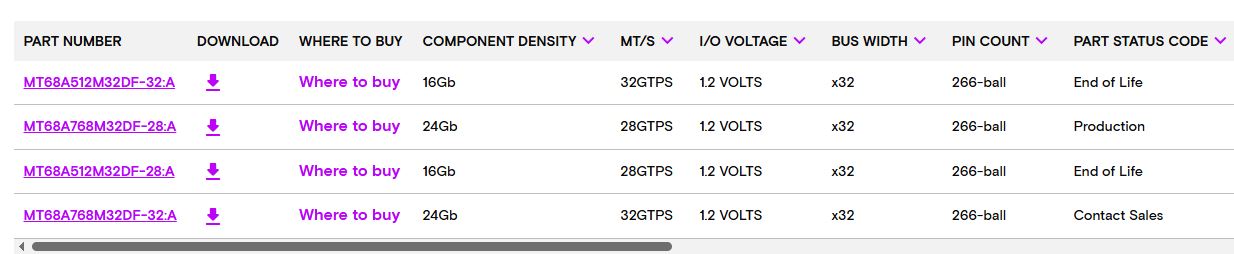
Micron's 2 GB GDDR7 chips at 28 and 32 Gbps reached end-of-life status on the company's product page, ending a supply window that lasted roughly two months.
Two months. That is the entire window Micron's 2 GB GDDR7 chips spent in active production for NVIDIA's RTX 50 series before the company marked both the 28 Gbps and 32 Gbps variants as end-of-life on its product page. The expectation going into 2026 was that a third supplier would ease the memory bottleneck. Instead, the third supplier exited before it had meaningfully shifted the supply curve.
The specific SKUs affected are the 16 Gb (2 GB) GDDR7 die at 28 Gbps, part number MT68A512M32DF-28:A, and its 32 Gbps sibling. Micron had been shipping the 28 Gbps variant into select RTX 50 boards since February 2026, when the chips were first identified on a retail card. The 32 Gbps variant never reached broad deployment. The trade-off here is straightforward: Micron is continuing to produce 3 GB GDDR7 modules, but those do not map to any current RTX 50 VRAM configuration. The 3 GB die is effectively dead weight for the existing product line.
Before Micron's entry, the RTX 50 GDDR7 supply chain ran on two vendors: Samsung and SK Hynix. After the EOL, it runs on the same two. The net change in supplier count is zero. Wccftech estimates that even 10% of total GDDR7 volume from a third source would create a noticeable market effect, and Micron's two-month window likely never reached that threshold. NVIDIA has already executed multiple price increases on GPU-memory bundles this year, and the removal of a marginal supplier removes one variable from the pricing equation. The direction of travel for RTX 50 street prices is unchanged: upward.
The source does not state why Micron pulled the 2 GB die from production. No yield data, no capacity reallocation rationale, no statement from Micron beyond the EOL flag on the product page. The 32 Gbps variant's pre-EOL shipment volume is unconfirmed. Whether Micron's 3 GB GDDR7 modules will find a use in a future NVIDIA product, or whether they are a dead-end SKU, is not addressed. The 4 GB and 6 GB GDDR7 chips reportedly targeted for 2027-2028 are attributed to unnamed memory makers, not specifically to Micron.
Watch whether Samsung or SK Hynix announce capacity expansions in response to the two-vendor concentration. The 4 GB and 6 GB GDDR7 die roadmap for 2027-2028 is the next structural shift; if those land on schedule, the current 2 GB and 3 GB die sizes become legacy. The RTX 50 supply equation is back to the same two names it started with, and the pricing pressure behind NVIDIA's bundle hikes has lost one potential relief valve.
Desk take
The EOL of Micron's 2 GB GDDR7 die removes the only third-source option for RTX 50 memory, concentrating supply back to Samsung and SK Hynix with no near-term relief. The 3 GB die Micron continues to produce does not align with any current RTX 50 VRAM configuration, making it irrelevant to the immediate supply problem.
RTX 50 GDDR7 supply is now a two-vendor dependency with no third-source buffer, locking in the pricing leverage that drove NVIDIA's bundle hikes this year.
Source dispatch
The company hardly supplied its GDDR7 memory chips to NVIDIA for a couple of months, but already ended the production of 2 GB memory modules SK Hynix Puts 2 GB GDDR7 28 Gbps and 32 Gbps Chips to EOL, While Producing Only 3 GB GDDR7 Modules We thought the situation would improve after Micron decided to enter the market with its GDDR7 memory chips. Micron joined the list of memory suppliers in mid-2025 to supply its GDDR7 chips to NVIDIA, but it was not until February this year that we spotted Micron's GDDR7 chips on an RTX 50 card. Micron […]