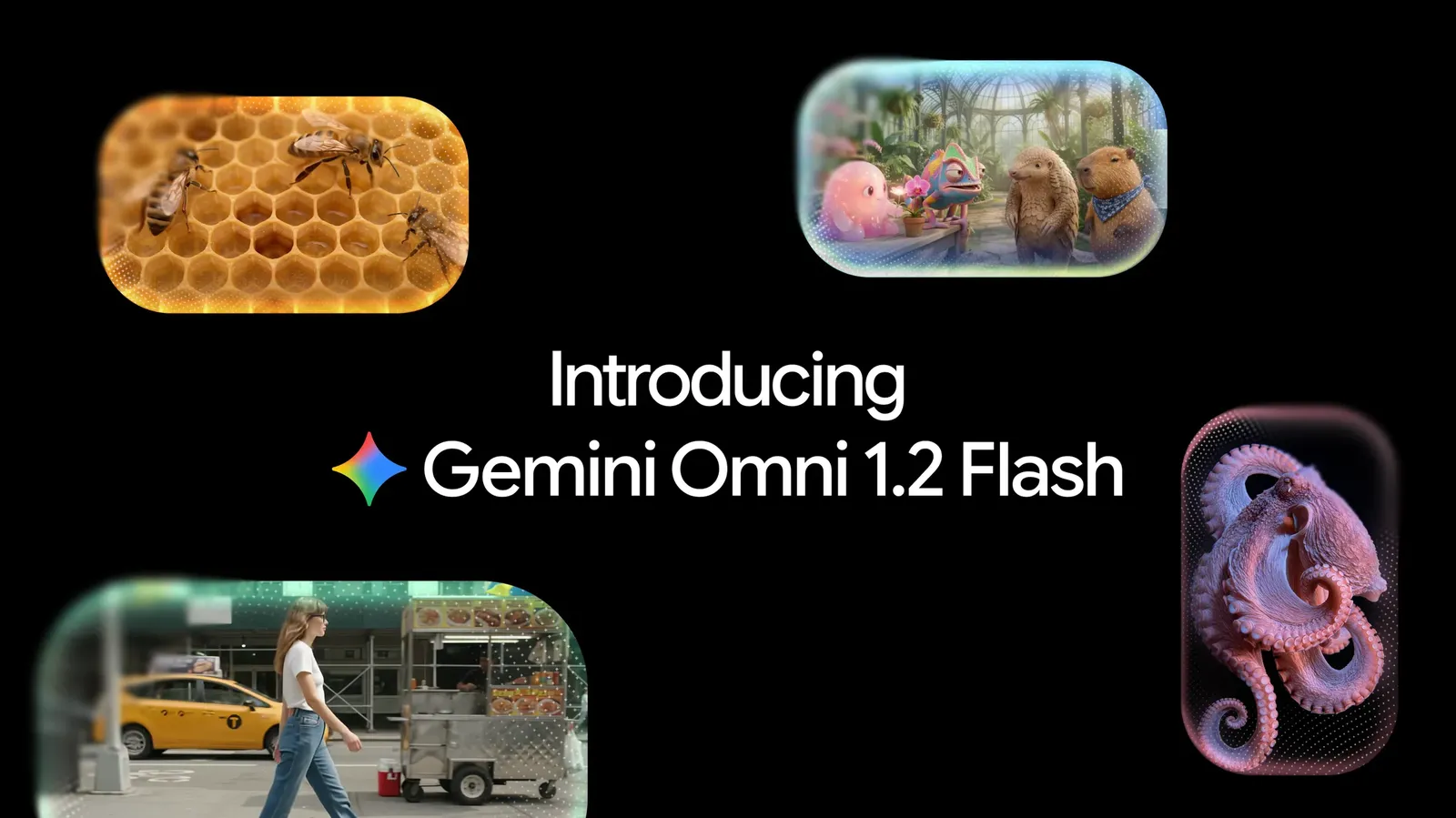
Gemini Omni 1.2 Flash extends native video to 15 seconds at $0.07 per second
Gemini Omni 1.2 Flash generates video natively up to 15 seconds, up from 10 seconds in Omni 1.1, and prices 720p output at $0.07 per second.
| Gemini Omni 1.2 Flash | |
|---|---|
| Max clip length | 15 seconds |
| Previous max (Omni 1.1) | 10 seconds |
| Price (720p) | $0.07 per second |
| Price reduction | 30% |
| Duration range | 3 to 15 seconds, one-second increments |
| Resolution tiers | 360p / 720p / 1080p / 4K |
| Motion clip reference max | 3 seconds |
The Google blog post dated November 5, 2026, written by Anish Nangia, Product Manager at Google DeepMind, states that Gemini Omni 1.2 Flash generates video natively up to 15 seconds, up from 10 seconds in Omni 1.1, and prices 720p output at $0.07 per second. Duration is specifiable in one-second increments from 3 to 15 seconds, giving room for complete stories, product explainers, or full social ad spots in a single generation. The model is generally available across the Gemini API and Google Cloud.
The post describes a three-step workflow: draft at 360p or 720p, apply a follow-up edit, then upscale to 1080p or 4K. Reference inputs include character or product images, motion clips up to three seconds, and audio cues, and the model is said to hold those details from start to finish across camera angles. Multi-turn conversational editing lets a user swap a background, change lighting, or switch aspect ratio across a full 15-second clip without regenerating it.
The post shows a 15-second virtual try-on sequence across 360-degree turns and a continuous FPV drone flight through the Pantheon's coffered dome as examples of what the model handles in a single generation. It also notes improved lip-sync and multi-speaker conditioning for dialogue scenes, and claims fewer unwanted jump cuts in complex camera movements like sweeping flythroughs and dramatic zoom-outs. The model is available in Google AI Studio, the Google Cloud console, Flow, Google Vids, the Gemini app for Google AI Ultra subscribers, and Google Ads, with Provisioned Throughput available for production workloads and outputs carrying an imperceptible SynthID watermark.
The 30 percent price cut is the number that changes the buyer's math. At $0.07 per second, a 15-second 720p clip costs $1.05, and the 30 percent figure implies Omni 1.1 charged roughly $0.10 per second. What the table does not prove is whether the 15-second ceiling holds under Provisioned Throughput at scale, because the post gives no throughput, concurrency, or latency figures, and the upscaling step to 1080p or 4K has no stated price, so the total cost of a finished 4K clip is not derivable from this page.
No benchmark score, no generation-time figure, no parameter count, and no rate-limit number appear in the document. The SynthID watermark is described as "imperceptible" but its embedding mechanism is not specified, and the post offers only qualitative comparisons between 1.1 and 1.2 with no numerical metric to verify the consistency claims. The post also does not state pricing for the 1080p or 4K tiers, which leaves the full cost of a finished clip unmeasured.
The 30 percent cut to $0.07 per second makes a 15-second 720p clip cost $1.05, but the absence of 1080p and 4K tier pricing means the true cost of a finished deliverable is not stated. The 15-second ceiling is unverified under Provisioned Throughput because no concurrency or latency figure is given.
No benchmark score, generation-time figure, parameter count, rate-limit number, or 1080p/4K tier pricing appears in the document.
At $0.07/s the 720p tier is the only price point with a number. The upscaling path to 1080p/4K has no per-second figure, so a buyer cannot compute the full pipeline cost from this page. Provisioned Throughput is named but unquantified; the 15-second ceiling may behave differently under load, and the document provides no data to test that.
After blog.google. We did not report this. The pictures, if any, are theirs. Also filed by Google AI, Google DeepMind, The Decoder.