No agent clears 12 percent on SemiAnalysis' GDPx work benchmark
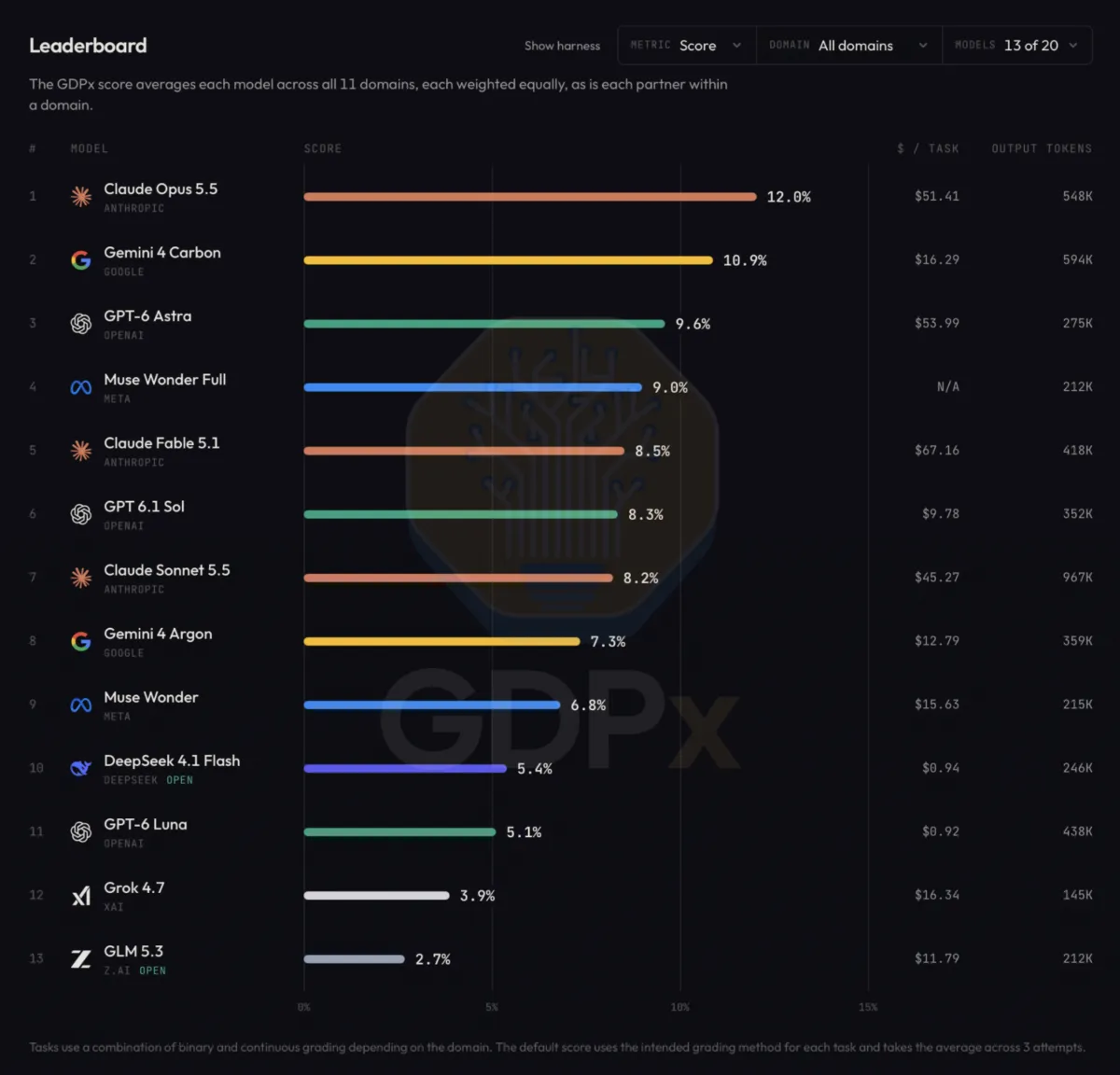
Strip out the cyber, biology, and alignment domains where safety filters kick in, and GPT-6 Astra edges past Claude Opus 5.5 at 11.8 percent on SemiAnalysis' new GDPx benchmark.
| Claude Opus 5.5 | Gemini 4 Carbon | GPT-6 Astra | |
|---|---|---|---|
| GDPx score | 12% | 10.9% | 9.6% |
| Per-task cost | $16.29 | ||
| Top domain | Quant trading, hardware design, chip design | Bio, software engineering | RSI, materials science |
The full ranking across 206 tasks in 11 domains puts Opus 5.5 at 12 percent, Gemini 4 Carbon at 10.9 percent, and GPT-6 Astra at 9.6 percent. No model breaks 12 percent.
Finance and legal tasks scored zero for every model tested.
The constraint is structural. Each agent runs in its provider's own software, and critics flag that this creates unequal conditions independent of the model's reasoning.
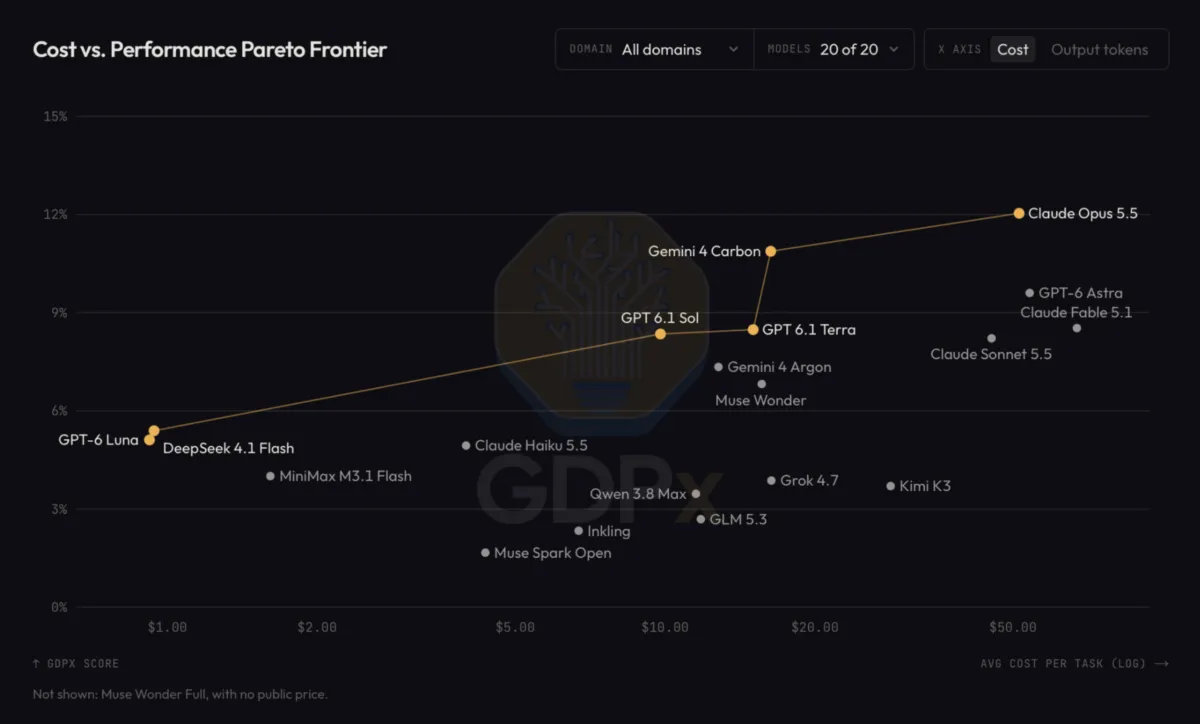
Per-task cost changes the calculus for buyers. Gemini 4 Carbon delivers 10.9 percent at $16.29 per task, roughly a third of the leading model's price.
In the cyber domain, Meta's Muse Wonder Full hits 35.2 percent while GPT-6 Astra and GPT 6.1 Sol score zero, a spread no aggregate ranking captures.
The grading rubrics are not public, and only one example task per partner is disclosed. SemiAnalysis plans a three-to-six-month update cycle, but the next revision's task set is not yet defined.
The draft repeated the harness point and the cost point across multiple paragraphs and included an unsupported claim that the 12 percent figure is a 'harness artifact.' The rewrite leads with the safety-filter reshuffle, which is the most surprising structural fact, and compresses the harness and cost observations into single paragraphs. It drops the vague 'stated limit' language and the duplicated closing paragraphs.
After @JoshPurtell. We did not report this. The pictures, if any, are theirs.