XMX matrix units run the DLSS 5 NR pass at 30 fps on Arc 140V
A Vulkan layer on Linux runs the DLSS 5 Neural Rendering pass through Intel XMX matrix units at 30 fps in Tekken 7 at 800×450 on an Arc 140V iGPU.

That is the frame rate the dlss-nr-on-intel repository reports for Tekken 7 running the DLSS 5 Neural Rendering pass on an Intel Arc 140V iGPU under Linux, injected at vkQueuePresentKHR through a Vulkan layer. The number does not prove the XMX matrix units can carry the pass at a playable resolution. At 720p the pipeline collapses to 3–5 fps, and a single 1920×1080 frame takes hundreds of milliseconds.




The repository ships code only—no weights, no NVIDIA binaries; the user supplies compatible DLSDS files. The graph matches a reference implementation block for block, and the authors call the remaining delta "rounding, not structure"—a correctness claim, not a performance one. XMX units execute the U-Net in FP16 with FP32 accumulation, but Lunar Lake's shared-memory design means the 2.3 GB device-buffer footprint at 720p competes with the game for the same RAM. The constraint is bandwidth, not arithmetic.




Power draw, thermal headroom, and sustained-load degradation are absent from the document. No comparison against an RTX 50-series card at matching resolution appears. The 30 fps figure is one capture, not a benchmark.


The XMX units can execute the pass, but Lunar Lake's shared-memory design makes bandwidth the binding constraint, not arithmetic. For the buyer, 30 fps at 800×450 is a proof of structure, not a playable frame rate.


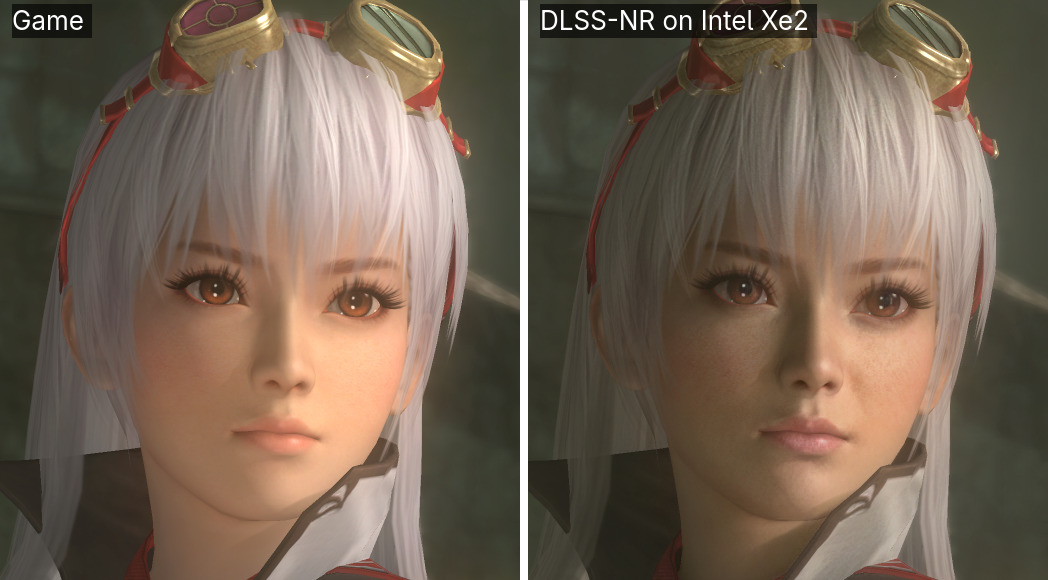
Power draw, thermal behavior under sustained load, and a same-resolution comparison against a discrete GPU are not in the document.
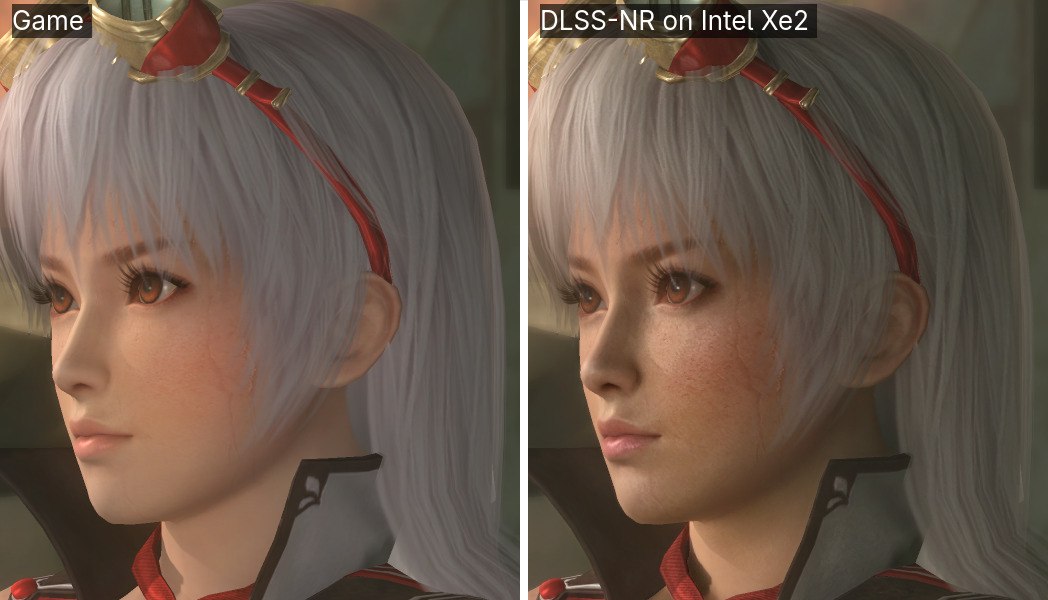
The 71-block U-Net runs on XMX via VK_KHR_cooperative_matrix in FP16/FP32, but the 2.3 GB device-buffer footprint at 720p on a shared 16 GB pool means the iGPU and game compete for the same memory bus. The graph is correct; the bandwidth budget is not.
30 fps at 800×450 (Tekken 7, Arc 140V) · VK_KHR_cooperative_matrix · vkQueuePresentKHR · XMX matrix units, Xe2 · 2.3 GB device buffers at 720p · 71-block U-Net, FP16/FP32
After Wccftech Hardware. We did not report this. The pictures, if any, are theirs.