What a gigabyte of HBM4 costs, next to DDR5 at $58.90 a die
TrendForce's spot board, stamped 9 October 2026, averages a DDR5 16Gb die at 58.90 dollars. That public page has no HBM row. A reported HBM4 ask is still not a contract.
| Posted figure | Per gigabyte | As of | |
|---|---|---|---|
| DDR5 16Gb die | $58.90 session average | $29.45 arithmetic | 9 Oct 2026 |
| DDR5 16Gb eTT | $26.80 session average | $13.40 arithmetic | 9 Oct 2026 |
| DDR5 UDIMM 16GB | $239 session average | $14.9375 arithmetic | 28 Sep 2026 |
| DDR5 RDIMM 32GB | $2,163.50 session average | $67.609375 arithmetic | 28 Sep 2026 |
| DDR5 8GB SO-DIMM contract | $133 session average | $16.625 arithmetic | 31 Aug 2026 |
| September DRAM contract | not on the public page | ||
| HBM3E reported ask | about $1.50 per Gb | about $12 arithmetic | 7 Oct 2026 |
| HBM4 reported ask | mid-to-high $4 per Gb | 7 Oct 2026 | |
| HBM on the spot board | 9 Oct 2026 |
A gigabyte of memory does not have one price. The public pages price a die, a module, and, in the case of high-bandwidth memory, an asking figure that the seller has not confirmed. This brief keeps those objects apart, dates each one, and does not draw a bar when the page does not print the number.
TrendForce's DRAM spot board was opened on 10 October 2026. The page's own stamp says the last update was 2026-10-09 18:10 GMT+8. The row labeled DDR5 16Gb (2Gx8) 4800/5600 shows a daily high of 70.00, a daily low of 44.00, a session high of 70.00, a session low of 44.00, and a session average of 58.90. The session change is up 0.40 percent. The page prints those dollars against the die. It does not print the word gigabyte on that row.
A 16 gigabit die holds two gigabytes, because a byte is eight bits. Dividing 58.90 by 2 gives 29.45 dollars a gigabyte, and that division is ours. The number TrendForce posted is 58.90 dollars for one die. The wide high and low on the same row, 70.00 and 44.00, are a reminder that the average is a session print, not a quote a buyer can point at and demand.
The DDR5 16Gb eTT row on that same update shows a session average of 26.80, a daily high of 28.30, and a daily low of 26.00, up 0.75 percent. The same division by two gives 13.40 dollars a gigabyte. eTT is the label the board uses. This brief does not expand the abbreviation past what the page prints.
The rows on that spot update are DDR5, DDR4, and DDR3, and no HBM generation appears. Anyone looking for an HBM3, HBM3E, or HBM4 dollar on the public spot board will not find one there. Those bars are absent on purpose.
A second table on the TrendForce site, module spot, carries a different stamp: 2026-09-28 14:40 GMT+8. DDR5 UDIMM 16GB 4800/5600 shows a session average of 239.00, a weekly high of 265.00, a weekly low of 223.00, and an average change of zero. Dividing 239 by 16 gives 14.9375 dollars a gigabyte. The date is 28 September, eleven days before the die print, and the object is a module rather than a bare die. DDR5 RDIMM 32GB on that module table shows a session average of 2,163.50, up 3.02 percent. Dividing by 32 gives 67.609375 dollars a gigabyte. A registered server module and a commodity die are different products, which is why those per-gigabyte results cannot be swapped.
The contract table still shown without a login is marked as the second half of August, last updated 2026-08-31 14:00 GMT+8. DDR5 8GB SO-DIMM shows a session average of 133.00, a high of 141.00, a low of 118.00, and an average change of up 2.31 percent. Dividing 133 by 8 gives 16.625 dollars a gigabyte. The page says the September DRAM contract series was updated on 30 September 2026 and that the detail is a download for members. The September contract dollar is not on the public page, so that contract is not on the chart.
High-bandwidth memory is not on that board at all. The Korea Herald, on 7 October 2026, wrote that KB Securities expects Samsung's HBM selling prices to rise more than 100 percent from one year to the next in 2027. It said local media reports describe a Samsung proposal in the mid-to-high 4 dollar range per gigabit for HBM4 supply in 2027, set against roughly 1.50 dollars per gigabit for current HBM3E in those same reports. The Herald says the figures are reported asking prices, not disclosed final contracts, and that Samsung has not publicly confirmed the individual 2027 terms.
Eight gigabits make one gigabyte. Multiplying the reported roughly 1.50 dollars a gigabit by eight gives about 12 dollars a gigabyte. The multiplication is ours, and the input is an approximate number inside a newspaper's account of other reports. The product of that multiplication is not an invoice. The HBM4 proposal is a band, described as the mid-to-high 4 dollar range per gigabit, rather than a single print. At 4 dollars a gigabit the same multiplication would be 32 dollars a gigabyte, and at 5 dollars it would be 40. The Herald does not pick a point inside the phrase, so this brief does not either. HBM4 is not a bar, because the Herald does not pick a single price.
The Herald also says TrendForce, on 29 September, forecast that the blended average selling price of the whole HBM market would rise 121 percent in 2027 against 2026. The forecast mixes a tighter supply with a larger share of HBM4 and HBM4E. A blend across a year is not the price of one stack on 10 October. The same story says TrendForce expects ordinary DRAM contract prices to rise another 10 to 15 percent from one quarter to the next in the fourth quarter, and that HBM supply remains tight through 2027. Those sentences are forecasts. They are labeled as forecasts here.
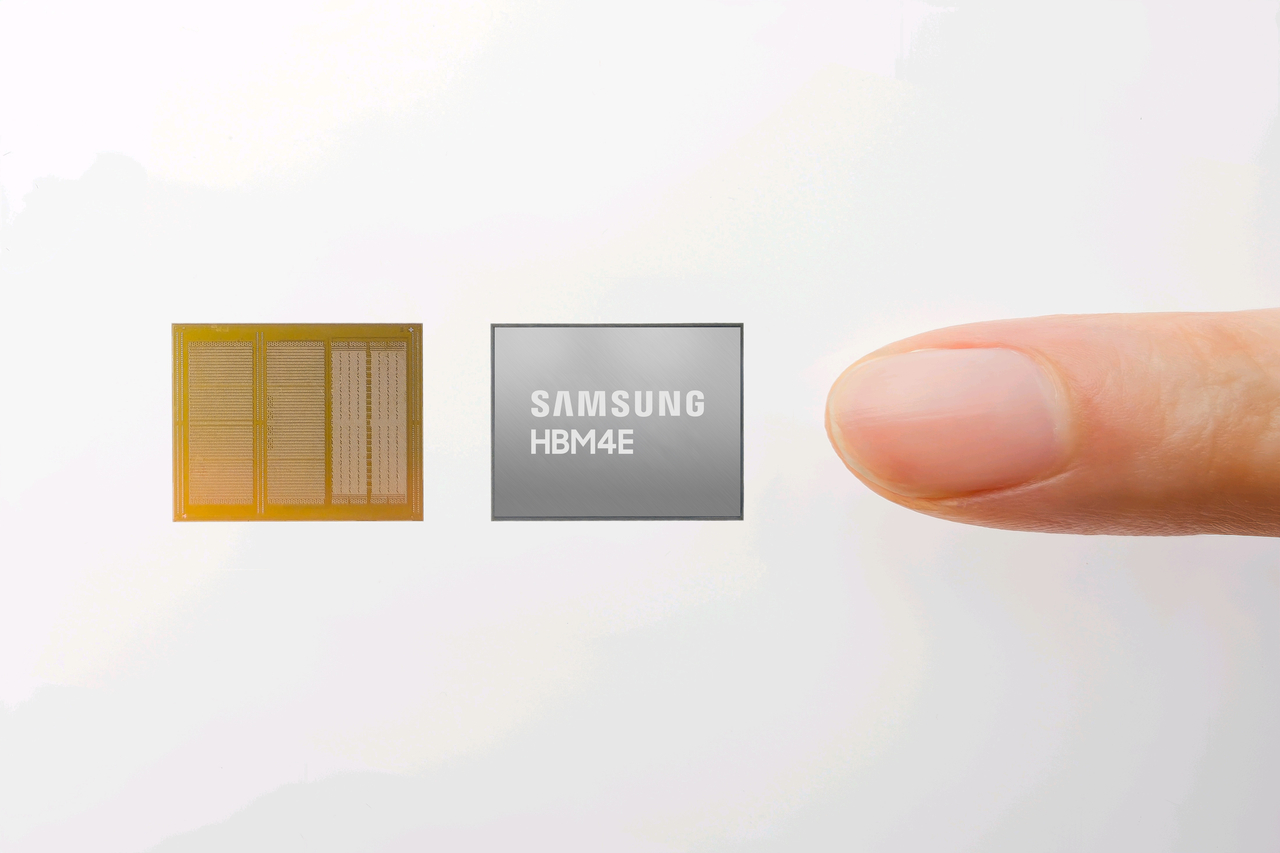
The photograph is the one the Herald published with that story: a Samsung package marked HBM4E, next to a fingertip. It shows the sample in their piece. It is not a picture of an HBM4 stack with a posted contract price, and it is not the DDR5 die whose session average is 58.90 dollars.
To revise the die line, open the spot board and read the Last Update stamp before copying the average. The 58.90 dollar print belongs to 9 October 2026 at 18:10 GMT+8, not to whatever the board says next week. The HBM asking range belongs to the Herald's 7 October account and should be replaced only when a supplier or a filing prints a contract. A page that reconstructs older points backward from a later print is not used here. If the history is a back-cast, it is not a session average.
The two-year path is in retail listings, counted here month by month from August 2024 through September 2026. DDR5's cheapest listed gigabyte was $2.82 in August 2024 and $2.92 in October 2025. November 2025 was $4.97. March 2026 was $13.28, May was $7.11, and September 2026 was $13.41. DDR4 was $0.90 in August 2024 and $6.55 in September 2026. The line draws every month in those two years. The cheapest listing is not the same module each month, so a dip can be a different stick. These are asking prices, not a contract and not the $58.90 die. High-bandwidth memory has no listing series of this kind, so it is not drawn.
The spread already on the public pages is the story. A DDR5 die at 58.90 dollars is 29.45 dollars a gigabyte by our division. A 16GB module at 239 dollars is 14.9375 dollars a gigabyte, on an older day. A reported HBM3E comparison near 1.50 dollars a gigabit is about 12 dollars a gigabyte if that approximate figure is taken at face value. HBM4's reported ask sits in a range this page will not collapse. None of those sentences is a purchase order.
After TrendForce. We did not report this. The pictures, if any, are theirs. Also filed by The Korea Herald.