Cervoz's T449 and T459 pair the vibration table with a silicon burnout trigger
Cervoz's T449 and T459 Series pair MIL-STD-810H vibration compliance with a hardware trigger that burns out the NAND controller and memory cells via electrical overstress.
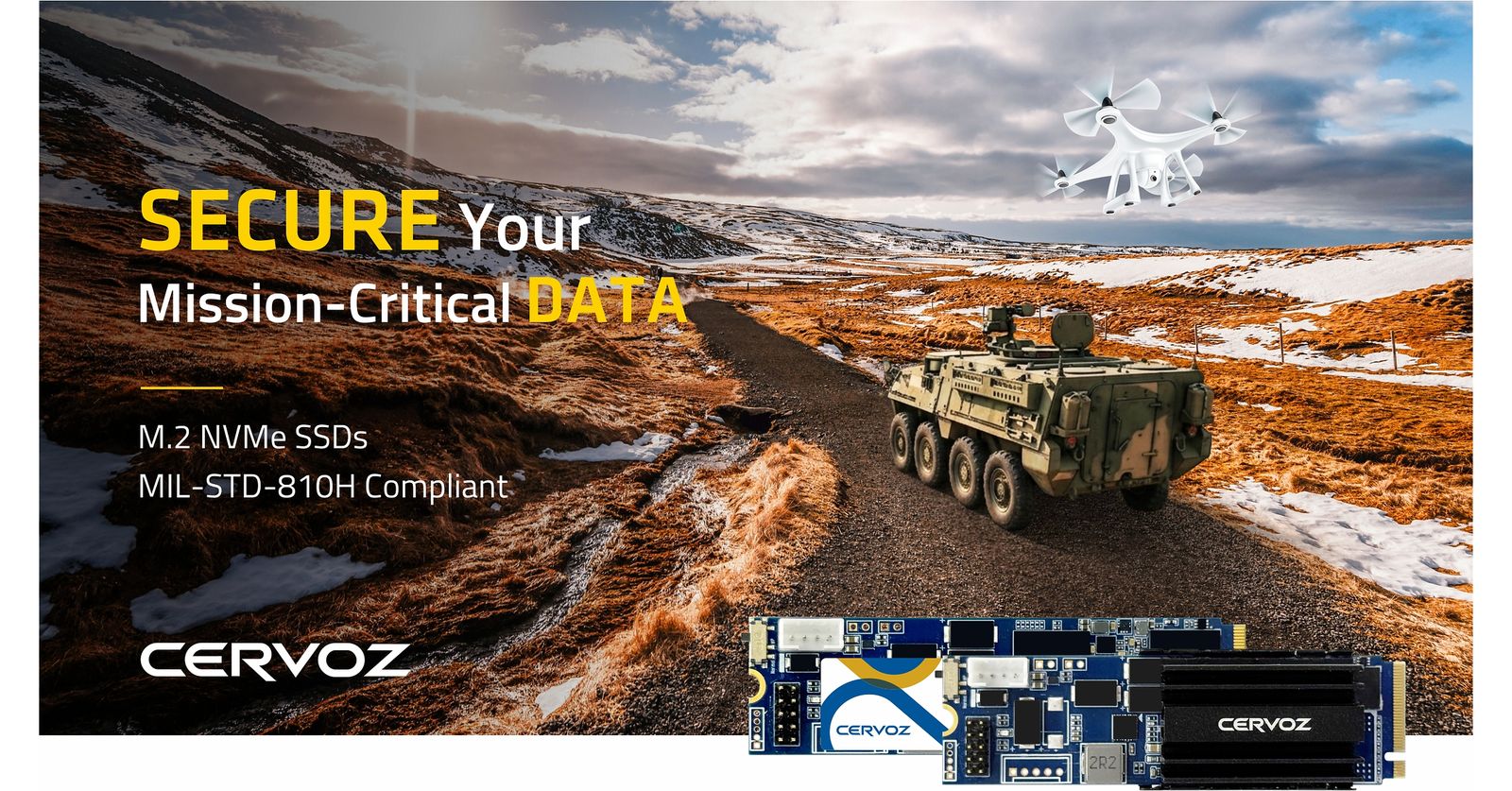
Rugged embedded storage has long been sold as a mechanical problem — pour the epoxy, pass the vibration table, ship the drive. Cervoz's T449 and T459 Series, filed with PR Newswire on October 1, 2026, complicate that framing. The pair passes the MIL-STD-810H vibration, shock, and temperature-altitude profiles, yes, but the document's most consequential line is not about the case. It is about a dedicated hardware trigger that routes electrical overstress through the NAND controller and memory cells to physically burn the silicon.
On the bus side, the drives run PCIe Gen4 x4 NVMe in the M.2 2280 form factor, with sequential read up to 5,085 MB/s and write up to 4,765 MB/s. The media is Industrial 3D TLC NAND, protected by LDPC error correction, wear leveling, and end-to-end data protection. Anti-Vibration Fill is standard, not an option; conformal coating is optional for high-humidity or outdoor deployments. Temperature options span 0 to 70 °C standard and -40 to +85 °C wide, with capacities topping out at 2 TB.
Where the mechanical story ends, the electrical one begins. Write Protection is a hardware-enforced lock on boot files and critical data. Quick Erase clears stored data "within seconds" — a duration the document does not quantify. Physical Destroy goes further: a dedicated trigger initiates high-voltage electrical overstress that burns out the controller and the flash cells, rendering the data unrecoverable even if the physical drive is captured. This is not a firmware command. It is a destructive event on the silicon itself.
The filing does not prove endurance. There is no TBW figure, no DWPD number, no power consumption in watts. The T459's Over-Provisioning, Dynamic SLC Write Cache, Safeguard, and Circuitguard are named as features but not quantified against a workload. A buyer sizing a continuous-recording pipeline for a UGV or a marine support system cannot derive write endurance from this document. The Physical Destroy voltage is likewise unspecified, which means the host board's ESD and overvoltage tolerance must be verified separately before the trigger is wired into a maintenance procedure.
No independent MIL-STD-810H test report is cited, and no comparison to existing rugged NVMe drives appears in the filing. The question that will matter in procurement is whether the Physical Destroy event stays contained to the M.2 module or propagates through the connector to the host PCB. Until a teardown or a third-party test addresses that, the vendor's claim of permanent data loss rests on its own description. Watch for a defense procurement spec that names hardware-level physical destruction as a line-item requirement rather than a differentiator.
The filing names four endurance features on the T459 but quantifies none of them, leaving a buyer unable to size write endurance for a continuous-recording workload. The Physical Destroy voltage is unspecified, so the host board's overvoltage tolerance must be verified before the trigger is wired into any maintenance procedure.
No TBW, no DWPD, no wattage in the filing. The T459's Over-Provisioning, Dynamic SLC Write Cache, Safeguard, and Circuitguard are listed without workload context, and the Physical Destroy trigger's voltage is undefined — a host-PCB ESD and overvoltage check is a prerequisite before the trigger can be integrated into a field-maintenance SOP.
PCIe Gen4 x4 NVMe, M.2 2280 form factor · Up to 5,085 MB/s read, 4,765 MB/s write · Capacities up to 2 TB · Wide temp: -40 °C to +85 °C
After prnewswire.com. We did not report this. The pictures, if any, are theirs.