AMD's Tetrahedral Cage Technique Cuts Ray Tracing Memory Usage by 98%
AMD demonstrated a tetrahedral cage technique that cuts ray-tracing BVH memory usage from 80GB to 1.7GB, running 500 million animated triangles at 60 FPS on an RX 9070 XT.
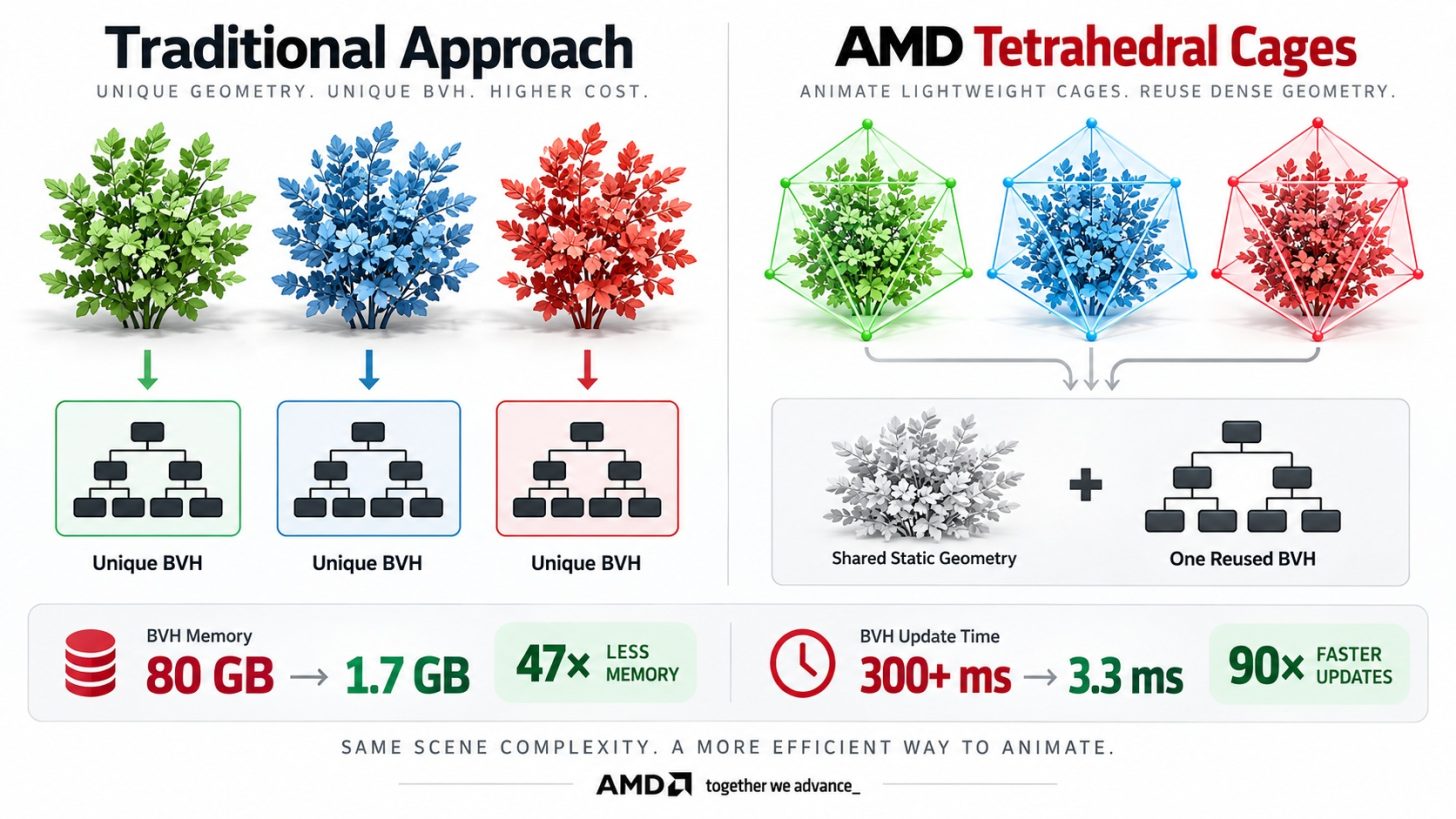
According to Wccftech, AMD Fellow Holger Gruen demonstrated a tetrahedral cage technique in a GPUOpen article published September 17. The technique slashes BVH (Bounding Volume Hierarchy) memory usage from 80GB to just 1.7GB.
The mechanism is the tetrahedral cage: instead of the traditional BVH, which requires enormous acceleration structure overhead for complex animated scenes, the tetrahedral cage allows hundreds of millions of independently animated triangles to be ray traced in real time without that overhead. The demo used a large-scale terrain scene with approximately 25,000 independently animated plants.
What changed is the memory constraint for ray tracing: the 98% reduction in BVH memory (80GB to 1.7GB) means complex animated scenes no longer need enormous acceleration structures. The 500 million animated triangles at 60 FPS on an RX 9070 XT is the proof of concept.
What is unconfirmed is whether the technique scales to production games or is a research demo. The 60 FPS result is on a specific scene, not a general workload. The technique is a research contribution, not a shipping feature.
What to watch is whether AMD ships the tetrahedral cage in a future GPU or whether it becomes a software technique adopted by game engines. The memory reduction is the key value: it makes complex ray-traced scenes feasible on consumer hardware.
Desk take
The tetrahedral cage cuts BVH memory by 98%, which is the key constraint for complex ray-traced scenes. The 500 million triangles at 60 FPS is a proof of concept. Watch for a shipping GPU or a software adoption by game engines.
Cutting BVH memory by 98% makes complex ray-traced scenes feasible on consumer hardware, which matters for the future of real-time ray tracing.
Source dispatch
AMD has showcased a particularly impressive graphics research breakthrough that could significantly reduce the memory and computational costs associated with ray tracing complex animated environments. Its tetrahedral cage technique allows hundreds of millions of independently animated triangles to be ray traced in real time without the enormous acceleration structure (AKA Bounding Volume Hierarchy or BVH for short) overhead traditionally associated with such workloads. In a new GPUOpen article published on September 17, AMD Fellow Holger Gruen demonstrated the technique using a large-scale terrain scene containing approximately 25,000 independently animated plants. At their maximum level of detail (LOD), these plants represent roughly […]