Intel replaces locked 8+0+4 razor lake SKU with 12+0+4 on 18A-P
Intel pulled a locked 8+0+4 bLLC SKU and replaced it with a 12+0+4 configuration on the 18A-P process, putting twelve Coyote Cove P-cores on a single compute tile.

| Razor Lake 12+0+4 | |
|---|---|
| P-cores (compute tile) | 12 |
| E-cores (compute tile) | 0 |
| LP E-cores (SoC tile) | 4 |
| Process | 18A-P |
| P-core design | Coyote Cove |
| Launch window | 2028 |
Intel replaced a locked 8+0+4 bLLC SKU with a 12+0+4 configuration: twelve Coyote Cove P-cores on the compute tile, zero E-cores on that tile, four LP E-cores on the SoC tile. The HotHardware article from November 16, 2026, carries the full breakdown; Jaykihn's X thread is the primary source, and the compute tile is fabricated on 18A-P while the 8+16 and 4+8 tiles go to TSMC on N2P.
The wire frames the bLLC as Intel's answer to AMD's 3D V-Cache, which is a marketing descriptor, not a measured equivalence. Jaykihn's follow-up on X is more precise than the wire: the 8+0+4 was not merely rumored but "locked," meaning the SKU had already been finalized before Intel pulled it. Hyper-Threading is absent on this SKU even though HT returns with Diamond Rapids, which caps the thread count at twelve for a part that otherwise reads as a gaming flagship.
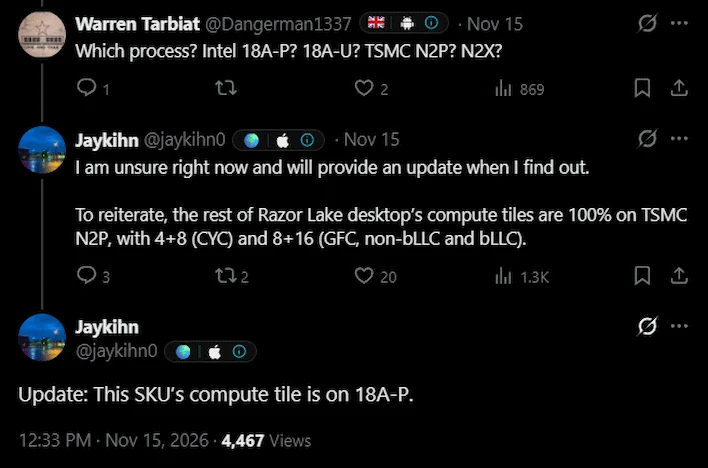
The 18A-P assignment is the constraint that matters. Diamond Rapids Xeon 7 is expected to take the majority of 18A-P capacity, so this consumer tile is a secondary tenant on a fab line built for server silicon, and the buyer has no visibility into wafer allocation for a 2028 desktop chip. Coyote Cove is the P-core design slated for Nova Lake, not Razor Lake; this SKU is architecturally a Nova Lake refresh wearing a Razor Lake nameplate, while Griffin Cove, the next-generation P-core, lives on the 8+16 tile.
No document states the bLLC cache size, base or boost clocks, TDP, price tier, or a specific quarter within 2028. The architectural delta between Coyote Cove and Griffin Cove P-cores is also unmeasured, and no benchmark data exists for the twelve-core configuration.

The 18A-P assignment makes this a secondary tenant on a fab line dominated by Xeon volume, and the buyer has no visibility into that allocation. Coyote Cove on a 2028 tile means this is a Nova Lake refresh, not a new microarchitecture; the Griffin Cove tiles carry the next-gen P-core.
The bLLC cache size, clock speeds, TDP, price tier, and the architectural delta between Coyote Cove and Griffin Cove P-cores are not stated in any document.
The 12+0+4 SKU competes with Diamond Rapids Xeon 7 for 18A-P wafer allocation, constraining yield and timing for a 2028 consumer launch. The P-core choice (Coyote Cove, a Nova Lake design) confirms this is a refresh, not a new architecture; Griffin Cove on the 8+16 tile is the actual next-gen part.
After x.com. We did not report this. The pictures, if any, are theirs.