AlphaGenome 2 shifts from parallel tissue outputs to conditional cell-state predictions
AlphaGenome 2 identifies 30 percent of causal variants on the TenK10K benchmark, up from 16 percent for the original model, across 28 primary immune cell types.
| AlphaGenome 2 | |
|---|---|
| input length | 1-million-letter DNA sequence |
| training data | 107 million cell profiles, 68 tissues |
| causal variant recall (TenK10K) | 30% |
| directional gene effect recall (TenK10K) | 43% |
| Atlas coverage | 9 billion single-letter changes |
| availability | AlphaGenome API (non-commercial); private preview (commercial) |
30 percent of causal variants in the TenK10K benchmark, across 28 primary immune cell types, is what AlphaGenome 2 identifies where the original model found 16 percent. That figure does not prove the same recall holds across the 9 billion single-letter changes in the AlphaGenome Atlas, nor in non-immune tissues.
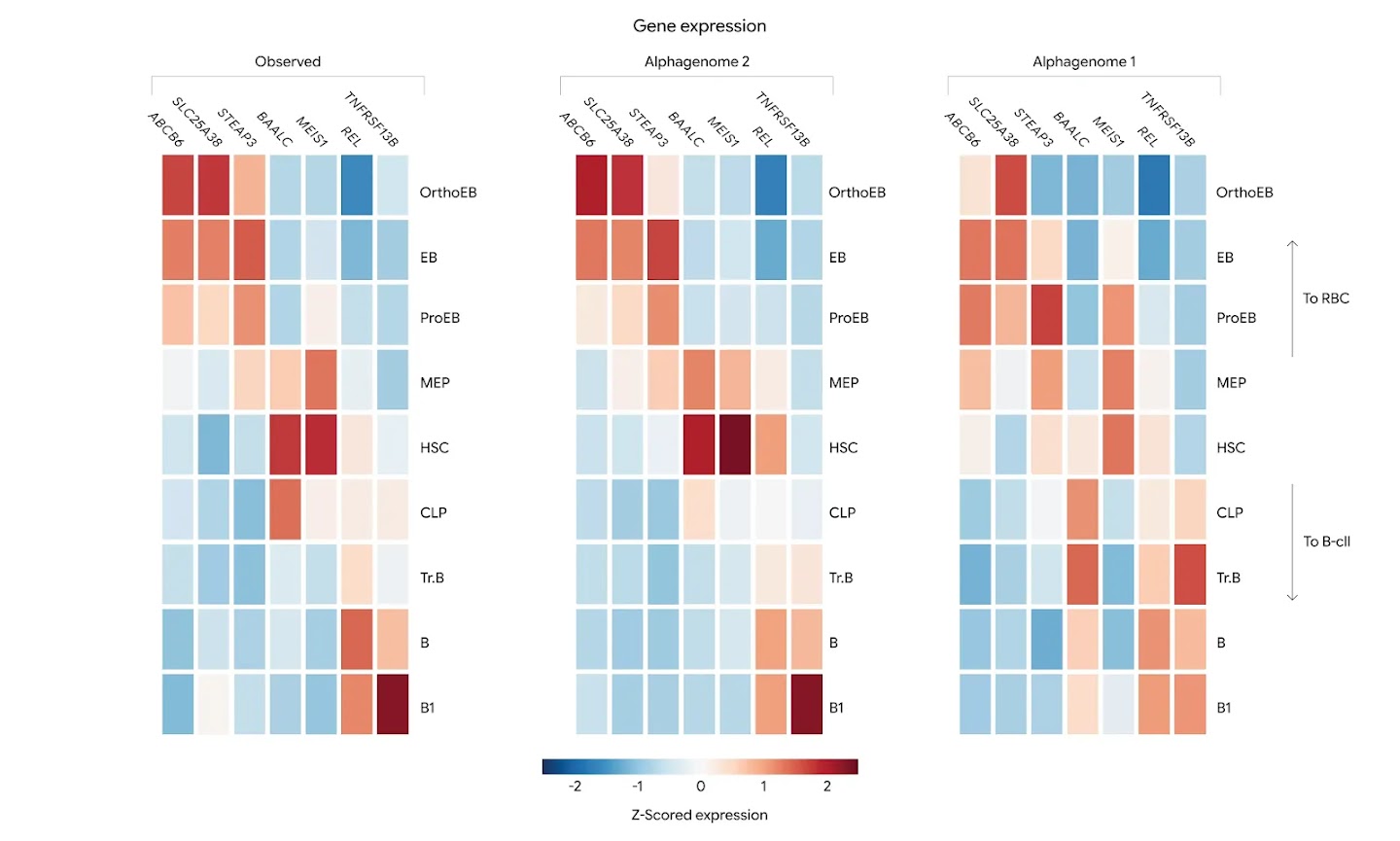
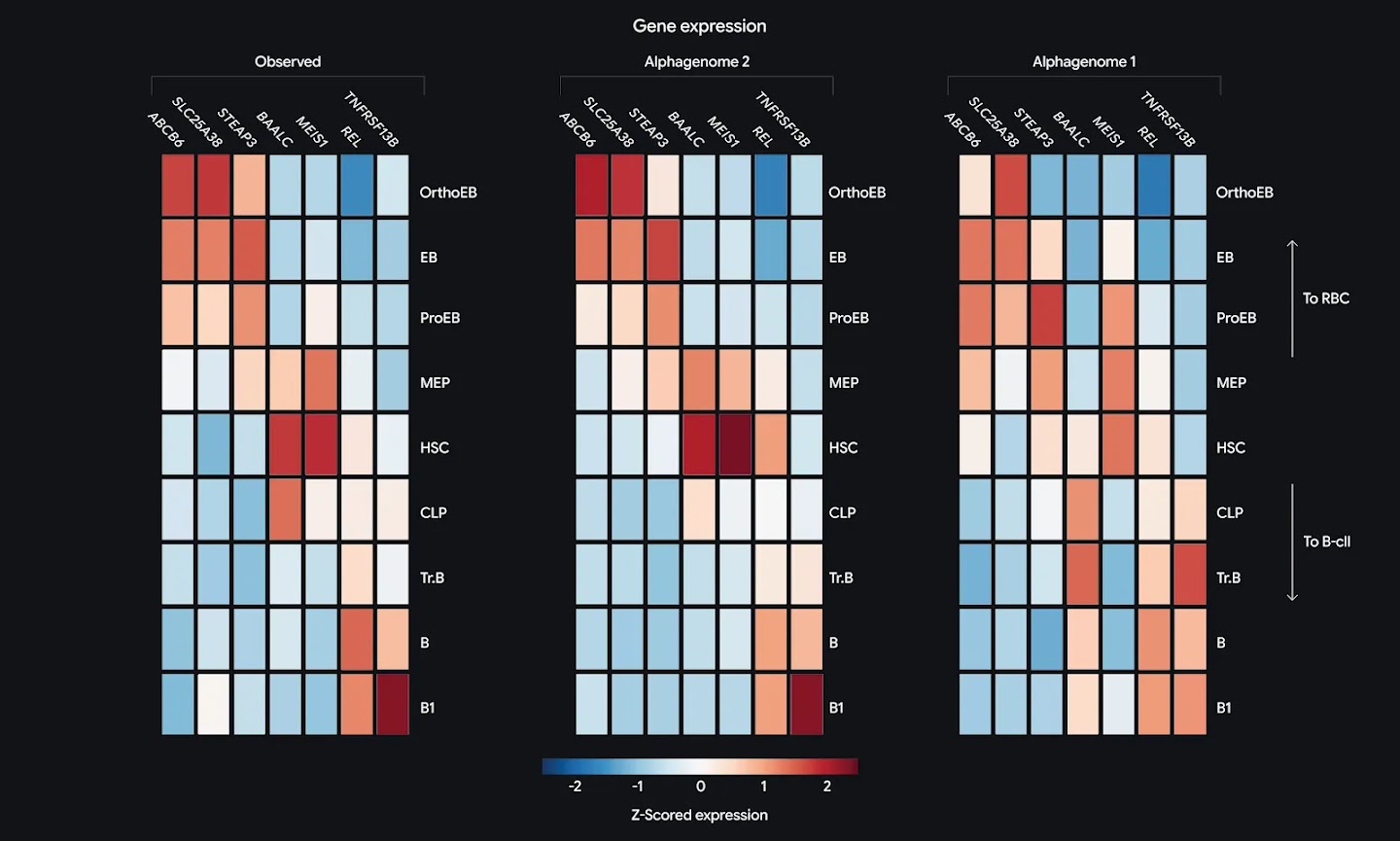
The architecture shift is the constraint change. AlphaGenome 1 produced fixed parallel outputs across bulk tissues; AlphaGenome 2 feeds one biological condition alongside a 1-million-letter sequence at every stage of the model. A researcher uploading a few dozen single-cell RNA-seq reads gets a conditioned prediction without retraining. What the filing does not give the buyer: per-query latency, a rate limit, or a price for the commercial private preview. The 30-versus-16 gap is one benchmark, one tissue family.
No parameter count, no training compute figure, no held-out metric beyond TenK10K, and no exact count of GWAS traits with precomputed scores appear in the document.
The conditional architecture is the real constraint change: a lab now queries one cell state at a time without retraining, but the filing gives no latency, rate limit, or price for the commercial preview. The 30-versus-16 gap covers 28 immune cell types on one benchmark and is not a genome-wide guarantee across the 9 billion Atlas variants.
No parameter count, training compute figure, per-query latency, rate limit, or commercial price appears in the filing.
The shift from parallel bulk-tissue outputs to a single-condition input at every architectural stage removes the capacity-spreading problem of AG1. What is missing for a lab planning API use: per-query latency, rate limits, and commercial pricing. The TenK10K numbers cover 28 immune cell types only.
After deepmind.google. We did not report this. The pictures, if any, are theirs.