Google opens Gemini 4 Carbon to all paying developers at Argon's price
Gemini 4 Carbon is live on the API at $2 per million input tokens and $10 per million output tokens, the same introductory price as Argon.
| Gemini 4 Carbon | |
|---|---|
| Input price | $2 per million tokens |
| Output price | $10 per million tokens |
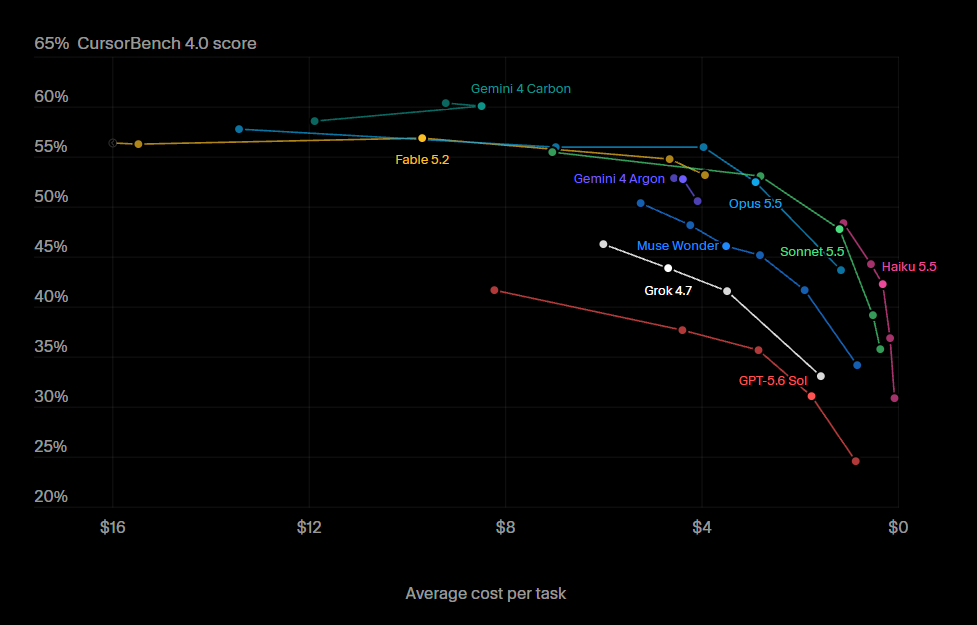
| CursorBench 4.0 | #1 |
| MKA benchmark | #2 |
| Fortify recall / precision | 100% / 95% |
| CASP17 homolog increase | 40-fold |
Gemini 4 Carbon is available on the API at $2 per million input tokens and $10 per million output tokens, the same introductory price as Argon. The DeepMind blog post, dated November 10, 2026 and signed by Koray Kavukcuoglu, SVP and Chief AI Architect, opens the model to developers, enterprises, scientists, and consumers. Two weeks before that date, Carbon had already been handed to a set of cybersecurity defenders through the Fairwind Program, giving security teams a head start on scanning, triage, and remediation workloads.
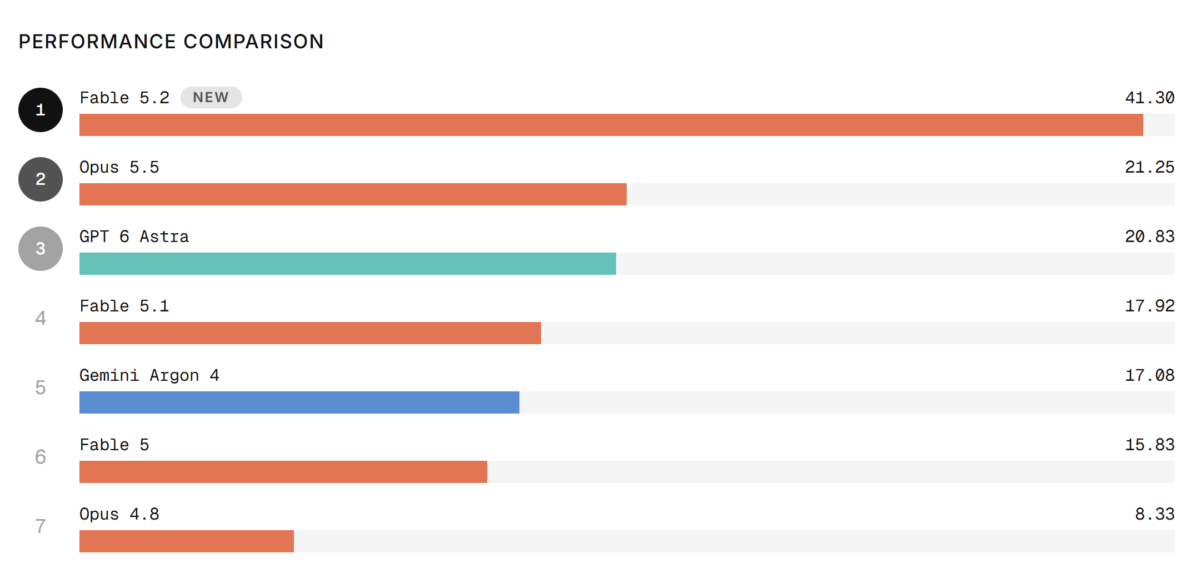
The benchmark rows in the table are the page's own framing. Carbon sits at #1 on CursorBench 4.0, Perplexity's WANDR, and Zapier's AutomationBench, and at #2 on the Multimodal Knowledge Agent benchmark co-launched with Artificial Analysis. The document never names the model it calls "the next best external model" or "the top performing model." The 2X and 6X cost-per-task gaps are measured against competitors the page declines to identify. A buyer reading the table gets a ranking and a price ratio but not a named rival to verify against, and the MKA benchmark is new enough that no independent replication exists yet.
Die Brief reads the positioning as the real mechanism here. Carbon is the token-hungry sibling: the page says it uses more tokens than Argon to explore thoroughly, reason deeply, and run extended verification loops. Argon stays the default for the majority of software engineering and knowledge work. The architectural shift is /swarm in Google Antigravity, which turns a single prompt into a coordinated team of agents trackable in real time, with parallel isolated workspaces and adversarial verifiers that test every change. For the buyer, the constraint is arithmetic: you pay Argon's per-token price but burn more tokens per task, so the effective cost per completed job depends entirely on how many loops the agent needs. The 10 overnight loops on the 906K-triangle Platform 37 reconstruction is the page's own example of that multiplier, and the 206 extracted engineering drawing views across seven City Council PDFs is the input that drove it.
The cybersecurity numbers are the most concrete in the document. In Project Fortify, Carbon hit 100% recall on scanning and 95% precision on triage on Google's internal benchmark, with an over 25% relative improvement on Argon's recall rate for open-source code repository testing. The Cloud Vulnerability Research team used Carbon to prove two bugs in an unnamed open-source package were exploitable at PHP2Shell severity. Wiz's Scan for Good team found 0-day vulnerabilities in two major SaaS providers in under two hours. On the science side, Carbon increased homolog retrieval by 40-fold across seven low-homolog protein families from the CASP17 blind test set, and researchers used it in AlphaProof Code to generate millions of lines of Lean code proving security properties of Signal's cryptographic protocol.
The page is truncated mid-sentence in the scientific-reasoning section, cutting off at "While broader benchmarking is still un." No parameter count, no context window, no training-data description, no latency or throughput figure appears anywhere in the document. The two SaaS providers and the open-source software with the PHP2Shell-comparable bugs are unnamed pending responsible disclosure. What the table proves is a price point and a set of rankings. What it does not prove is whether those rankings hold outside Google's own evaluation harness, or what the token multiplier actually costs a production team at scale.
Carbon's value proposition is a token multiplier at Argon's price, and the /swarm multi-agent architecture is the mechanism that makes that multiplier manageable. The document proves a price point and a set of rankings but not the effective cost per completed task at production scale.
No parameter count, context window, latency, or throughput figure appears in the document, and the page is truncated mid-sentence before the full scientific-reasoning results.
The constraint is arithmetic: same per-token price as Argon, more tokens per task, so effective cost scales with loop count. The /swarm multi-agent pattern is the architectural change; the benchmark rankings are self-reported or single-lab with unnamed competitors, so the 2X and 6X cost gaps cannot be independently verified from this page.
After deepmind.google. We did not report this. The pictures, if any, are theirs. Also filed by The Verge AI, The Decoder.