AlphaGenome 2 drops genome-scale screening for cell-type resolution
AlphaGenome 2 identifies nearly twice as many expression-altering variants than its predecessor, but the trade is that it can no longer screen the whole genome in one pass.

| AlphaGenome 2 | |
|---|---|
| training data | 100 million cell profiles |
| tissues | 68 |
| performance | nearly 2x variants vs. prior model |
| availability | non-commercial API; limited commercial preview |
Trained on more than 100 million cell profiles across 68 tissues, the model turns static cell atlases into what DeepMind calls a predictive engine for human genetics. It can flag new cell types and biological states without retraining and point out gaps in experimental data.
The September 2026 genome-wide Atlas was built on v1 because the finer predictions cost more to produce. A lab that needs both genome-scale screening and cell-type resolution must run two models in parallel, and no document prices that second pass.
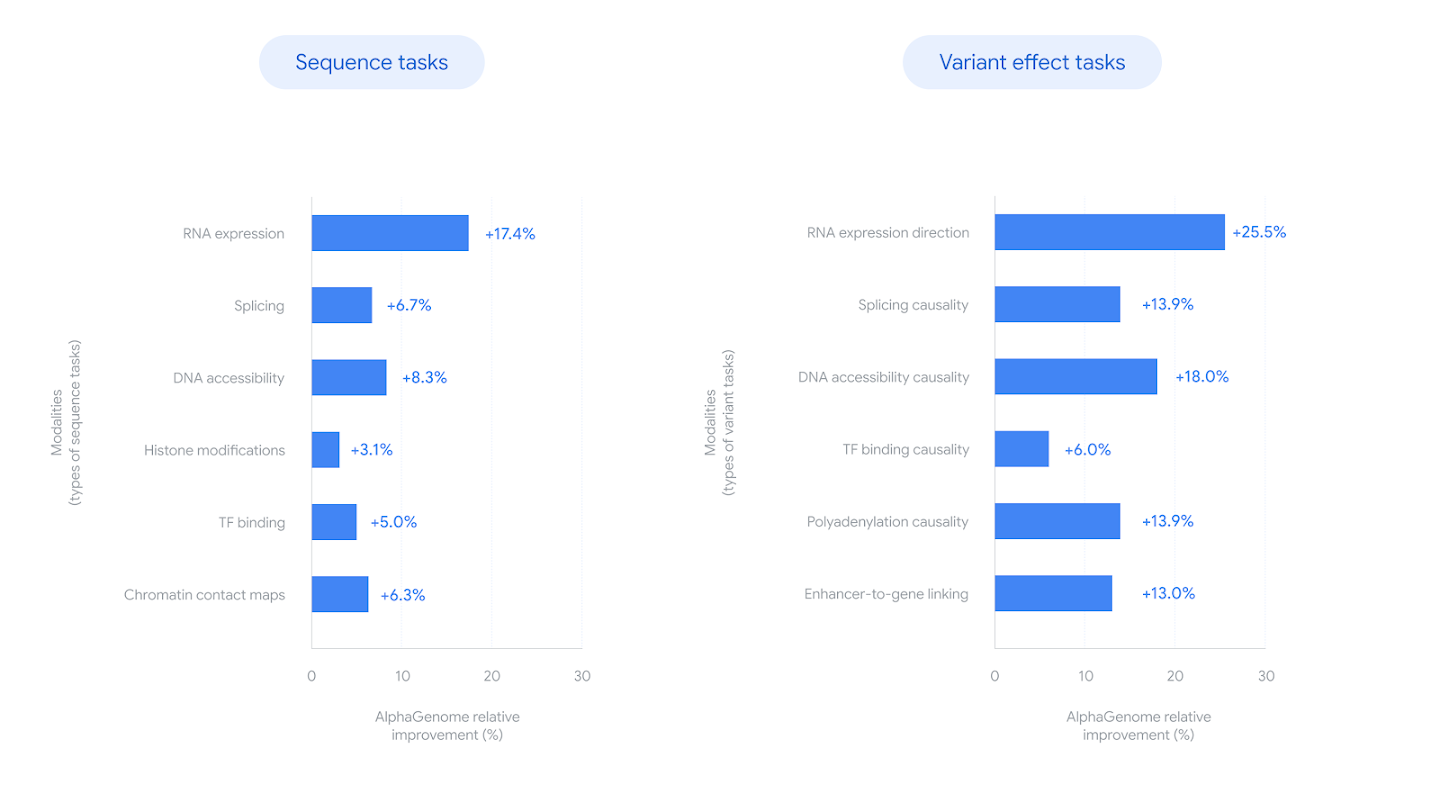
No parameter count, no FLOPs per prediction, no per-cell-type benchmark, and no commercial pricing or rate-limit figure appear in any document. The primary DeepMind blog post returned garbled text, and the architecture details in the dossier belong to v1.
The API is open for non-commercial work, but the commercial preview is limited with no stated pricing or rate limits.
The trade-off is the story, not the benchmark. The missing documentation makes the nearly-twice claim hard to verify, but the Atlas decision is concrete evidence of the cost.
After @pushmeet. We did not report this. The pictures, if any, are theirs.