BotPsy-0.8B outperforms a 2.5× larger model on five of six tool-use benchmarks
Tether AI Research ships BotPsy-0.8B, a Qwen3.5-0.8B-based agentic model that beats a 2.5× larger rival on five of six tool-use benchmarks.
| BotPsy-0.8B | |
|---|---|
| Parameters | 0.8B |
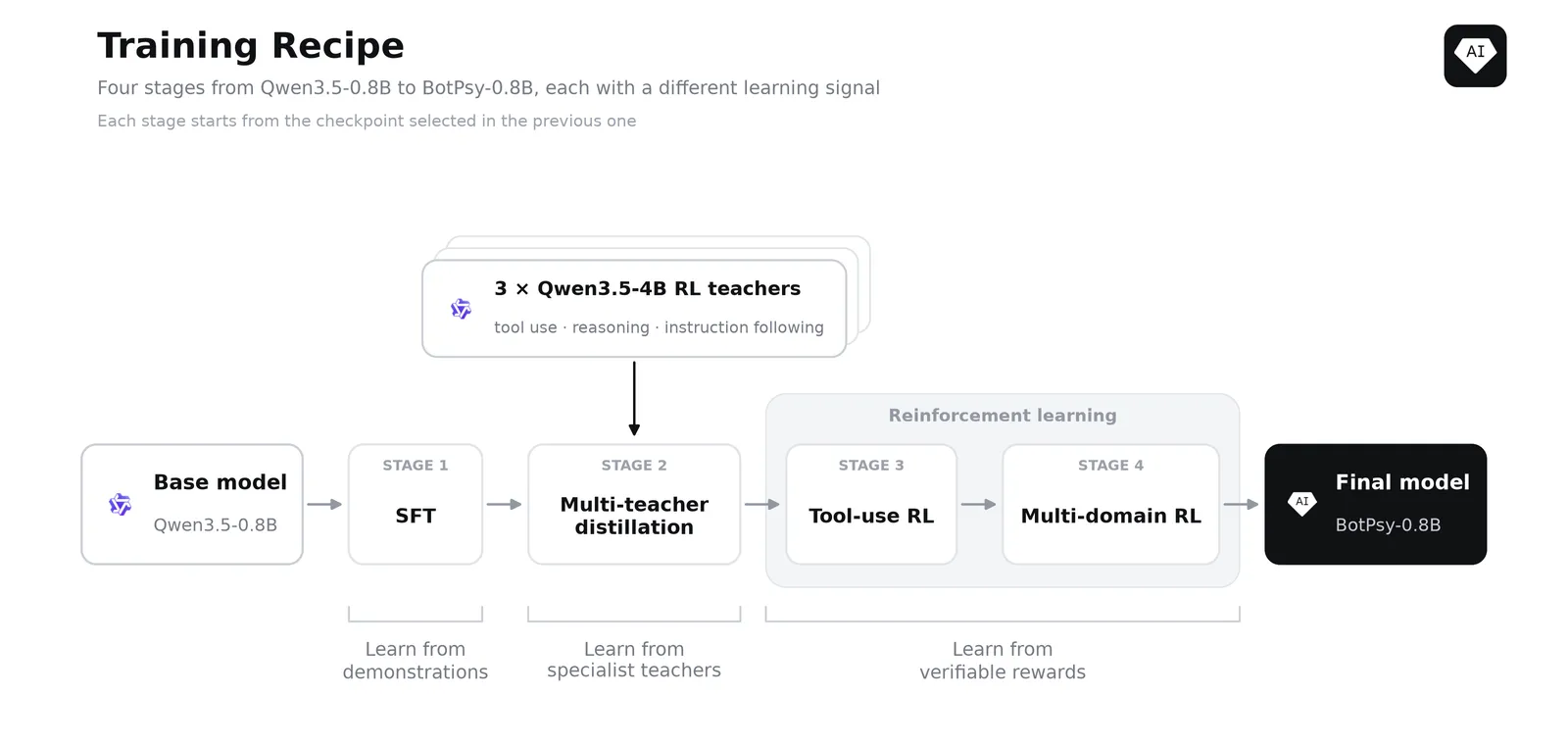
| Base model | Qwen3.5-0.8B |
| BFCL v4 | 44.0 |
| ACEBench | 58.7 |
| τ-bench | 51.5 |
| Claw-Eval | 46.5 |
| License | Apache 2.0 |
| Quantizations | bf16, Q8, Q4 |
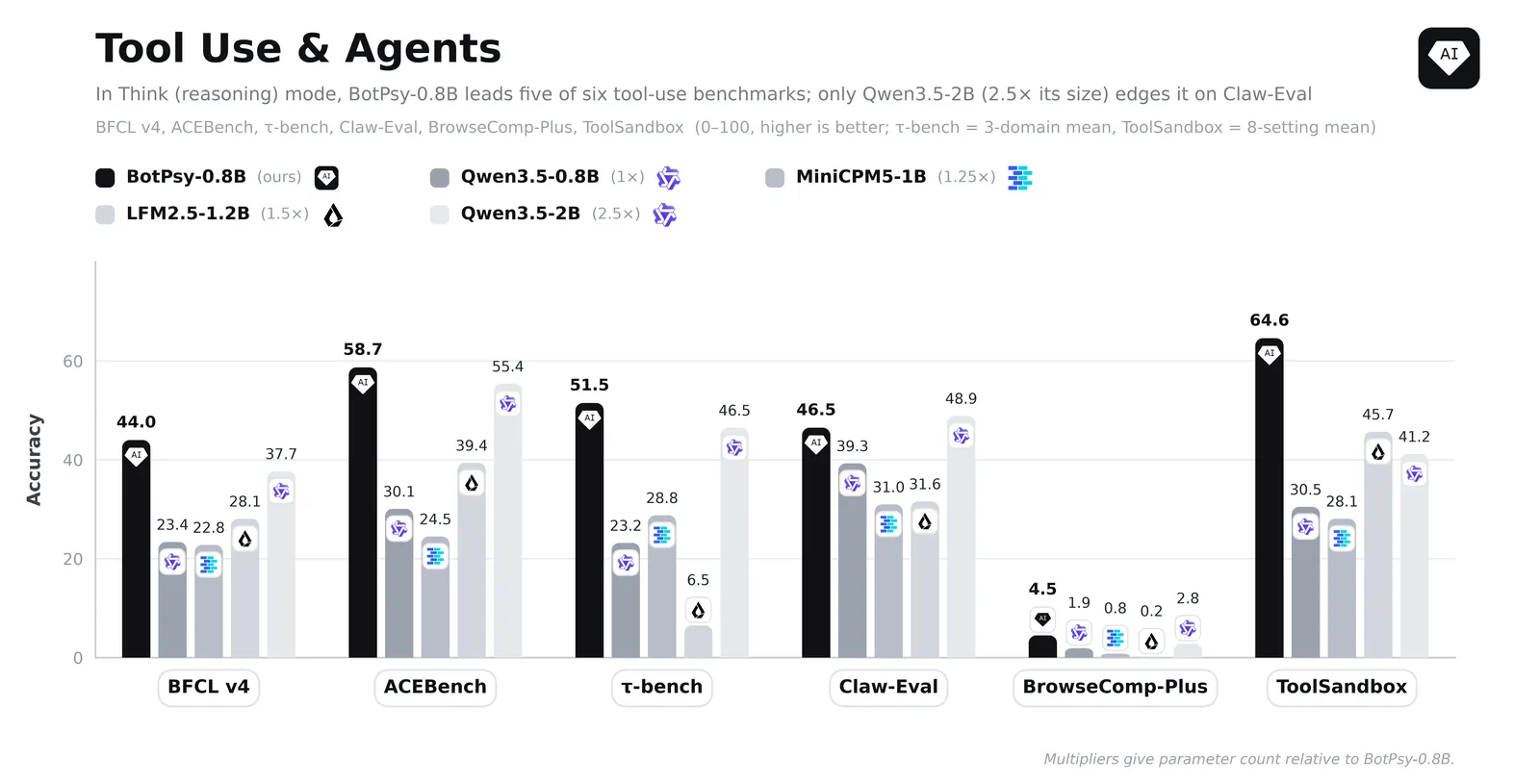
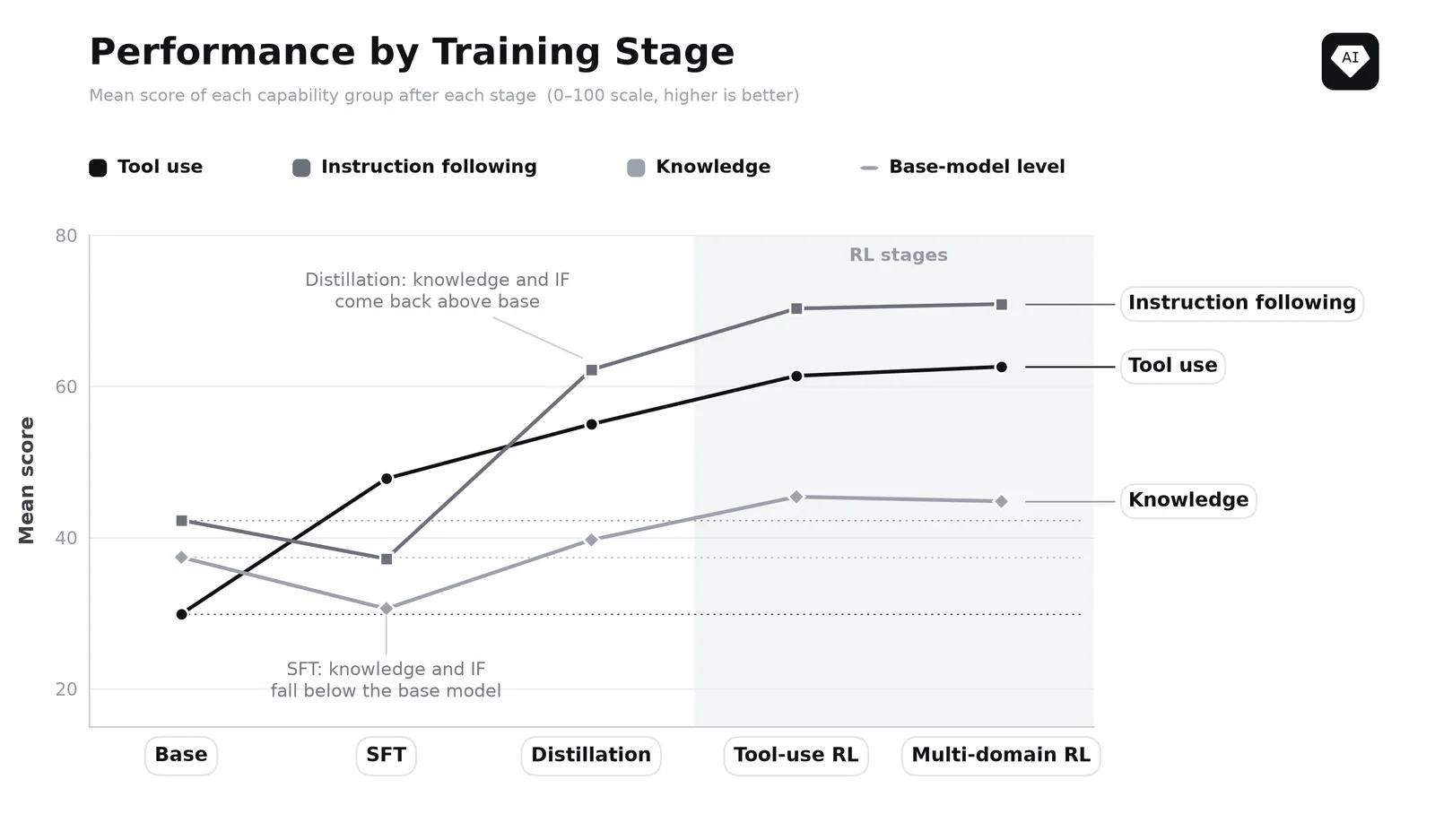
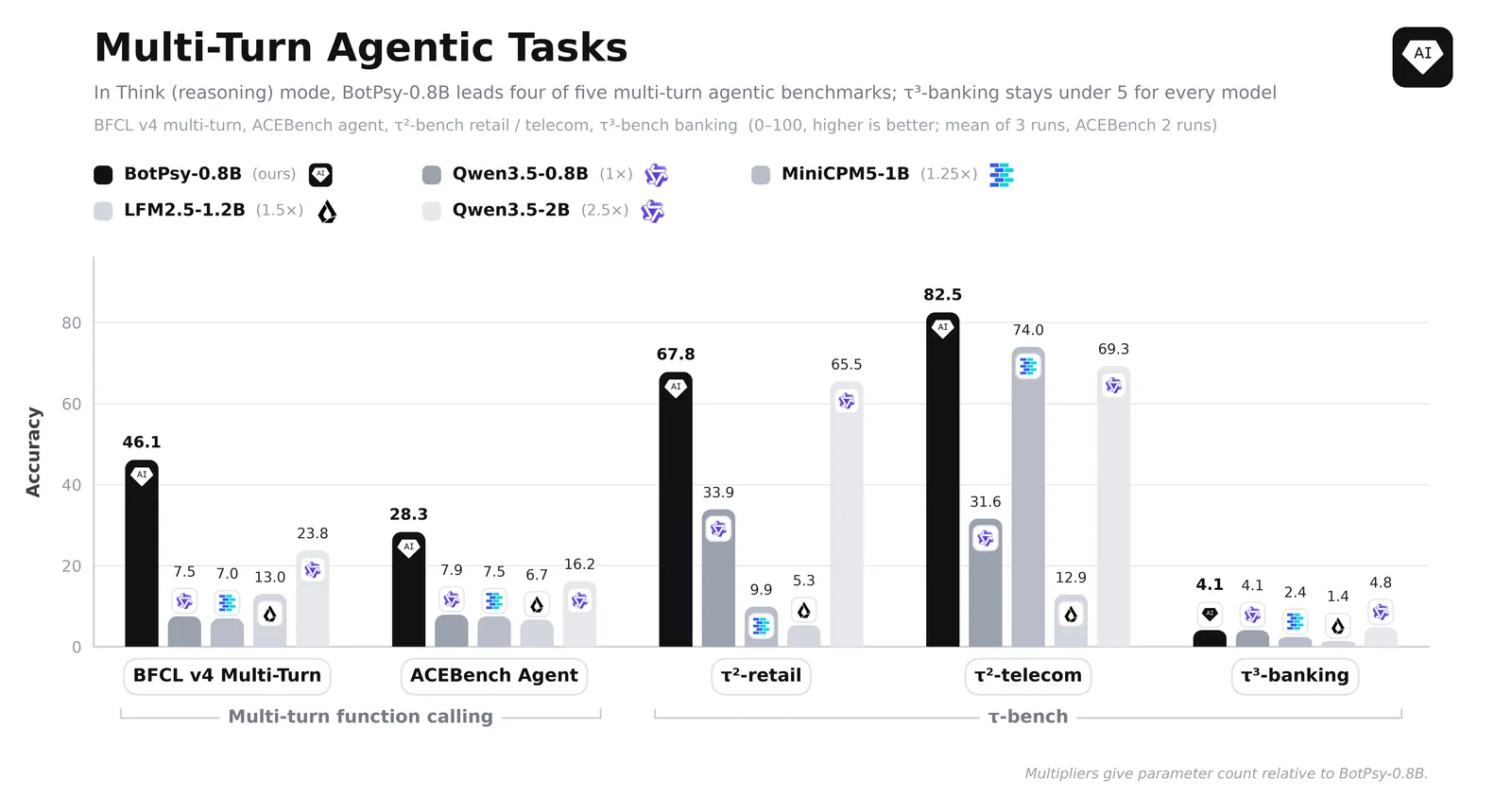
On BFCL v4 the score climbs from 23.4 to 44.0, ACEBench from 30.1 to 58.7, and τ-bench from 23.2 to 51.5. Against Qwen3.5-2B-Think, a model 2.5× its size, BotPsy takes five of the six tool-use and agentic benchmarks. The only loss is Claw-Eval, 46.5 to 48.9.
The Claw-Eval gap is the long-horizon, multi-step task where the agent must hold state across turns. For a device vendor wiring this into a phone or a head unit, that is the number that matters, because it is where the loop must close without a cloud fallback. The filing proves the model can call tools; it does not prove the loop closes fast enough for a user watching a spinner.
No latency figure, no tokens-per-second on a named device, no minimum RAM, CPU, GPU, or OS. The page ships GGUF files in bf16, Q8, and Q4 for llama.cpp and calls the model suitable for on-device deployment, but it names no hardware floor. A parameter count is not a deployment spec.
The document also omits the specific APIs and tools the model was trained to call, and the dataset token counts behind that training. It measures benchmark scores and red-team rates. It does not measure the wall-clock cost of a single tool call on hardware a reader can name.
The piece holds to the source's facts and the draft's structural argument: capability is proven, deployment is not. The Claw-Eval gap anchors the practical concern without inventing a latency number the filing never gives.
After huggingface.co. We did not report this. The pictures, if any, are theirs.