Vera CPU posts 1.6x agents per watt against unnamed x86 baseline
In a 100-megawatt data center scenario, Vera posts 1.6x more agents per watt against the fastest x86 part and 2x faster agent speed against the most energy-efficient x86 part.
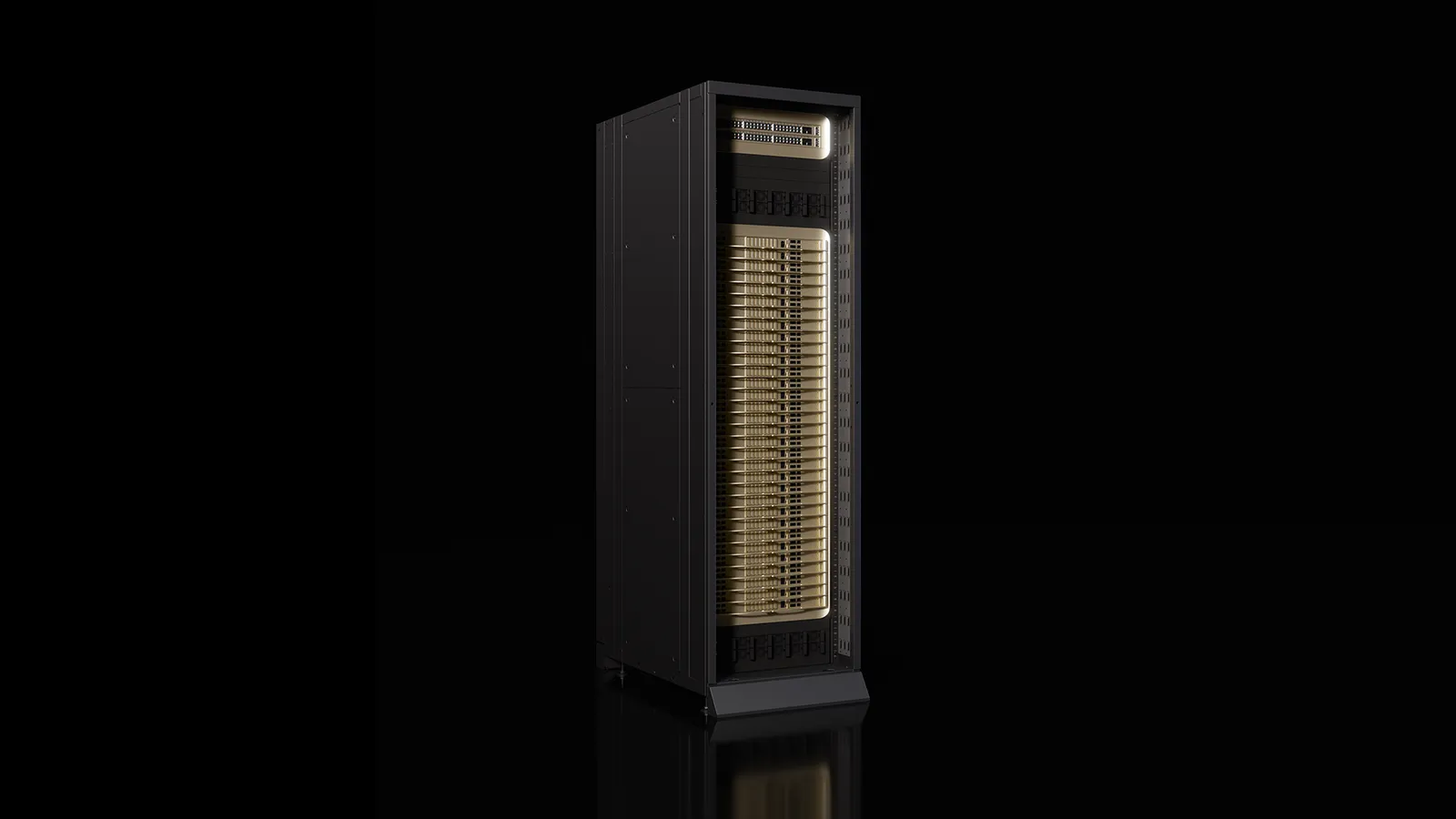
| Vera CPU | |
|---|---|
| agents per watt vs fastest x86 | 1.6x |
| agent speed vs most energy-efficient x86 | 2x |
| cores (test config) | 176 |
| jobs/sec at 2,000 concurrent sandboxes | 12.7 |
| sandbox spin-up time (1,000) | 10.8 s |
| TPC-H SF1000 vs Xeon 6 | 1.5x |
In a 100-megawatt data center comparison, NVIDIA's Vera CPU posts 1.6x more agents per watt against the fastest x86 part and 2x faster agent speed against the most energy-efficient x86 part. Daytona brought 1,000 agent sandboxes online in 10.8 seconds on Vera versus 88.4 seconds on x86, and at 2,000 concurrent sandboxes the machine completed 12.7 jobs per second. ClickHouse ran its stock binary with no Vera-specific tuning and scaled near-linearly across 176 cores to top the ClickBench hardware leaderboard.
The power ceiling, not the clock ceiling, is the binding constraint for agent workloads at data-center scale. A buyer choosing between Vera and a dense x86 rack is choosing between two different power budgets, not two different speed tiers. The 1.6x and 2x margins are vendor-measured against unnamed x86 parts, so the buyer cannot verify the comparison partner. The document does not prove that Vera outperforms a specific named x86 SKU at a given TDP; it proves a ratio against an unspecified baseline.
The document names no process node, total core count as a spec-sheet figure, TDP, memory subsystem, socket, or price. The 176-core figure is a test configuration, not a SKU specification. Without a TDP or a named comparison part, the per-watt numbers cannot be reproduced by a third party.
The power ceiling, not the clock ceiling, is the binding constraint for agent workloads at data-center scale. The 1.6x and 2x margins are vendor-measured against unnamed x86 parts, so the buyer cannot verify the comparison partner.
The document names no process node, TDP, memory subsystem, socket, price, or total core count as a spec-sheet figure.
At 100 MW the constraint is watts per agent, not GHz. The per-watt ratios are measured against unspecified x86 baselines, so a buyer cannot reproduce the comparison without knowing which part was the denominator.
After blogs.nvidia.com. We did not report this. The pictures, if any, are theirs.