M6 iMac starts at $1,499 with November 6 availability
The M6 iMac opens pre-orders October 28 and ships November 6, starting at $1,499, powered by Apple's first 2-nanometer chip.

| M6 iMac | |
|---|---|
| CPU | 12-core (2 super, 4 performance, 6 efficiency) |
| GPU | 12-core with Neural Accelerators |
| Neural Engine | Dual 16-core |
| Memory bandwidth | 170GB/s |
| Process | 2 nm |
| Starting price | $1,499 |
| Pre-order date | October 28 |
| Availability | November 6 |
The M6 iMac starts at $1,499, with pre-orders opening October 28 and availability beginning November 6. The chip inside is M6, Apple's first 2-nanometer design, which Apple announced on August 25 in a press release that named the Mac mini as its debut platform. The Apple Newsroom post that names the iMac's price and ship date was not in the packet Die Brief read. The figures come from the wire.
M6 carries a 12-core CPU complex — two super cores, four performance cores, six efficiency cores — a 12-core GPU with Neural Accelerators in each core, and a Dual 16-core Neural Engine. Unified memory bandwidth reaches 170GB/s. The process is 2 nanometers. Apple describes the super cores as handling single-threaded workloads, the performance cores as joining them for multithreaded tasks, and the efficiency cores as handling background work. The CPU complex is two cores larger than M5, and the GPU is two cores larger than the M4 GPU that preceded it in the Mac line.
The 4x faster AI performance figure is a comparison against M4, measured in the Mac mini context using LM Studio for LLM prompt processing. Apple states up to 13.5x faster than M1 and up to 4.8x faster than M4 in that benchmark. The iMac page does not restate these numbers. The peak is not an FP4-with-sparsity figure; it is a measured prompt-processing throughput on a specific workload in a specific enclosure. The iMac's own throughput under the same test is not in the packet.
The configuration the $1,499 starting price buys is the base M6 iMac. The configuration the headline AI number describes is the same chip, tested in the Mac mini enclosure. The stretch is the gap between what the iMac's thermal envelope allows and what the Mac mini's smaller chassis constrains. The document does not state whether the iMac sustains the same clocks as the Mac mini under prolonged load, or whether the display panel's power draw competes with the SoC for thermal headroom.

The Mac mini with M6, announced the same day, shares identical silicon in a smaller enclosure. That is the only contrast Die Brief will draw here. The iMac is the all-in-one; the Mac mini is the box.
Other desks filed the iMac launch as a continuation of the Mac mini story, or treated the August 25 chip announcement as the iMac announcement. The iMac is a second product receiving the same silicon approximately six weeks later. The launch is not the chip. The launch is the enclosure, the display, and the price point that the chip press release never named.
Two mechanisms produce the AI performance gain. The Dual 16-core Neural Engine is new; Apple says system frameworks can utilize both engines simultaneously, doubling peak Neural Engine compute over the previous generation. The GPU Neural Accelerators are also new to the Mac line, embedded in each of the 12 GPU cores. Together they account for the 4x figure. The 2x faster graphics claim is separate and refers to the GPU core count increase from 10 to 12, not to the Neural Accelerators.
The 2-nanometer process is the first use of that node in an Apple silicon product. The document does not name the foundry. It does not state die size, transistor count, or thermal design power for the iMac configuration. The memory configuration ceiling for the iMac is not stated in the packet. The Mac mini with M6 supports up to 32GB of unified memory; the iMac's ceiling is not confirmed here. The storage options, the display resolution, and the panel technology are all absent from the documents Die Brief read.
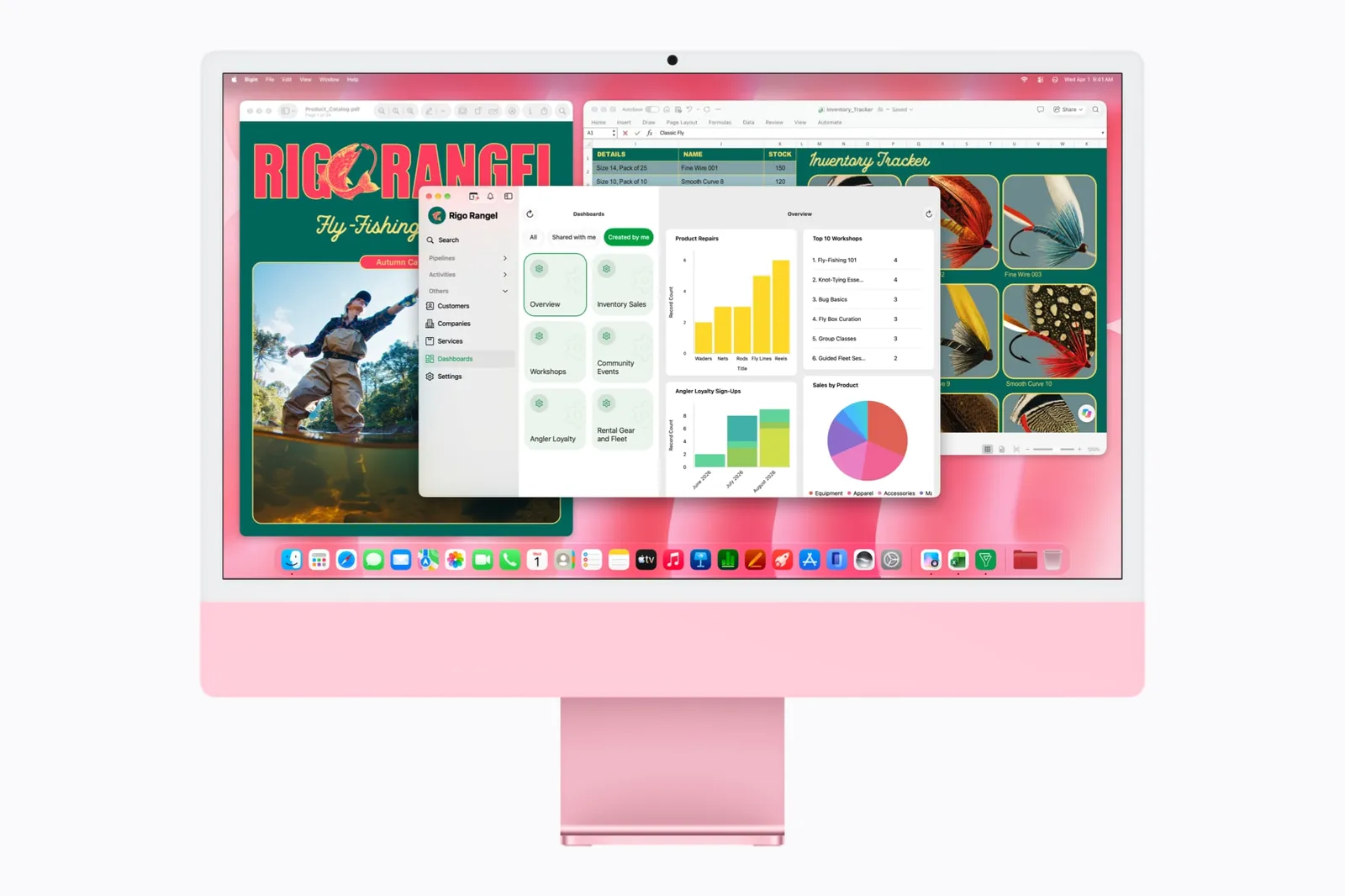
The buyer at $1,499 gets the same M6 silicon as the Mac mini, but bundled with a display, keyboard, and trackpad in one enclosure. It is the configuration ceiling and the thermal envelope. What the buyer cannot know from this packet: whether the base configuration includes 16GB or a higher memory tier, what the display panel specifications are, and whether sustained performance under load matches the Mac mini's measured figures. The fab question — which foundry produced the 2nm wafer — is unanswered in the document. The buyer is constrained by information, not by silicon.
The iMac's sustained CPU and GPU clocks under load, the display panel specifications, the actual AI throughput on the iMac's specific memory configuration, and the foundry confirmation for the 2nm process are all absent from the packet. The price and dates are confirmed by the wire. The silicon is confirmed by the chip press release.
The buyer at $1,499 is constrained by information, not by silicon: the chip is confirmed, the enclosure is not. The document does not prove that the iMac sustains the same performance as the Mac mini under load, and the foundry for the 2nm node is unnamed.
The iMac's sustained clocks under load, display panel specifications, maximum memory configuration, and the foundry for the 2nm process are not stated in any document in the packet.
M6 is confirmed at 2nm with a 12-core CPU, 12-core GPU with per-core Neural Accelerators, and a Dual 16-core Neural Engine at 170GB/s bandwidth. The iMac-specific thermal and display data are absent. The 4x AI figure is a Mac mini measurement, not an iMac measurement. The foundry is unnamed.
After apple.com. We did not report this. The pictures, if any, are theirs. Also filed by MacRumors, AppleInsider, 9to5Mac, ComputerBase.