Apple benchmarks Muse Spark Open on four Mac Studios via MLX distributed inference
Apple's MLX framework runs Muse Spark Open, an 816B-parameter MoE model, at over 36 tokens per second across four M5 Ultra Mac Studios connected over Thunderbolt 5 RDMA.
| Muse Spark Open | Mistral Medium 3.5 | Qwen 3.8 | |
|---|---|---|---|
| Total Parameters | 816B | 128B | 27B |
| Active Parameters | 42B | 128B | 27B |
| Architecture | MoE | Dense | Dense |
| Evaluation Precision | NVFP4 | FP8 | BF16 |
| RAM at 65,536 tokens | ~493GB | 158GB | 68GB |
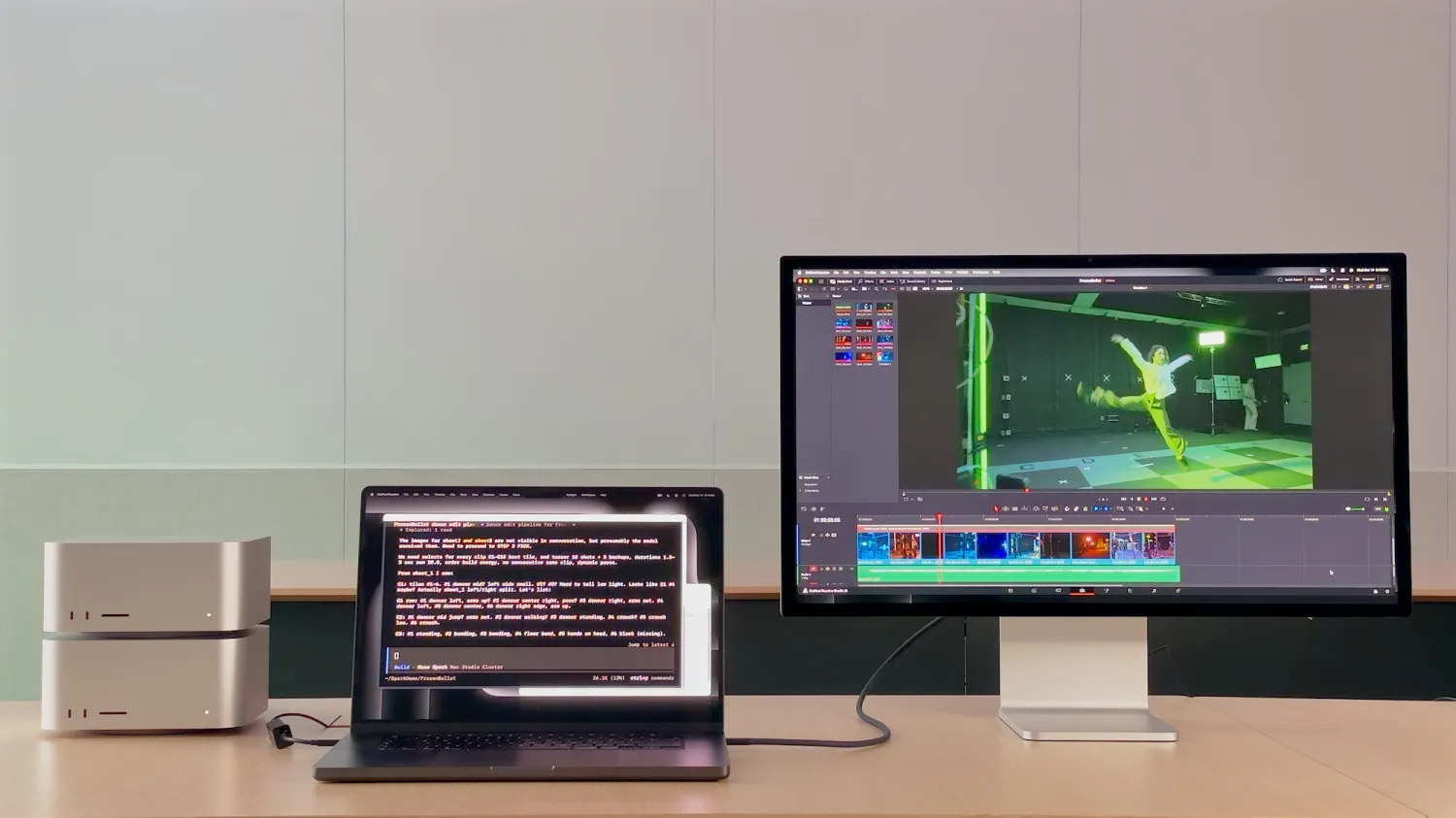
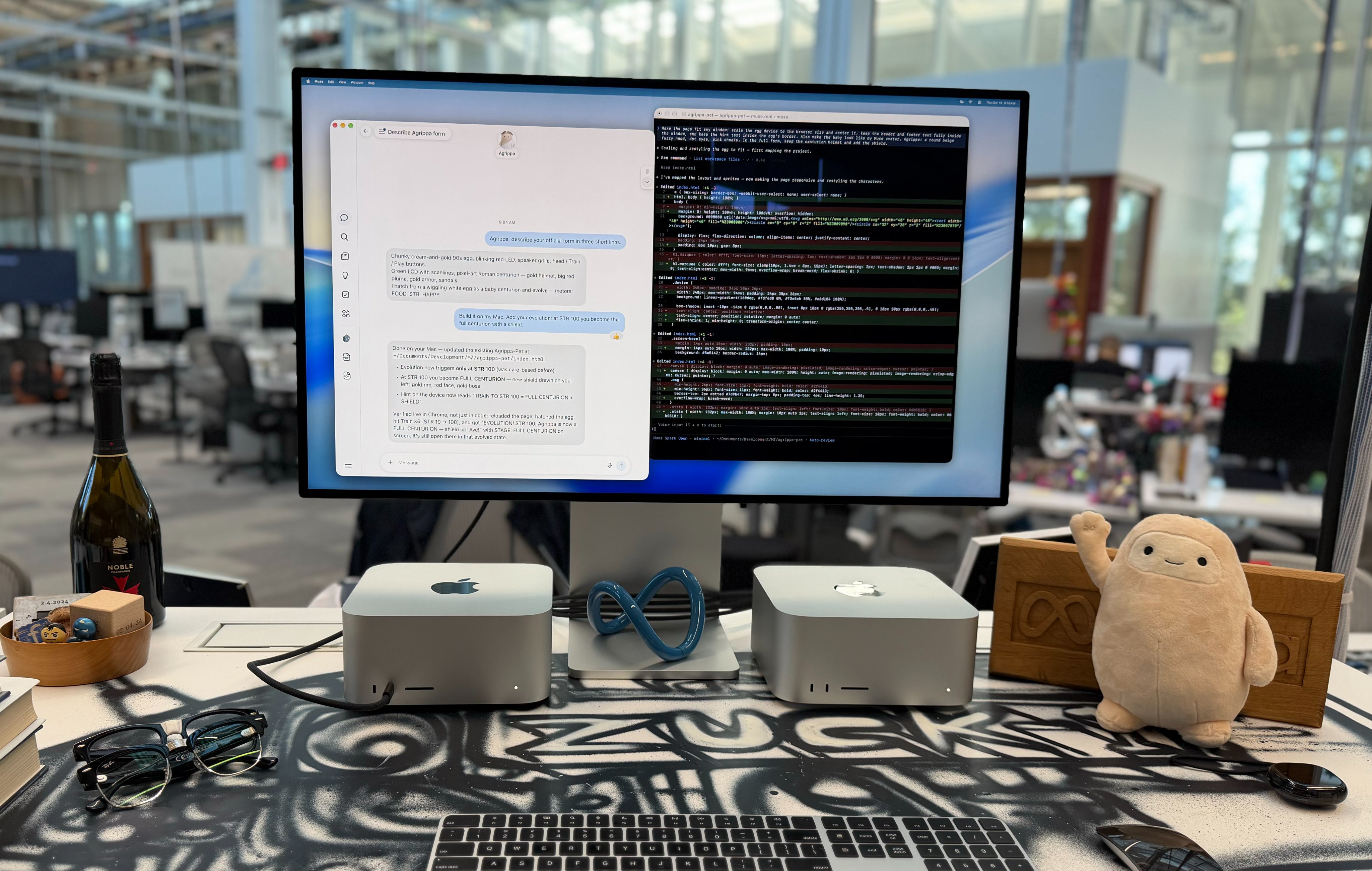
The Apple Machine Learning Research page dated October 15, 2026, benchmarks Muse Spark Open — a mixture-of-experts model with 816B total parameters and 42B active, evaluated in NVFP4 precision — on Mac Studio hardware using MLX, the open-source array framework that ships the same day. The model's 493GB memory footprint in 4-bit format exceeds the 512GB unified memory ceiling of a single Mac Studio, so the page splits inference across two or four machines via pipeline and tensor parallelization over RDMA on Thunderbolt 5. The framework leverages the unified memory architecture of Apple silicon, and the post positions the Mac Studio as a local inference target for frontier-class models.
The page measures three metrics — time to first token, generation throughput, and peak power — all obtained with mlx_lm.benchmark. TTFT is compute-bound, where the M5 Ultra GPU Neural Accelerators deliver a 4.6x speedup over M3 Ultra. Decode is memory-bandwidth-bound, where the 1.2 TB/s unified memory bandwidth of M5 Ultra versus 819 GB/s on M3 Ultra yields a 1.6x generation speedup. The inter-machine link is RDMA over Thunderbolt 5, introduced in macOS 26.2, with MLX v0.30.1 providing jaccl collectives for the parallelization schemes. Two Thunderbolt cables per link cut the 65,536-token TTFT for Muse Spark Open on four M5 Ultras from 50.5 seconds to 40.6 seconds. Pipeline parallelization at 65,536 tokens is up to 1.8x faster than a single node because MLX segments the context into 8,192-token chunks and overlaps computation across machines.
The constraint is the interconnect, not the model. Tensor parallelization requires per-layer, per-token broadcast and aggregation, and the page shows that at 65,536 tokens, two-machine tensor parallelization for Muse Spark Open lags behind two-machine pipeline parallelization because MoE expert normalization adds communication overhead that the two-cable link cannot absorb. Dense architectures scale better across machines at small cluster sizes; the MoE structure of Muse Spark Open makes the communication cost visible. The four-machine configuration is where tensor parallelization pays off, sustaining over 36 tokens per second. For a buyer, the minimum viable cluster is four Mac Studios in a Thunderbolt mesh, not two.
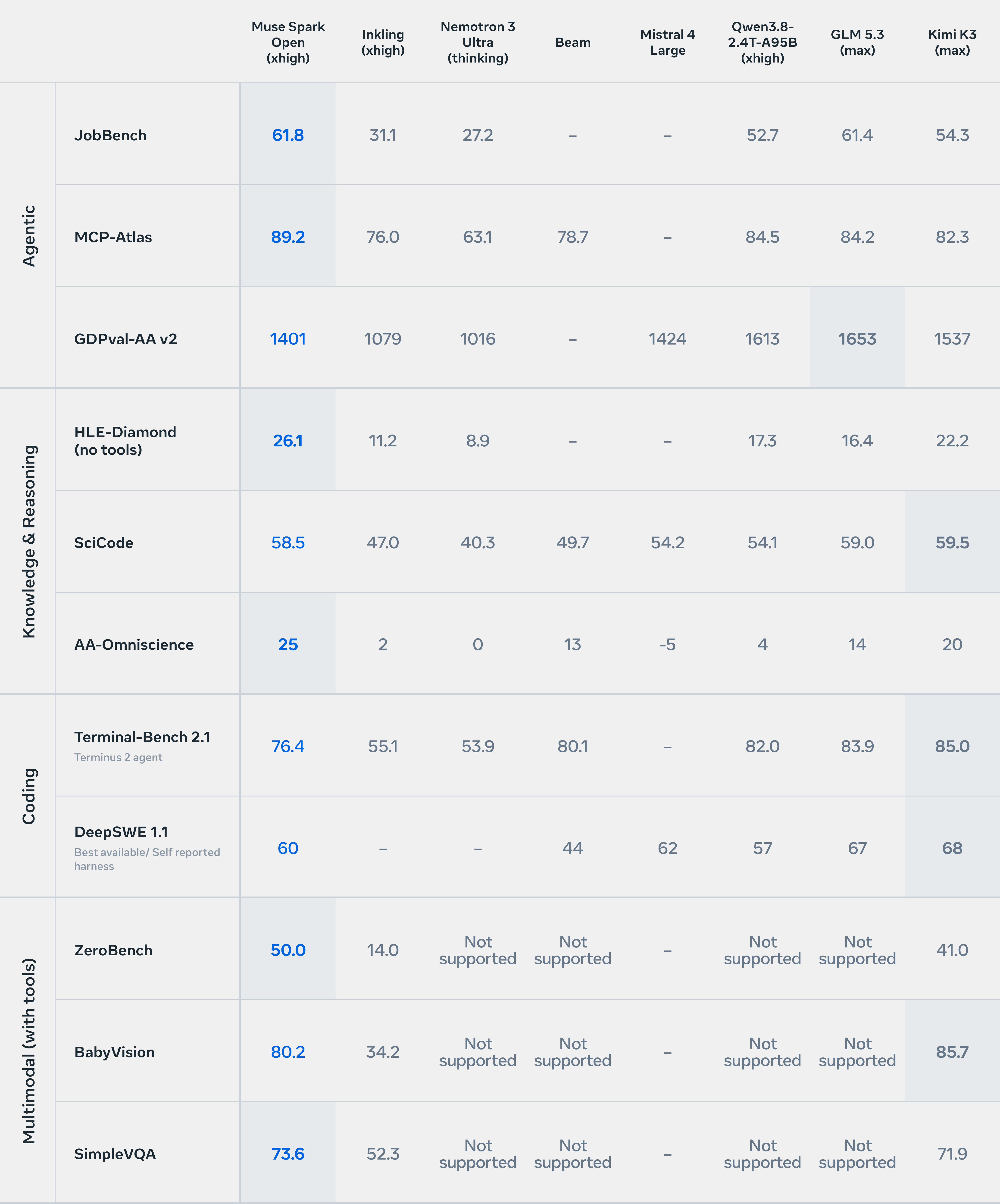
The page benchmarks two smaller dense models alongside Muse Spark Open — Mistral Medium 3.5 at 128B in FP8 and Qwen 3.8 at 27B in BF16 — both of which fit on a single 512GB Mac Studio, using up to 158GB and 68GB of RAM respectively at the 65,536-token context. Peak power is roughly 200W for the M3 Ultra Mac Studio and 300W for the M5 Ultra. What the page does not measure: exact decode throughput values for every model and configuration beyond the stated 36 tokens per second, peak power for Muse Spark Open or distributed configurations, intermediate computation memory footprints, RDMA latency, Thunderbolt bandwidth, and cost or SKU details for the Mac Studio configurations.
The interconnect is the binding constraint, not the model: at two machines the MoE communication overhead makes tensor parallelization slower than pipeline, so the practical floor is a four-node Thunderbolt mesh.
The page does not report peak power for Muse Spark Open, RDMA latency, Thunderbolt bandwidth, intermediate computation memory, or cost and SKU details for the Mac Studio configurations.
MoE expert normalization forces per-layer all-reduce that the two-cable Thunderbolt link cannot hide at 65,536 tokens, so tensor parallelization only wins at four nodes. The 4.6x TTFT gain from GPU Neural Accelerators is real but irrelevant if the model does not fit on one machine; the 1.2 TB/s bandwidth ceiling sets the decode floor.
After @finkd. We did not report this. The pictures, if any, are theirs. Also filed by MacRumors, AppleInsider, 9to5Mac.