SPEARS coin cells survive the lunar thermal swing
The cells ran from -80 C to 80 C, but the survival test pushed the stack to -170 C and 100 C in a vacuum.
| SPEARS coin-cell battery | |
|---|---|
| project | SPEARS |
| cell form | coin-cell |
| material | solid ceramic or polymers |
| operating temperature | -112 F to 176 F (-80 C to 80 C) |
| survival thermal cycle | -274 F to 212 F (-170 C to 100 C) |
| thermal-vacuum result | survived without structural damage |
| power at coldest limit | does not generate power |
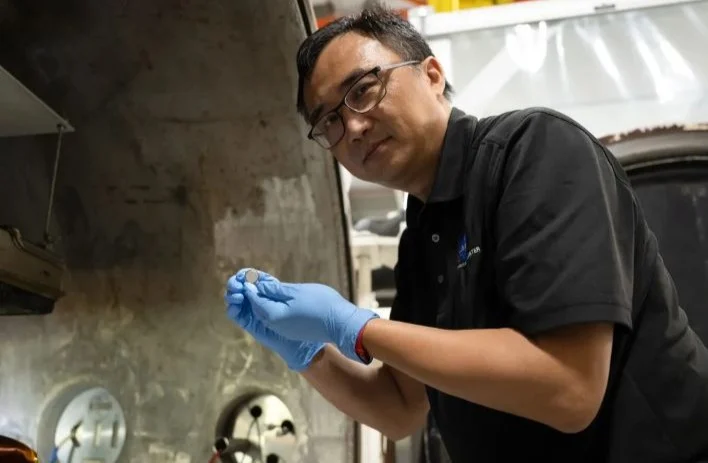
NASA's SPEARS coin cells used solid ceramic or polymer materials and came through without structural damage.
The cells did not produce power at the coldest point, but the solid-state structure prevented internal freezing damage.
The binding constraint is thermal mass rather than chemistry, and a lander or rover can drop heater hardware if the cell holds through the lunar swing.
Energy density, cycle life, charge rate, and pack-level behavior are not measured in the page.
A buyer gains a smaller thermal budget. A fab still faces the question of whether the ceramic or polymer stack scales past coin cells.
Capacity, charge time, cycle count, and EV range are absent from the document.
Surviving a vacuum swing does not make a coin cell a battery pack ready to replace lithium-ion in a vehicle.
What is missing is the usable energy per cell and how the cell behaves after repeated cycles.
The rewrite leads with the operating window, names the thermal survival and the mass savings, and flags the missing pack-level data.
After nasa.gov. We did not report this. The pictures, if any, are theirs.