Frore LiquidJet diamond targets 2,300 W rubin hotspots
Frore's LiquidJet Diamond coldplate targets 2,300 W Nvidia Rubin GPUs and claims up to 22 C lower temperatures at 770 W/cm2 hotspots.
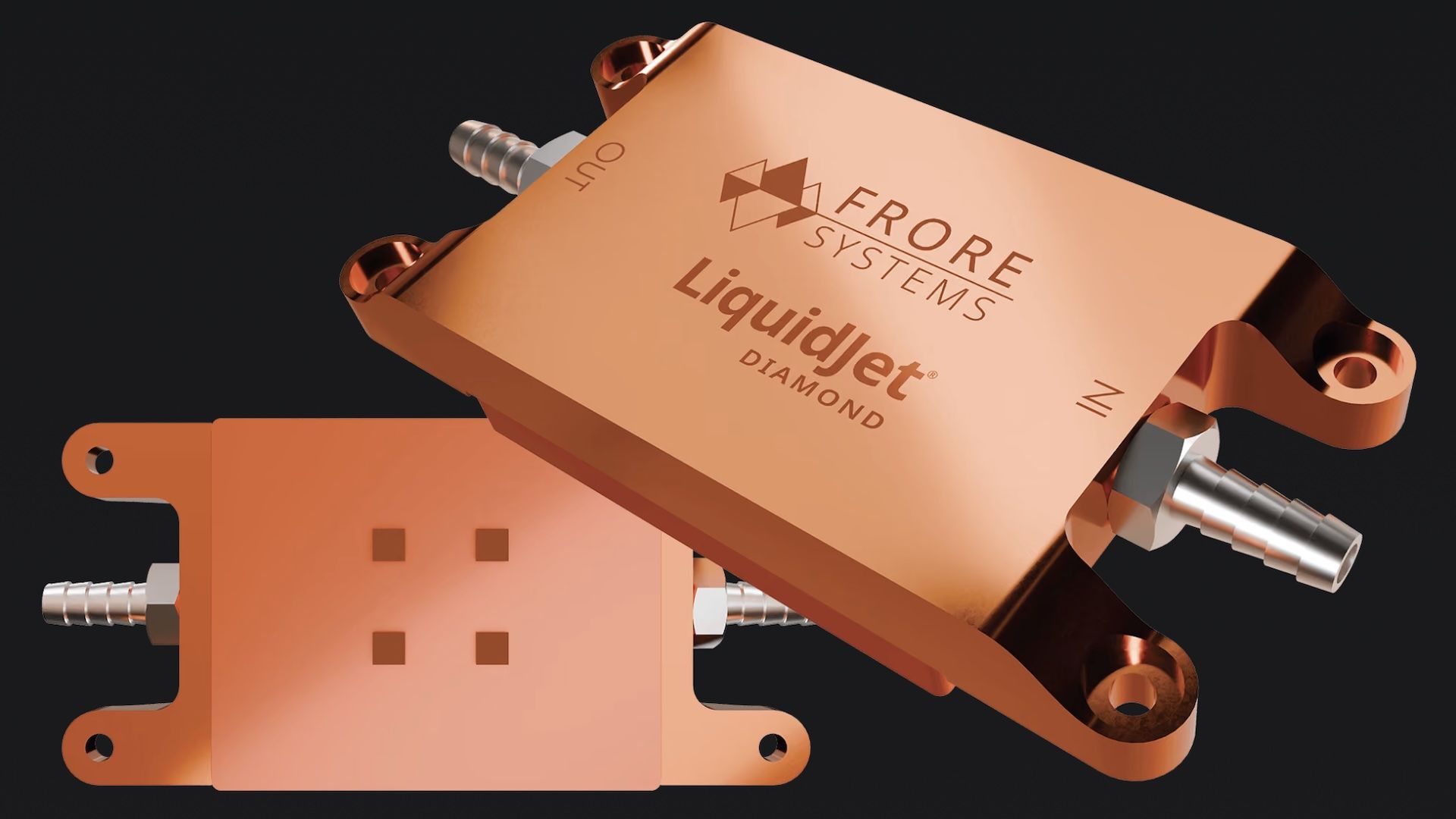
| LiquidJet DIAMOND | |
|---|---|
| Hotspot cooling | 770 W/cm2 |
| Rubin power target | 2,300W |
| Temperature reduction | up to 22 C |
| Heat transfer efficiency | 75% higher |
| Max power density | over 150% higher |
| AI tokens per watt | 30-35% more |
| Test conditions | 5 mm x 5 mm hotspot, 25 C inlet, 95 C T Jmax, PTM7950 TIM, unlidded package |
| Material and GB300 dimensions | Copper, diamond; 104.6 mm x 62 mm x 20.4 mm |
That is the maximum temperature reduction Frore claims for LiquidJet Diamond on a 2,300 W Rubin design, not a measured die temperature. It does not prove boost clock, because the document also points to a 770 W/cm2 hotspot.
The desk reads the 22 C figure as vendor thermal headroom, not independent proof. The binding constraint is the 770 W/cm2 hotspot, because it sets the coldplate requirement for server builders. A 2,300 W Rubin package needs a coldplate that can move that flux before inlet temperature, pump power, or rack airflow becomes the limiting factor in a real rack.
The dossier leaves out actual Rubin die temperature, boost under load, coolant flow, pressure drop, pump power, and diamond concentration. It also does not name a SKU, manufacturing node, or absolute tokens-per-watt value. Those missing figures decide whether the 22 C margin survives in production racks.
The claimed 22 C drop is vendor thermal headroom, not independent proof of sustained Rubin performance. The 770 W/cm2 hotspot is the real constraint for server builders.
The document does not measure actual Rubin die temperature, sustained clock, coolant flow, pressure drop, pump power, or diamond concentration.
Treat 22 C as a predicted delta from Frore's thermal model, not a measured die temperature. The 770 W/cm2 hotspot sets the coldplate requirement; flow, pressure drop, and sustained clock still need validation.
After froresystems.com. We did not report this. The pictures, if any, are theirs.