Bee Eclipse at $99.99: a phone-back transcription slab
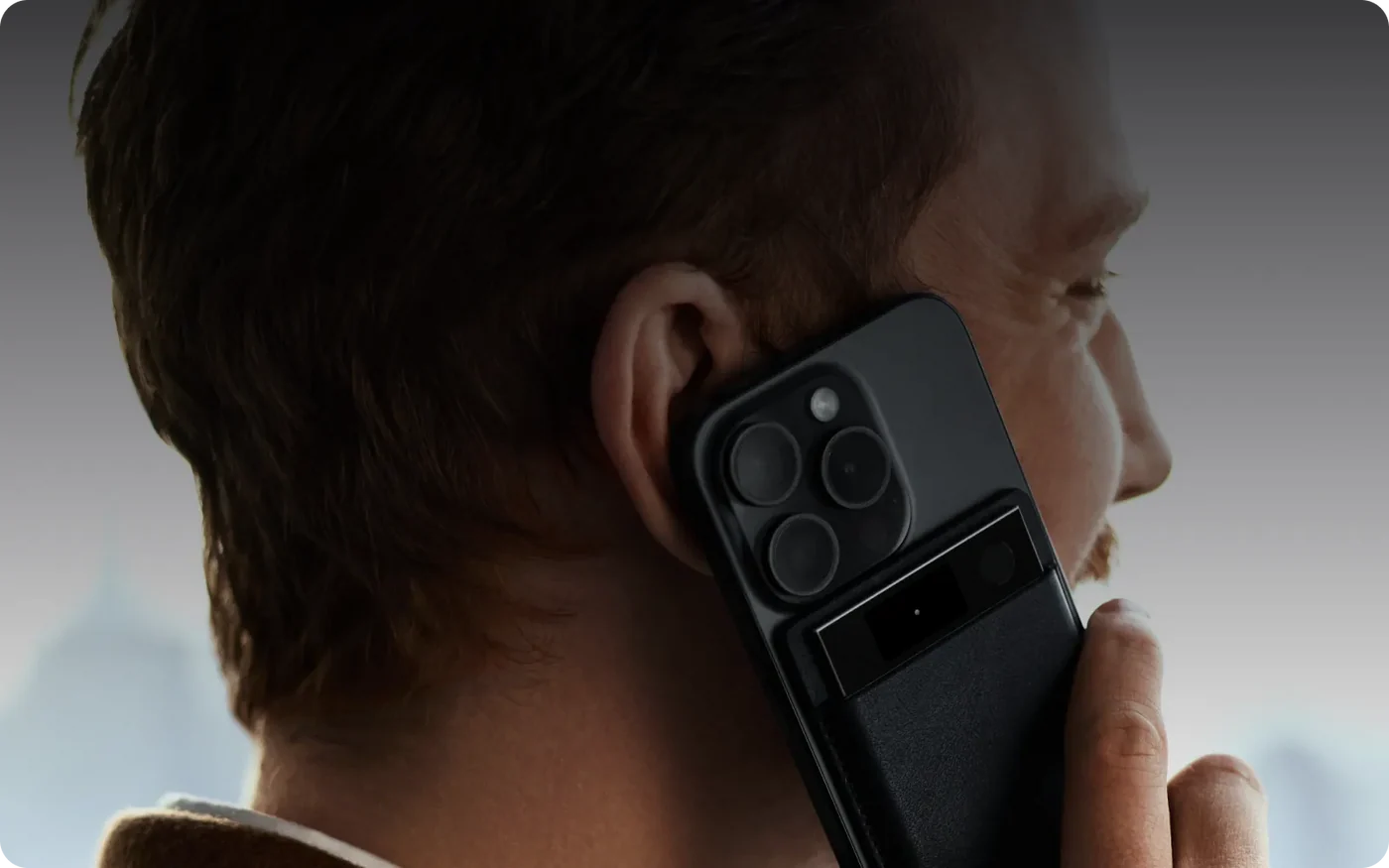
Bee Eclipse is a $99.99 credit-card-sized device that magnetically mounts to a phone and transcribes conversations in real time.
| Bee Eclipse | |
|---|---|
| Price | $99.99 |
| Form | credit-card-sized, magnetic phone mount |
| Button | 1 |
| Colors | Silver, Midnight, Honey, Blush |
| Free memory | 14 days |
| Pro subscription | $11.99/month |
The Bee Eclipse is $99.99, a credit-card-sized slab that clips magnetically to the back of a smartphone. The figure and the form factor both come from the TechCrunch launch page, dated October 15, 2026, which is the earliest document in the packet to pair the price with the physical description. No other page in the packet states a different price or a different form factor for this device.
The device has one button. It ships in Silver, Midnight, Honey, and Blush. The document gives no dimensions, no weight, no battery capacity, and no audio codec. It is a phone accessory, not a standalone recorder, and the magnetic mount is the only mechanical interface the page describes. There is no secondary input, no screen, no speaker, no status LED, no charging port visible in the description. The one button is the entire physical interface, and the page does not say what it does when pressed or whether it is a record toggle, a pause, or a summary trigger.
At $99.99 the buyer gets the hardware plus a free tier: conversation summaries and recaps, and 14 days of memory. That is the configuration the starting price buys. The 14-day window is the ceiling on stored transcripts. After it, the page is silent on what happens to older data. The free tier is the floor of the product, and it is the only thing the $99.99 tag guarantees without a recurring charge. The device records, summarizes, and stores for two weeks. Then the buyer either pays or loses the history. There is no stated limit on the number of conversations within those 14 days.
The Bee Pro subscription, $11.99 per month, removes the 14-day ceiling and adds unlimited conversation summaries, integrations with Amazon.com and Alexa+, and third-party application hooks. Pro also unlocks suggested to-dos, daily memories, a personal chat assistant, and conversation templates. The stretch between the two configurations is not hardware. It is the same device with a different data horizon. The buyer pays $99.99 once and then decides whether $11.99 per month is the price of keeping the memory open. There is no annual plan, no tier above Pro, and no stated cap on minutes in the Pro tier.

The security architecture is described as "private computing." Raw audio is not stored. It is processed in real time and then deleted. Transcripts are encrypted with keys that the device creates and controls, and the document states that no one, including Amazon employees, can access those files unless the user shares them manually. What the page does not state is where the processing happens. The phrase "private computing" implies on-device inference, but the document names no chip, no process node, and no memory footprint for the model. The encryption is device-keyed, but the algorithm is not named. Amazon cannot read the transcripts, per the document. How the device computes them is not stated.
The device connects to Alexa for an optional Voice ID feature, which lets an Echo unit recognize the user's voice and trigger recording. It also syncs with Gmail, Google Calendar, and Microsoft Outlook to draft emails, set meetings, and surface action items. Apple HealthKit integration and photo upload round out the input side. The output is a to-do list, a calendar entry, or a summary. The mechanism behind that output is not named in the document. The Alexa connection is optional, and the page notes that transcripts and summaries can be deleted at any time. The device does not create its own calendar or email client. It writes into the tools the user already has.
The Bee Frontier, at $74.99, is the wrist-worn or pinned variant of the same product line; the Eclipse is the phone-back form factor.
The TechCrunch page positions the Eclipse against the Plaud Note at $159, the Note Pro at $189, and the Pocket AI device at $129. The Eclipse undercuts all three by a wide margin. The comparison is price-to-function: same category, lower entry cost, and a subscription model that the Plaud page lists as tiered plans rather than a flat monthly fee. The Plaud page in the packet lists three tiers: Free Starter at 300 minutes per month, Pro at 1,200 minutes, and Unlimited. The Bee model is different: a flat $11.99 with no stated minute cap. The Plaud device is a standalone recorder. The Eclipse is a phone attachment. The form factor changes the use case.
No document in the packet names the silicon inside the Eclipse. There is no process node, no core count, no memory figure, no audio sample rate, no transcription latency, and no context window. The page describes what the device does and what it costs. It leaves the inference engine and the battery life unnamed. The "private computing" claim is a data-handling promise, not a performance specification. There is no theoretical peak stated, no measurement, and no benchmark of any kind. The document is a launch page, not a spec sheet. The absence is not a gap in reporting. It is the shape of the product: a consumer device sold on function and price, not on a datasheet.
The buyer is constrained by the absence of a compute spec. A $99.99 device that processes audio in real time and encrypts transcripts on-device must run a model small enough to fit in whatever silicon is inside a credit-card-sized slab. The packet does not say how small, or whether the model is quantized, or whether the 14-day free tier is a hardware limit or a software gate. The buyer cannot know whether the device will degrade on a two-hour lecture or a four-person meeting, because no benchmark, no latency figure, and no battery number appear in any page of the packet. What changes for the buyer is the price floor for on-device transcription: $99.99 is below every competitor the page names, and the subscription is the only variable cost. The document does not answer that question. It answers the price question and the form-factor question, and it leaves the performance question open.
What is still unmeasured: the chip, the battery, the audio fidelity, the transcription latency, the model size, and whether the "real-time" processing holds under sustained load. It does not prove the performance.
The buyer cannot verify the compute path because no chip, battery, or latency figure appears in any document. The $99.99 price sets a floor for on-device transcription, but the document does not prove the device can sustain real-time inference under load.
No chip name, battery life, audio sample rate, transcription latency, or model size appears in any document in the packet.
No silicon, no battery, no latency. The "private computing" claim is a data-handling promise without a performance spec. The buyer is purchasing a price point, not a measured capability.
After plaud.ai. We did not report this. The pictures, if any, are theirs.