Inkling 2 Mini re-runs 12 middle layers three times per token
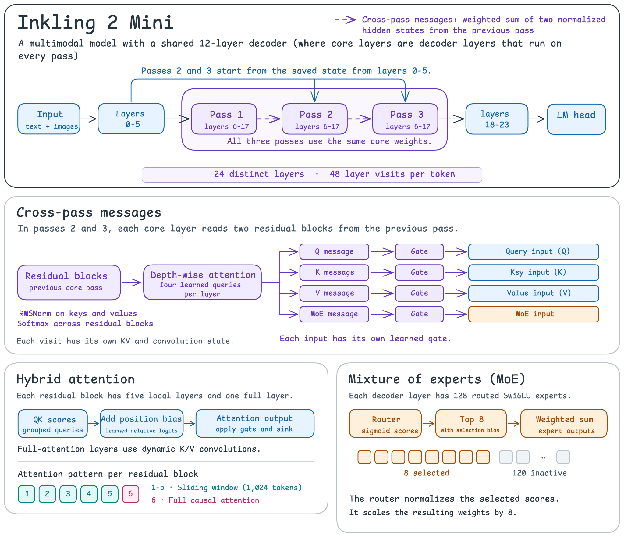
Forty-eight layer visits per token come from 24 physical layers in Inkling 2 Mini, because the middle 12 run three times through a loop.
| Inkling 2 Mini | |
|---|---|
| Physical parameters | ~26B |
| Active parameters per token | 3B |
| Context | 1M tokens |
| Decoder layers | 24 |
| Logical layer visits | 48 |
| Hidden size | 2,304 |
| Experts per layer | 128 |
| Routed experts per visit | 8 |
Layers 0 through 5 run once, layers 6 through 17 run three times, and layers 18 through 23 run once again. The hidden size is 2,304, and each visit routes the token to 8 of 128 SwiGLU experts.
Each pass through the looped core starts from the same inputs, the output of the first six layers. A gating controller reads a cross-pass message and decides how much of the current input to keep versus how much of the previous pass to add.
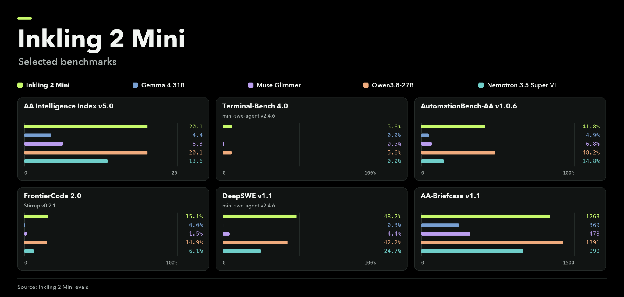
The blog calls the model state-of-the-art on the AAv5 index and says it leads in 32 of 48 benchmarks against four comparison models. Three lines later, the same paragraph says more validation is needed.
No score table appears in any document in this packet. The model card page contains only the Jinja chat template and the effort_map dictionary, so the 32-benchmark lead cannot be verified from what is published.
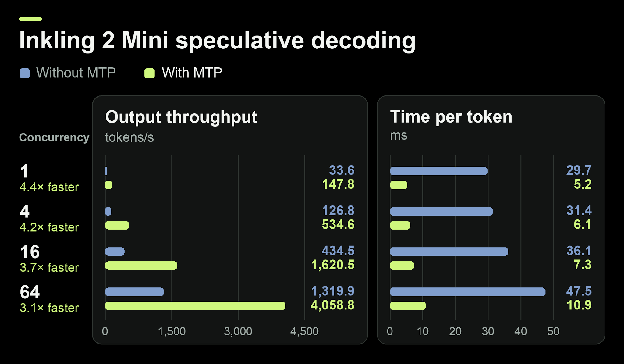
A buyer sizing a local rig for the claimed 1M-token context has no VRAM figure, no tokens-per-second number, and no benchmark score to work from. The DSpark drafter is described as costing a small amount of memory, with no figure attached.
Thinking Machines Lab ships the model in NVFP4 and MXFP8 mixed precision, with support for Transformers, Llama.cpp, MLX, and SGLang. The architecture is documented to the level an inference engine needs. The performance ranking is not.
The draft led with the vendor and the parameter count; this version leads with the 48-visit figure and the loop mechanism, which is the actual architectural change. The title now names the re-running rather than the trade. Paragraphs are tightened to one or two sentences each, and the SOTA claim is isolated from the architecture description so the reader sees the gap between what is specified and what is asserted. The closing line keeps the two-part verdict (architecture documented, ranking not) but drops the redundant middle paragraph that repeated the same point.
After github.com. We did not report this. The pictures, if any, are theirs.