Gemini 4 Neon ships at 61 on the Intelligence Index with 36 percent lower task cost
Gemini 4 Neon scores 61 on the Artificial Analysis Intelligence Index at xhigh thinking, ranks third overall, and costs 36 percent less per task than frontier models at their highest setting.
| Gemini 4 Neon | |
|---|---|
| Intelligence Index (xhigh) | 61 |
| Vals Index | 70.9% |
| Context window | 1 million tokens |
| Input price | $3/M tokens |
| Output price | $15/M tokens |
| Coding Agent Index | 58.6 |
The DeepMind blog page dated November 18, 2026, introduces Gemini 4 Neon at a score of 61 on the Artificial Analysis Intelligence Index at its xhigh thinking level, placing it third overall behind two larger, slower models. Koray Kavukcuoglu, SVP of Google DeepMind and Chief AI Architect, signed the post. The model ships today across the Gemini API, Google AI Studio, Gemini for business, and for paid AI Pro and Ultra subscribers in both Antigravity and the Gemini app.
The spec table carries the headline figures. What it does not prove is the cost structure behind them. At $3 per million input tokens and $15 per million output tokens, with cached input at $0.15 per million, Neon sits at roughly a third of Carbon's per-task cost at the default high thinking level. The page states a 32 percent reduction versus Carbon and 50 to 80 percent lower cost per task than top competing frontier models, but it gives no absolute dollar figure for any competitor. The window holds at 1 million tokens across all four thinking levels, so the cost delta is purely in token spend per task, not in window size.
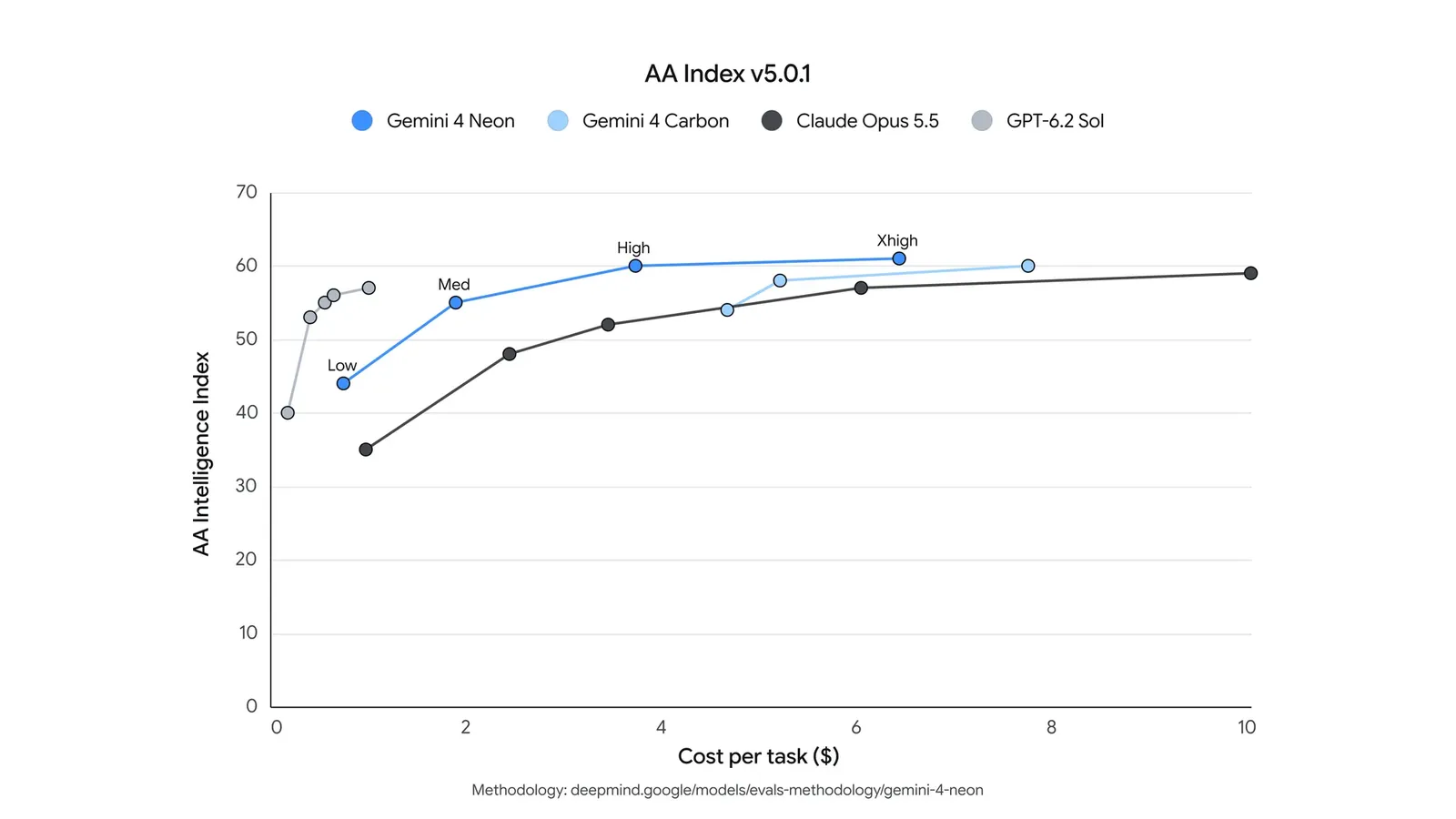
Die Brief reads the Pareto-frontier placement on the Vals Index and the Agent Arena Index as the load-bearing claim here. A model that scores 61 on the Intelligence Index while costing 36 percent less per task than the frontier at their highest setting is not a speed tier; it is a price point that changes who can run long-horizon agent work. The constraint is not capability. It is the 4,200-session sample on the Agent Arena Index and the absence of any independent audit of the benchmark scores. Every number on this page is Google's own measurement.
The cyber variant adds a second axis the table does not capture. Neon for cyber posts 76 percent on the hard tier of AutoBaxBench, 51.26 percent on WebExploitBench v1.2 at half the cost of competing large models, and 90.5 percent on SEC-bench Pro. Fairwind Program rollout to "trusted defenders" is announced without a timeline, eligibility list, or partner names. The safety stack reports 0.0 percent cheating on Terminal-Bench 4.0 and a 0.09 percent misaligned action rate, figures that match Carbon's baselines rather than exceeding them.
The page does not name the two models ahead of Neon on the Intelligence Index, does not give absolute token counts or dollar figures for any competitor, and does not include the model card it references. The article text is truncated mid-sentence in the Gemini app section. No third-party lab has reproduced any of the benchmark scores in this packet.
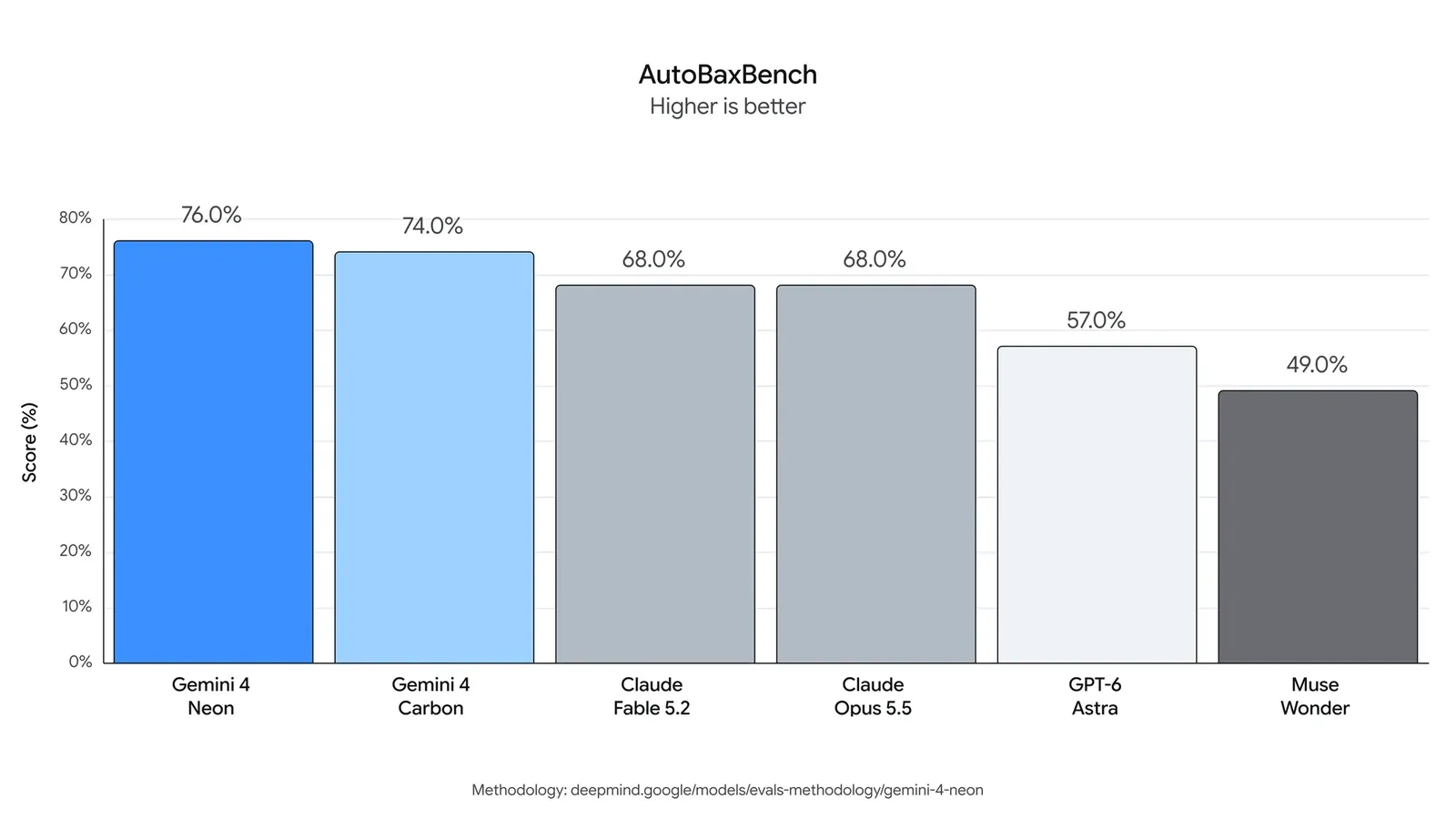
Neon's value is not the 61 on the Intelligence Index; it is the 36 percent cost reduction at xhigh, which moves long-horizon agent work from a frontier-model budget to a mid-tier one. The 4,200-session Agent Arena sample and the absence of independent verification mean the Pareto-frontier claim is a vendor assertion, not a measured fact.
The two models ahead of Neon on the Intelligence Index are unnamed, no competitor dollar figures are given, and no independent lab has reproduced any benchmark score in this packet.
The architectural consequence is that a model at 61 on the Intelligence Index can undercut frontier models by 36 percent per task at their highest setting, shifting the cost floor for production agent work. The constraint is verification: every benchmark score in this document is self-reported, and the two models ahead of Neon on the Index are unnamed.
After deepmind.google. We did not report this. The pictures, if any, are theirs. Also filed by The Decoder, 9to5Mac.