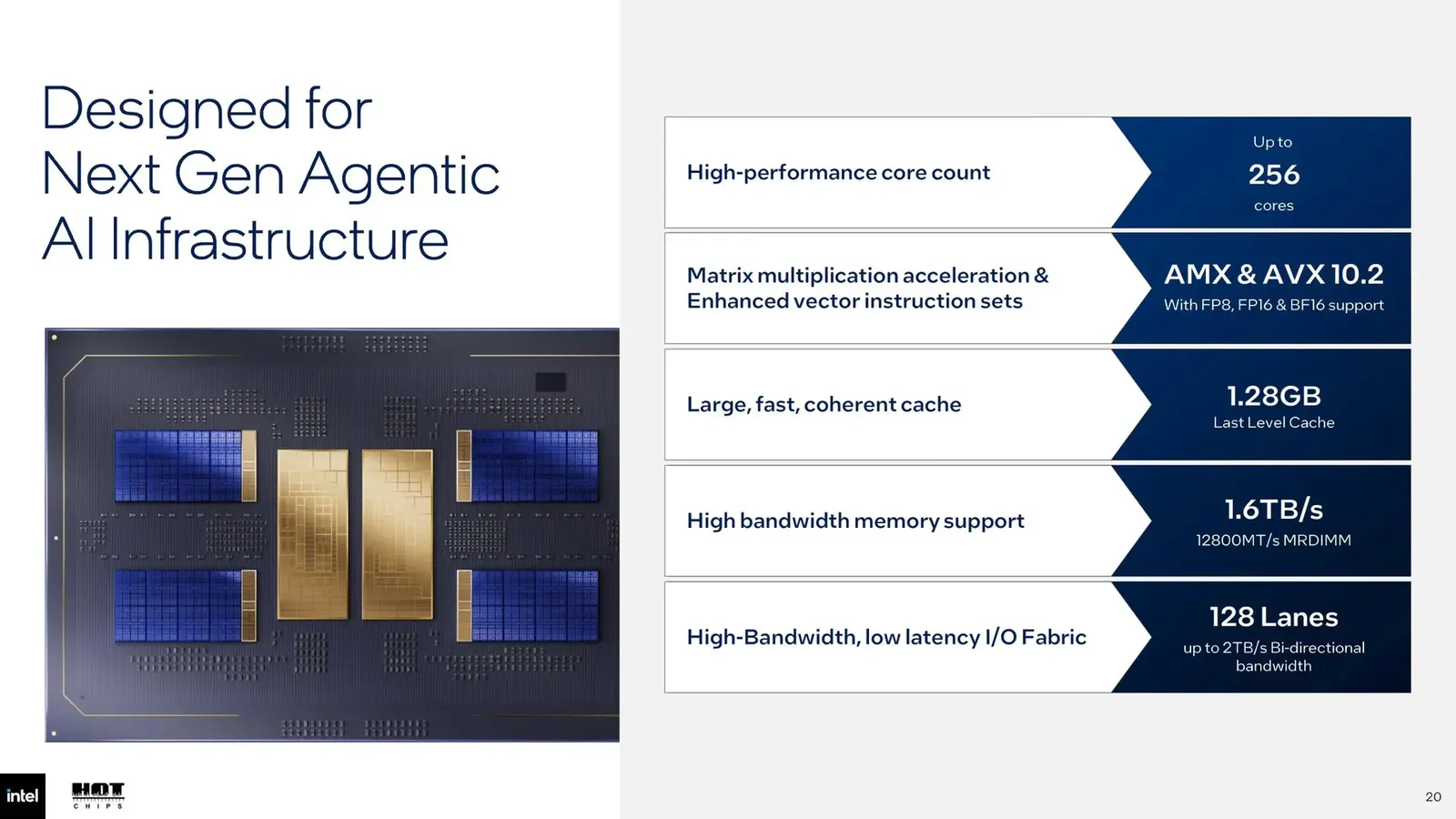
Venice splits its I/O die to carry 1.6 TB/s
Moving 1.6 TB/s through a conventional substrate would have consumed 10 to 15 percent of Venice's SoC power budget, so AMD split the I/O die and adopted 2.5D packaging.

| EPYC Venice | |
|---|---|
| CCD-to-I/O bandwidth | 1.6 TB/s |
| Previous-gen chiplet-to-I/O | ~700 GB/s |
| 32-core CCD physical cores | 33 |
| 32-core CCD L3 | 128 MB |
| 12-core CCD X3D total L3 | ~144 MB |
| MRDIMM | 12,800 MT/s / 16 ch |
| SP8 PCIe lanes per socket | 128 |
| Packaging | 2.5D |
The previous generation moved a little under 700 GB/s between chiplets and the I/O die, a load that standard GMI links handled without strain. At 1.6 TB/s the math changed.
Subramony, now corporate VP of design engineering leading server architecture, framed the split as a perimeter problem. Each CCD needs enough edge on the I/O die for short die-to-die connections, and a single die could not provide that while also routing I/O out to the board.
Both halves of the I/O die share a single design, the second copy flipped 180 degrees. One-off blocks like the root of trust get duplicated rather than consolidated.
SP7 and SP8 are mutually exclusive at the platform level. SP8 exposes 128 PCIe lanes per socket but half the memory channels of SP7, while the 12-core CCD targets 16 MRDIMM channels at 12,800 MT/s. You pick lanes or memory bandwidth, not both.
The transcript gives no clock speed, process node, die dimension, or per-socket TDP. The L3 lookup penalty on the 128 MB 32-core CCD is described only as "a few extra clocks," with no cycle count.
The 33rd core on the 32-core CCD is a yield valve, not a SKU. No buyer will see 33 active cores.
The draft buried the packaging decision under a bandwidth stat and repeated the 33rd-core and missing-spec facts twice. The rewrite leads with the power-budget constraint that actually forced the split, keeps the SP7/SP8 tradeoff as its own beat, and drops the duplicated paragraphs. Rhythm shifts from number-first to cause-first, and the title now names the structural change rather than restating the bandwidth figure.
After chipsandcheese.com. We did not report this. The pictures, if any, are theirs. Also filed by storagereview.com.