Intel D270 outpaces RTX PRO 6000 in FP64 monte carlo at 350 W
Intel's 350-watt GPU D270 beats the RTX PRO 6000 by 5.9× in European Monte Carlo options pricing, where Xe3P's full-rate FP64 meets Blackwell's double-precision penalty.
| GPU D270 | RTX PRO 6000 Blackwell Server Edition | |
|---|---|---|
| Cores | 32 Xe3P | |
| Memory | 160 GB LPDDR5X | 96 GB GDDR7 |
| Memory bus | 1280-bit | |
| Power | 350 W | 600 W |
| FP64 | full rate | penalty |
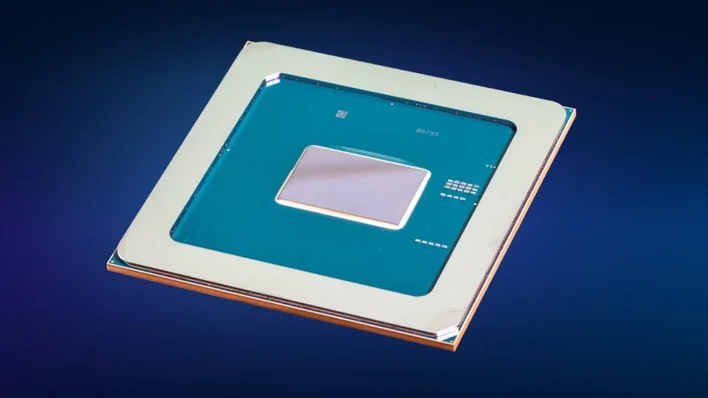
The HotHardware page from November 17 carries the number: 5.9×, from the European Monte Carlo options-pricing simulation, where Intel's GPU D270 outpaces the RTX PRO 6000 Blackwell Server Edition. The D270 is a non-graphics compute accelerator with 32 Xe3P cores, the same core count as the Arc Pro B70, and it draws 350 watts at its ceiling.
The wire's headline compresses four benchmarks into one multiplier; the American Monte Carlo on Crescent Island, the slowest of the four, sits at 1.92×. The gap between those two numbers is the whole story: the D270 wins where FP64 is the bottleneck and Xe3P runs double-precision at full rate, while Blackwell applies a penalty. The parallel to AMD's Ryzen AI Max conflates an integrated-memory advantage with a discrete card carrying 160 GB of LPDDR5X on a 1280-bit bus against 96 GB of GDDR7.
Die Brief's read: the 5.9× does not make the D270 a general-purpose replacement for the RTX PRO 6000; it shows that a 350-watt, 32-core part wins a narrow FP64 workload where the 600-watt card is architecturally disadvantaged. The 12% LLM throughput gain at matched power is the number a buyer actually prices, and it is a relative figure with no absolute tokens-per-second attached. Intel's hybrid proposal—SambaNova SN50 RDUs, D270s, and Xeon 6+ in an air-cooled rack—shifts the constraint from per-card performance to per-rack wattage, which is where the 350-versus-600 split matters most.
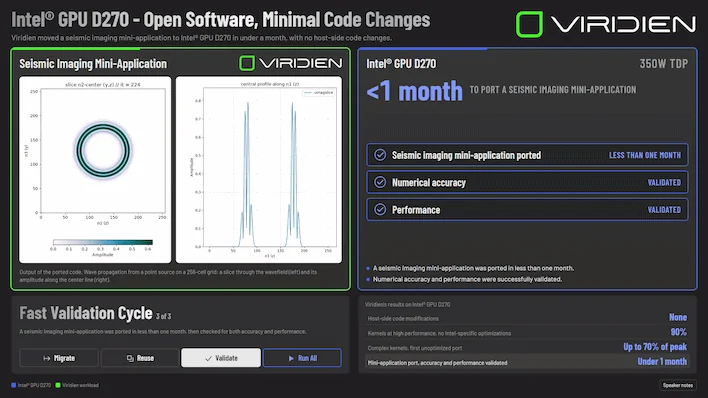
No document in this file states a FLOPS figure, a release date, or a price for the D270. The Viridien seismic port is described as "less than one month" with no host-side code changes, but no quantitative performance number accompanies it. The 29% agentic-AI latency claim and the 12% throughput claim are both Intel's, measured against a single NVIDIA SKU at a single power limit, and neither carries a third-party reproduction.
The 5.9× is a narrow FP64 win, not a general-purpose displacement of the RTX PRO 6000. The commercially relevant figure is the 12% LLM throughput gain at matched power, which carries no absolute tokens-per-second and no third-party reproduction.
No document states a FLOPS figure, a release date, or a price for the D270, and the 12% throughput claim has no absolute tokens-per-second behind it.
The D270's advantage is architectural: Xe3P executes FP64 at full rate while Blackwell applies a penalty, and the 160 GB LPDDR5X pool on a 1280-bit bus exceeds the 96 GB GDDR7 on the NVIDIA card. The 350 W ceiling versus 600 W shifts the constraint from per-card FLOPS to per-rack wattage in Intel's proposed SN50 + D270 + Xeon 6+ configuration.
After hothardware.com. We did not report this. The pictures, if any, are theirs.