Vera rubin NVL72 enters MLPerf at 100.89 kW, 32 chips
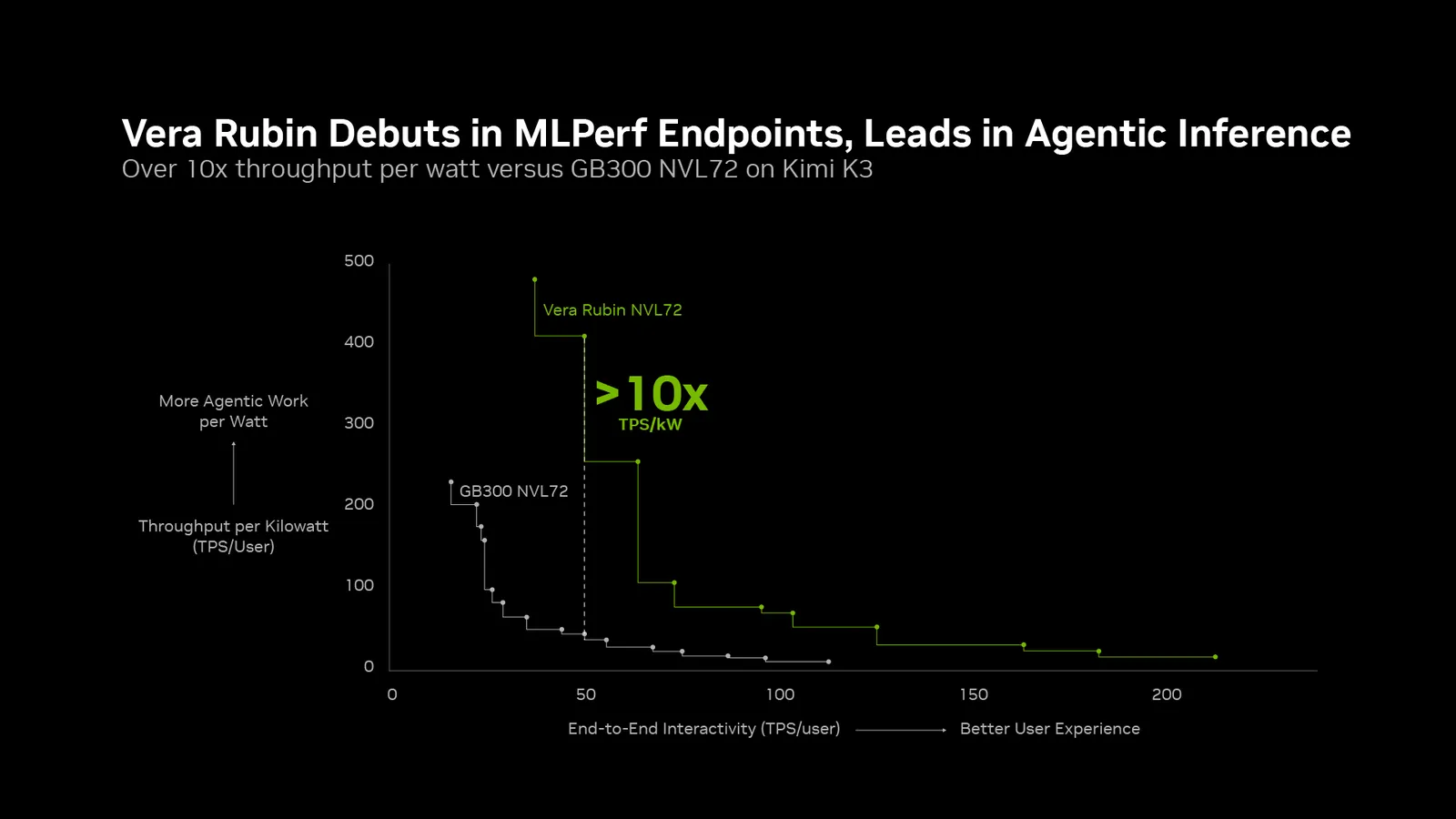
Vera Rubin NVL72 drew 100.89 kW at 1,024-query concurrency on Kimi K3 while GB300 NVL72 drew 60 kW at 48 queries, a comparison the document frames as 10x throughput per kilowatt.
| Vera Rubin NVL72 | GB300 NVL72 | |
|---|---|---|
| accelerators | 32 | 48 |
| operating power | 100.89 kW | 60 kW |
| concurrency (Kimi K3) | 1,024 queries | 48 queries |
| system TPS (Kimi K3) | 41,414.2 tokens/sec | 2,210.4 tokens/sec |
| TTFT P90 (Kimi K3) | 4,673.9 ms | 2,305.1 ms |
| E2E interactivity | 50.4 tokens/sec/user | 56.2 tokens/sec/user |
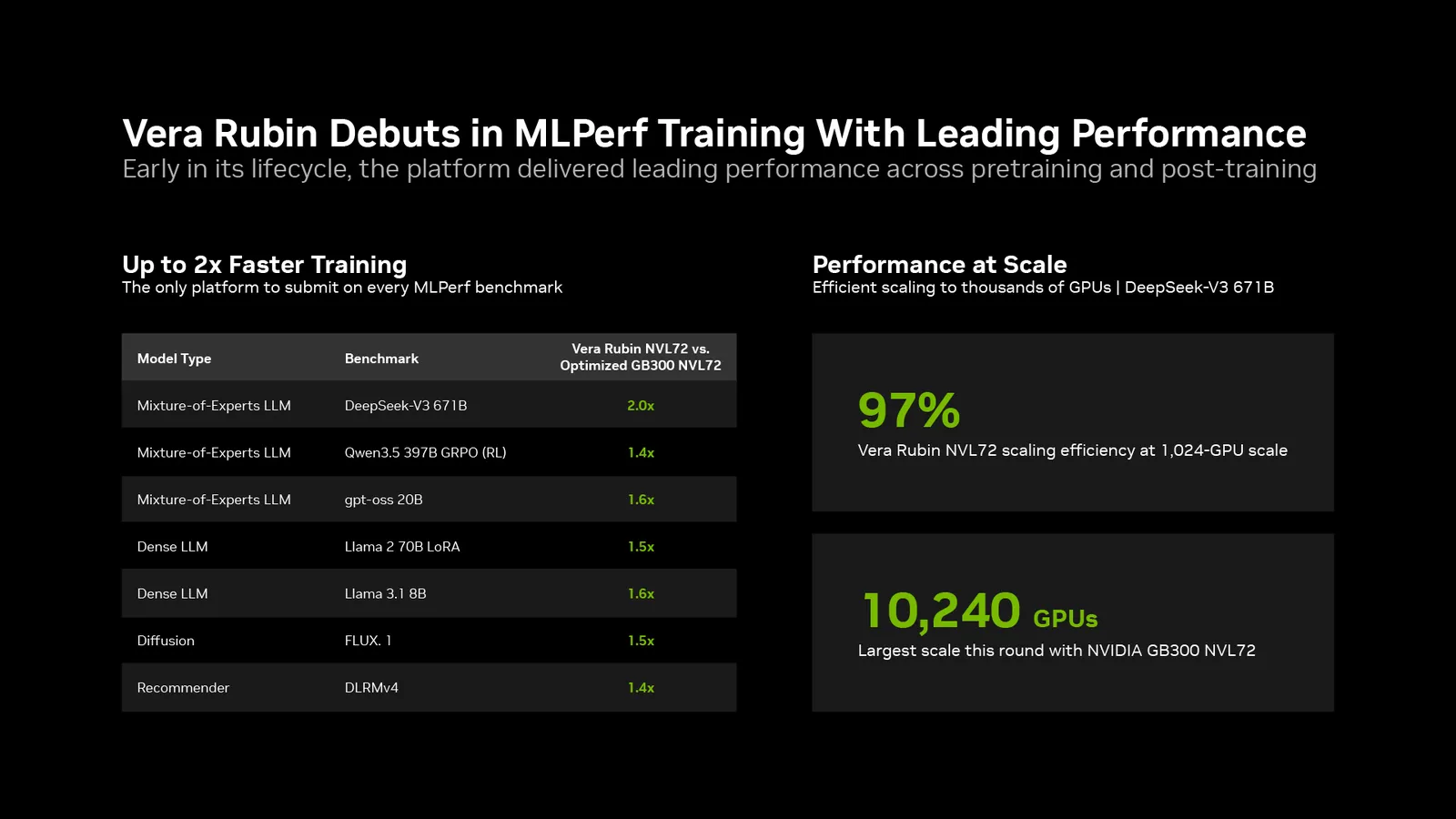
The NVIDIA blog post dated November 16, 2026, reports that Vera Rubin NVL72 drew 100.89 kW at 1,024-query concurrency on the Kimi K3 agentic benchmark while GB300 NVL72 drew 60 kW at 48 queries. The filing also states that Vera Rubin delivered up to 2x more performance per GPU than GB300 NVL72 across every MLPerf Training v6.1 benchmark, and that on DeepSeek-V3 the system scaled from 256 to 1,024 GPUs at roughly 97 percent efficiency, cutting training time from 16 minutes to about four. That is the number the vendor page leads with, and it is the one that needs the most scrutiny.
The Yahoo Finance desk picked up the "10x generational gain" headline and framed it as a raw throughput ratio between two systems. The document does not say that. The 10x is throughput per kilowatt measured at a shared floor of 50 tokens per second per user, and the two systems were tested at different concurrency levels: 1,024 queries on Vera Rubin versus 48 on GB300. The GB300 result carries MLCommons verification. The Vera Rubin result is provisional and pending peer review, which means the number can shift before it is locked.
The per-accelerator power draw is the real constraint here. Vera Rubin NVL72 packs 32 accelerators into 100.89 kW, roughly 3.15 kW per chip. GB300 NVL72 packs 48 into 60 kW, about 1.25 kW per chip. A buyer sizing a rack for Vera Rubin is not buying 32 faster chips; the buyer is buying a system that draws 68 percent more power for 33 percent fewer accelerators. The 2x per-GPU training gain is real but it is a relative figure against NVIDIA's own previous generation, and the document prints no absolute tokens-per-second for the Training benchmarks. The scaling story is cleaner: 97 percent efficiency from 256 to 1,024 GPUs is a number a data-center operator can plan around.
The filing names NVLink, Quantum-X800 InfiniBand, and Spectrum-X Ethernet but prints no bandwidth figure in gigabits or gigabytes. No process node, no die size, no per-GPU TDP, no price. The 97 percent scaling efficiency on DeepSeek-V3 is measured across 256 to 1,024 GPUs; what happens at 10,240 on Vera Rubin is not in this document. The 20 organizations that submitted to MLPerf Training are listed by name, but their individual results are not broken out on this page.
Per-accelerator power draw triples from GB300 to Vera Rubin, shifting the binding constraint from compute density to rack-level power budget before the compute budget does. The 2x training gain is relative to NVIDIA's own prior generation, and the document prints no absolute throughput figure to anchor it independently.
The document prints no process node, no per-GPU TDP, no interconnect bandwidth in Gb/s, no price, and no absolute training throughput in tokens per second.
Per-accelerator power scales from 1.25 kW (GB300, 48 chips in 60 kW) to 3.15 kW (Vera Rubin, 32 chips in 100.89 kW). The 2x per-GPU training multiplier is a relative figure against the prior generation; no absolute tokens/sec is printed for the Training benchmarks, so the gain cannot be independently verified from this page.
After blogs.nvidia.com. We did not report this. The pictures, if any, are theirs. Also filed by finance.yahoo.com.