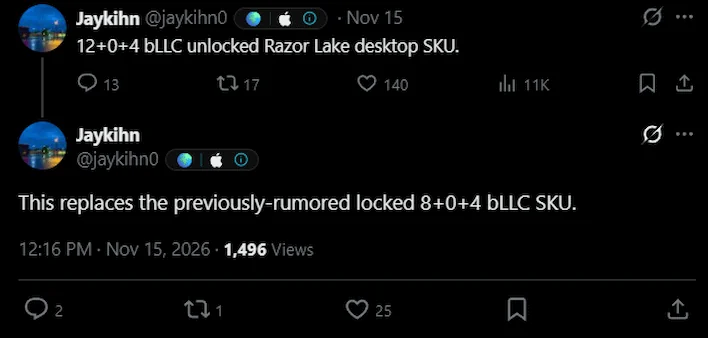
Razor Lake 12+0+4 SKU isolated on Intel 18A-P
A 12+0+4 Razor Lake desktop SKU reportedly sits on a single Intel 18A-P compute die with bLLC, replacing a locked 8+0+4 part.
| 12+0+4 bLLC (Razor Lake) | |
|---|---|
| P-cores | 12 |
| Standard E-cores | 0 |
| LP E-cores | 4 |
| Architecture | Coyote Cove |
| Process | Intel 18A-P |
| Launch | 2028 |
The 12+0+4 Razor Lake SKU sits on a single compute die built on Intel 18A-P, with all twelve Coyote Cove P-cores on one tile rather than split across two. The chip is unlocked and carries bLLC, replacing a previously rumored locked 8+0+4 part.
Guru3D hedges the 125W 6+12+4 segment with "may have shifted from Nova Lake," leaving the reader uncertain whether that SKU belongs to the current generation or the next. The VideoCardz report states the 125W figure belongs to the 6+12+4 bLLC segment and that it "will no longer launch with Nova Lake." The 125W number is the one that pins the SKU to a specific power envelope and separates it from the 12+0+4 part, which has no stated TDP at all.
The constraint here is Intel's own fab. The 18A-P assignment isolates this one tile from the rest of the Razor Lake desktop family, which reportedly uses TSMC N2P. That means the 12+0+4 part depends on Intel's internal yield at 18A-P while its siblings depend on an external foundry. A buyer waiting for a value gaming chip gets a part whose power draw, clock, and cache size are all unmeasured, and whose availability hinges on a process node Intel has not yet shipped in volume for desktop.
No document in the packet gives a bLLC capacity, a base or boost frequency, a memory generation, a socket, or a price for the 12+0+4 SKU. The 2028 launch window is a single year, not a quarter.
The 18A-P assignment makes this SKU dependent on Intel's internal yield while its N2P siblings depend on TSMC, splitting the family across two foundries. A buyer gets no clock, no TDP, no cache size, and no price until Intel confirms the part.
No document states the bLLC capacity, clock frequencies, TDP, memory generation, socket, or price for the 12+0+4 SKU.
The 12+0+4 tile is the only Razor Lake desktop compute die on Intel 18A-P; the 4+8 and 8+16 siblings use TSMC N2P. That split means yield risk on the 18A-P node gates this SKU independently of the rest of the lineup, and the absence of a TDP figure for the 12+0+4 part means no thermal design target exists in any public document.
After x.com. We did not report this. The pictures, if any, are theirs.