Marvell photonic fabric module stacks 72 GB HBM3e and eight DDR5 channels at 7.2 Tbps
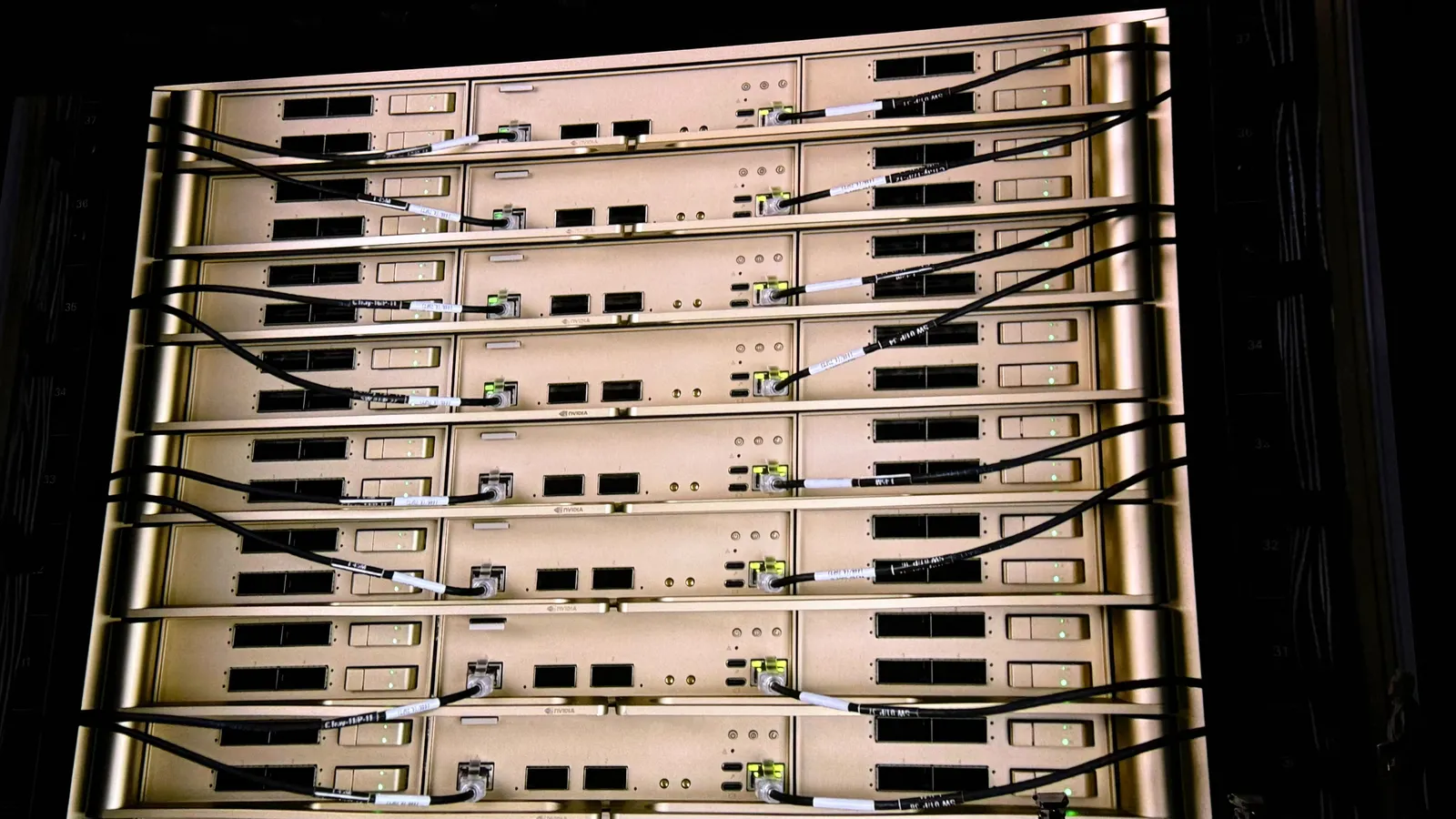
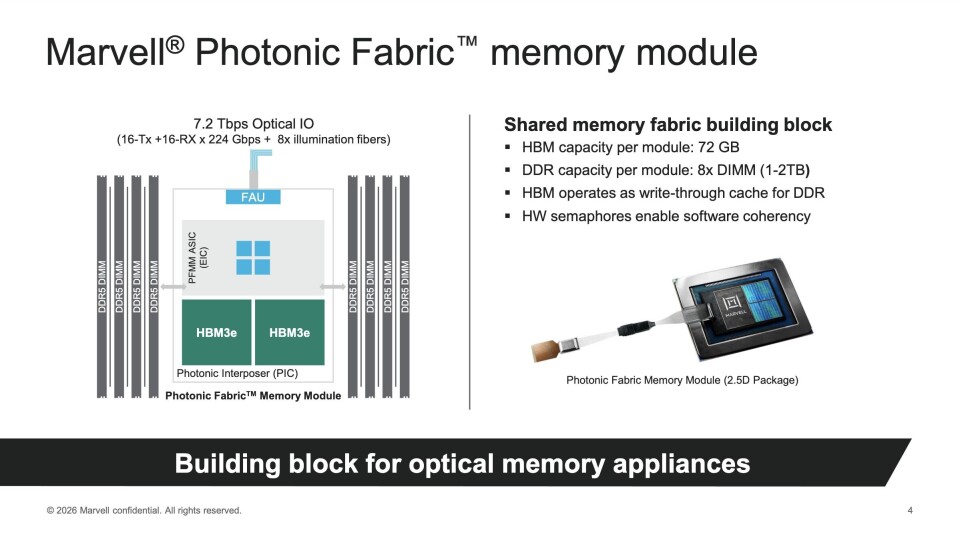
Penguin Solutions builds a 16-server appliance around sixteen Marvell Photonic Fabric modules, each pairing two HBM3e dies for 72 GB with eight DDR5 channels on a silicon photonic interposer.
| Photonic Fabric Module | Penguin Appliance | |
|---|---|---|
| HBM3e | 72 GB (two stacks) | 1 TB |
| DDR5 | 8 channels | 16 TB |
| Bandwidth | 7.2 Tbps (900 GB/s) | 57.6 Tbps |
| Servers supported | 16 | |
| Host interface | CXL 3.1 / AMD Venice |
The 7.2 Tbps figure is bidirectional bandwidth per module. The document gives no power draw, no thermal ceiling, and no per-module latency, so it reads as a peak interposer spec rather than a sustained system throughput.
Sixteen modules yield 16 TB of DDR5 and 1 TB of HBM, fanned to up to 16 servers at 57.6 Tbps. Marvell supplies the module, the NIC, and the fiber shuffle; Penguin Solutions packages the appliance.
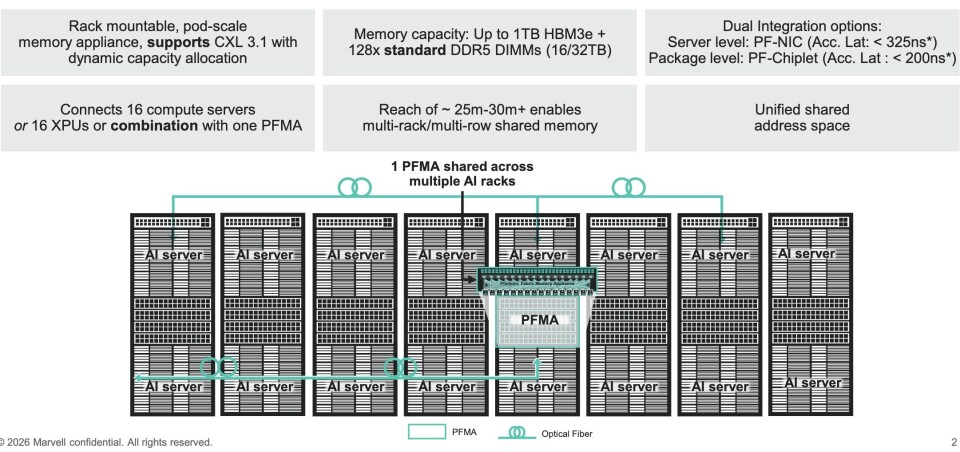
The host side is the constraint. Only CXL 3.1 NICs and AMD Venice CPUs are named as validated for the 50-meter tier, and the document lists no other CPU or NIC. A buyer on a different platform is outside the tested envelope.
No per-module wattage, no appliance price, no named hyperscaler deployment, and no thermal specification for the interposer appear in either document.
The draft repeated the host-side constraint and the missing-specs list twice. I consolidated each into a single paragraph, moved the lede to the Penguin Solutions appliance so the reader meets the product before the spec, and let the 72 GB / eight-channel stacking lead the title instead of the raw bandwidth number.
After nextplatform.com. We did not report this. The pictures, if any, are theirs.