A voltage dip frees 80 GB and up to 126 SMs on the CMP 170HX
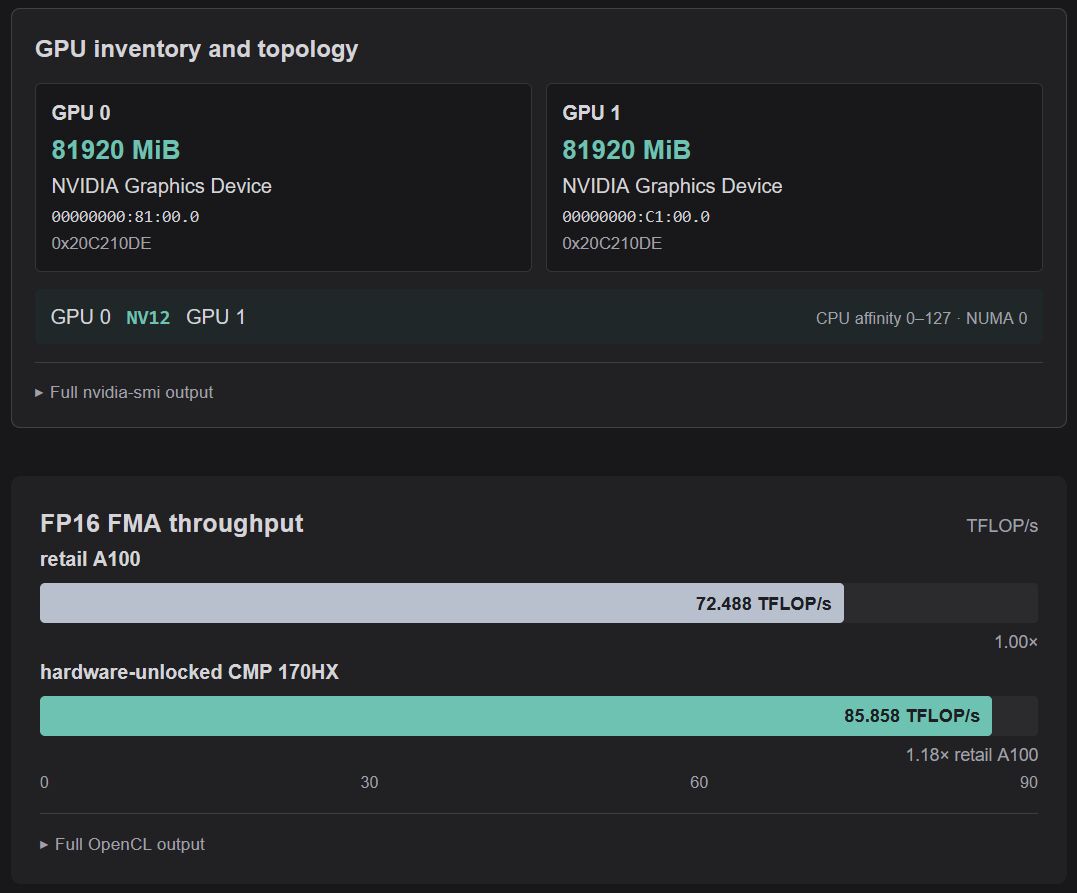
A targeted voltage dip into the eFuse controller frees 80 GB of HBM2e and 120 to 126 SMs on the CMP 170HX, measured at 85.858 TFLOP/s in FP16 FMA under OpenCL.
| CMP 170HX (unlocked) | A100 (retail) | |
|---|---|---|
| FP16 FMA | 85.858 TFLOP/s | 72.488 TFLOP/s |
| Active SMs | 120–126 | 108 |
| Memory | 80 GB HBM2e | |
| Coalesced read BW | 1883.17 GB/s | |
| Clock | 1410 MHz |
A small STM32 board drives the dips. The process requires soldering and between one and 48 hours of repeated attempts, and the fuse rewrite is permanent with no rollback path.
The GA100 die has 128 SMs on the silicon. Nvidia ships 70 of them on the mining card and 108 on the A100; the glitched unit lands at 120 to 126 depending on die lot. The package holds five HBM2e stacks, but the factory fuse map only enables a tenth of the 80 GB.
Nine of the ten cards Kate tested came up with the full 80 GB, reported as 81920 MiB under nvidia-smi. One topped out at 64. The packet does not state the voltage amplitude, pulse width, or whether the result holds across production batches.
The 1.18× ratio over a retail A100 is not a free lunch. The GA100 is a 2020-node part at 1410 MHz with 7936 cores, and its per-clock efficiency sits well behind a modern accelerator. The buyer is buying a memory play, not a compute play.
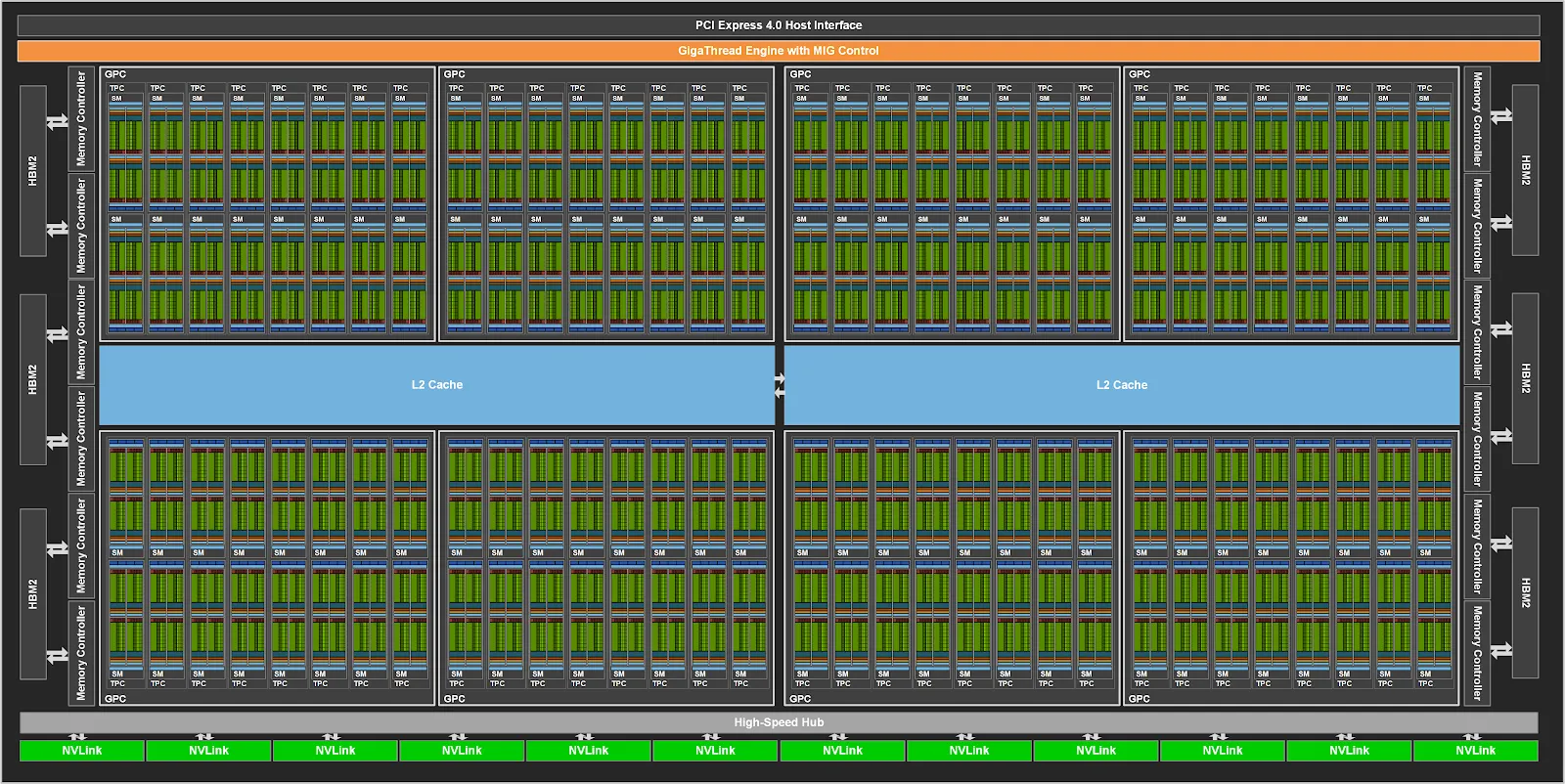
No document in the packet measures power draw under load, sustained clock behaviour after the fuse rewrite, or inference throughput on a named model. The 85.858 TFLOP/s figure is an OpenCL FMA benchmark, not a tokens-per-second number.
The eFuse controller's lack of fault-injection hardening is a design gap, not a manufacturing defect.
The draft repeated its list of missing measurements twice and led with the benchmark number rather than the physical act that produced it. The rewrite leads with the STM32 dip, front-loads the success rate, and folds the redundant caveats into a single paragraph. The 1.18× framing stays because it is the honest ceiling on the story: more SMs on a 2020 die is a memory play, not a compute leap.
After arxiv.org. We did not report this. The pictures, if any, are theirs.