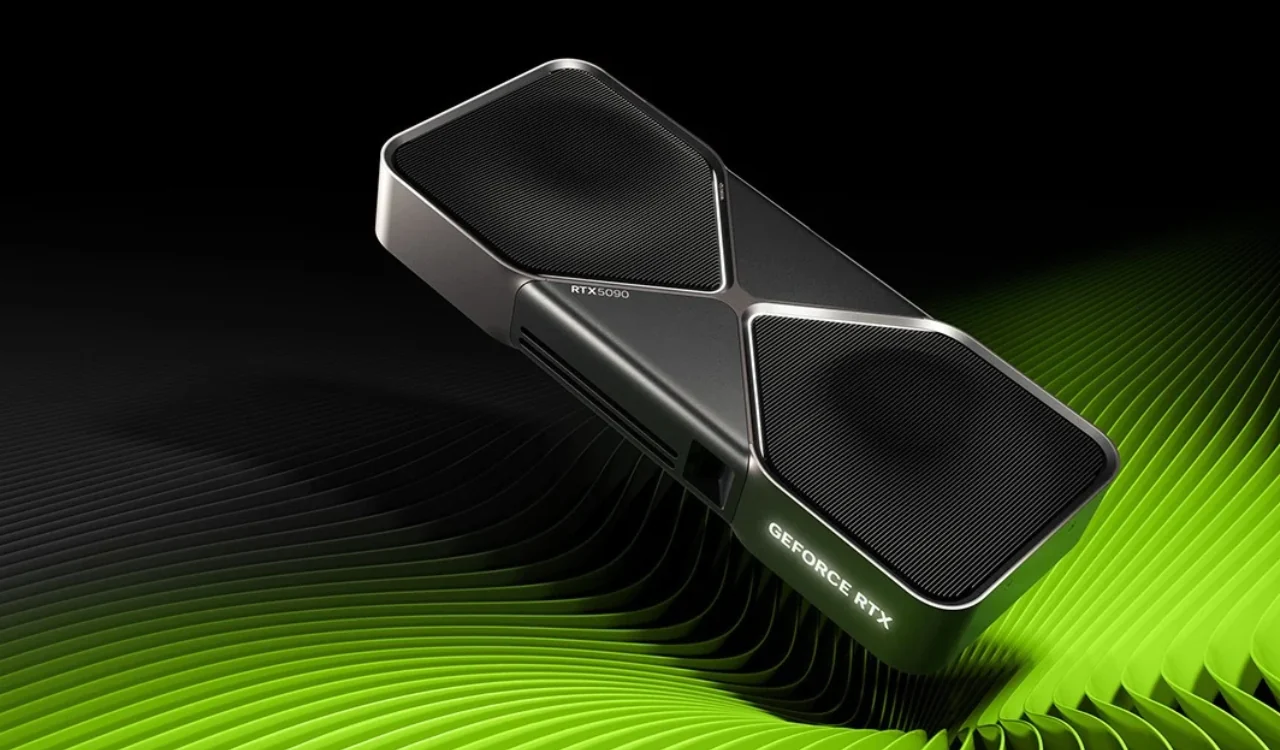
Nvidia DGX B300 packs eight B300 GPUs and 2.3 TB HBM3e in 10 RU
The DGX B300 user guide lists eight B300 GPUs, 2.3 TB of HBM3e, 144 PFLOPS FP4 inference, and a 14.5 kW power draw in a 10-rack-unit chassis.
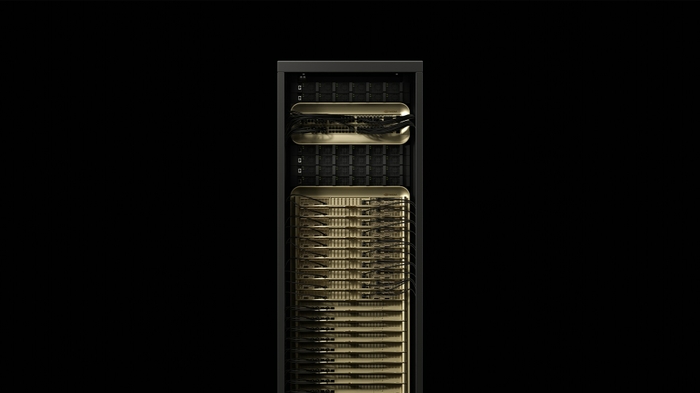
| DGX B300 | |
|---|---|
| GPUs | 8 x B300 Blackwell Ultra |
| GPU memory | 8 x 288 GB = 2.3 TB HBM3e |
| FP4 inference | 144 PFLOPS |
| FP8 training | 72 PFLOPS |
| Power | 14.5 kW |
| Rack units | 10 RU |
| System weight (PSU) | 168 kg |
| CPUs | 2 x Xeon Platinum 6776P |
The NVIDIA newsroom release of March 18, 2025, introduces the Blackwell Ultra platform around two configurations: the GB300 NVL72 rack-scale solution and the HGX B300 NVL16 GPU board. The DGX B300, documented in the user guide at docs.nvidia.com, is the complete system that wraps eight B300 Tensor Core GPUs in a 10-rack-unit chassis, and no price appears on that page. The vendor's designation for the system is simply "DGX B300," and the configuration it describes is the one an operator would rack in a data center.
The DGX B300 is the configuration that fits in a standard rack slot: eight B300 GPUs, 2.3 TB of HBM3e, two Xeon Platinum 6776P CPUs, 2 TB of system RAM expandable to 4 TB with 128 GB DIMMs, and a 14.5 kW power draw. The headline number in the press release belongs to the GB300 NVL72, which scales the same B300 silicon to 72 GPUs and 36 Arm Neoverse-based Grace CPUs in a rack-scale design. The DGX B300 is what an operator racks in a single 10 RU slot; the NVL72 is what fills an entire rack. The press release claims the NVL72 delivers 1.5x more AI performance than the GB200 NVL72, a figure that describes the rack, not the single node.
The user guide states 144 PFLOPS FP4 inference and 72 PFLOPS FP8 training for the eight-GPU system. It does not say whether the FP4 figure is dense or includes sparsity, and it does not break the number down per GPU. The wire headline carries "15 PFLOPS dense FP4" per GPU, a figure that does not appear in the user guide. Dividing 144 by eight yields 18, not 15, so the per-GPU number in the wire and the system-level number in the spec sheet do not reconcile without knowing which precision mode each one describes. The 72 PFLOPS FP8 training figure is likewise a system-level peak, and the guide does not state whether it assumes a specific clock speed or a specific model shape.
Tom's Hardware leads with the per-GPU dense FP4 figure and the 288 GB HBM3e count, both consistent with the user guide's per-GPU memory figure. What the wire collapses is the distinction between the DGX B300 system and the GB300 NVL72 rack. The 1.5x performance claim in the press release refers to the NVL72 rack versus the GB200 NVL72, not to the DGX B300 versus any prior DGX system. A reader who applies the 1.5x figure to the single-node DGX B300 is reading a rack-scale claim into a single-node spec. The wire also omits the 14.5 kW power draw and the 10 RU footprint, both of which are the constraints that matter to a data-center operator.
The chassis draws 14.5 kW through twelve 3.2 kW power supplies, each fed from a 200 to 240 VAC inlet at up to 16 A per outlet. Heat output is 49,476 BTUs per hour, and the system needs 1,500 CFM of airflow at 70 percent fan speed in the AC/PDU configuration. The unit weighs 168 kg without packaging and 207.6 kg in the box. Inlet air must stay between 10 and 35 degrees Celsius. A DC/busbar version is available, drawing from a 54 VDC busbar at up to 300 A per outlet, with a lower system weight of 123 kg and 1,350 CFM of airflow.
ConnectX-8 SuperNICs connect directly to the GPUs over PCIe Gen6, a change from prior DGX generations where the NICs sat on the motherboard. Eight OSFP ports carry 800 Gb/s InfiniBand or Ethernet to the cluster network; two BlueField-3 DPUs handle storage and management at 400 Gb/s. The NVLink interconnect is fifth-generation, with two NVSwitch units bridging the eight GPUs, but the user guide does not state the per-link or total NVLink bandwidth. The press release cites 800 Gb/s data throughput per GPU via the ConnectX-8 SuperNIC, which is the external network path, not the intra-node NVLink path.

Cache storage moved from U.2 to E1.S form factor: eight 3.84 TB self-encrypting NVMe drives. Boot storage is two 1.92 TB M.2 drives, software-encryptable. A new replaceable DC-SCM module houses the BMC, and the motherboard and GPU trays ride on sliding rails for service access. The system runs DGX OS 7 on Ubuntu 24.04 LTS, with support for RHEL 8 and 9 and Rocky Linux. All I/O connectivity moved to the front of the chassis, and the power supplies are front-loaded with rear power connections.
The buyer of a DGX B300 is constrained by the 14.5 kW power envelope and the 10 RU footprint, which rules out racks sized for the 12 RU DGX H100. The 2.3 TB of HBM3e is enough to hold a 70-billion-parameter model in FP8 with room for KV cache, but the document does not state the HBM3e bandwidth per GPU, so a buyer cannot calculate the memory-bound ceiling for a given batch size. What the spec sheet does not prove is whether the 144 PFLOPS FP4 figure is sustainable at the 14.5 kW system draw or whether it assumes a per-GPU TDP that the DGX B300 cooling cannot hold. The per-GPU TDP is not in the document, and the 49,476 BTU/hr heat figure is a system-level number that does not isolate the GPU contribution from the CPUs, the NVSwitches, and the NICs.
No document in the packet states the per-GPU dense FP4 FLOPS, the HBM3e bandwidth in terabytes per second, the per-GPU TDP in watts, the NVLink bandwidth per link, the price of the DGX B300, or the expected shipping date. The 144 PFLOPS figure is a spec-sheet peak, not a measured throughput, and the user guide contains no benchmark, no workload, and no clock speed that would let a reader verify it. The next measurement that matters is a sustained-inference number at the 14.5 kW draw, and that number is not in the packet.
The 14.5 kW envelope and the missing per-GPU TDP mean a buyer cannot confirm whether the 144 PFLOPS FP4 peak is thermally sustainable inside the DGX B300 chassis. The document proves the silicon is in the box; it does not prove the box can hold the silicon at peak draw.
The per-GPU dense FP4 FLOPS, HBM3e bandwidth, per-GPU TDP, NVLink bandwidth, price, and shipping date are absent from every document in the packet.
The DGX B300 spec sheet gives a system-level FP4 peak of 144 PFLOPS and a system-level power draw of 14.5 kW, but it omits per-GPU TDP, HBM3e bandwidth, and NVLink bandwidth. Without those three numbers, a data-center engineer cannot model the thermal headroom or the memory-bound ceiling for a target batch size. The 10 RU footprint and 14.5 kW draw are the binding constraints for rack planning; the 144 PFLOPS figure is the marketing number until a sustained-throughput measurement appears.
After docs.nvidia.com. We did not report this. The pictures, if any, are theirs.