Medusa Point 2/3 6-core and 8-core samples share one die model
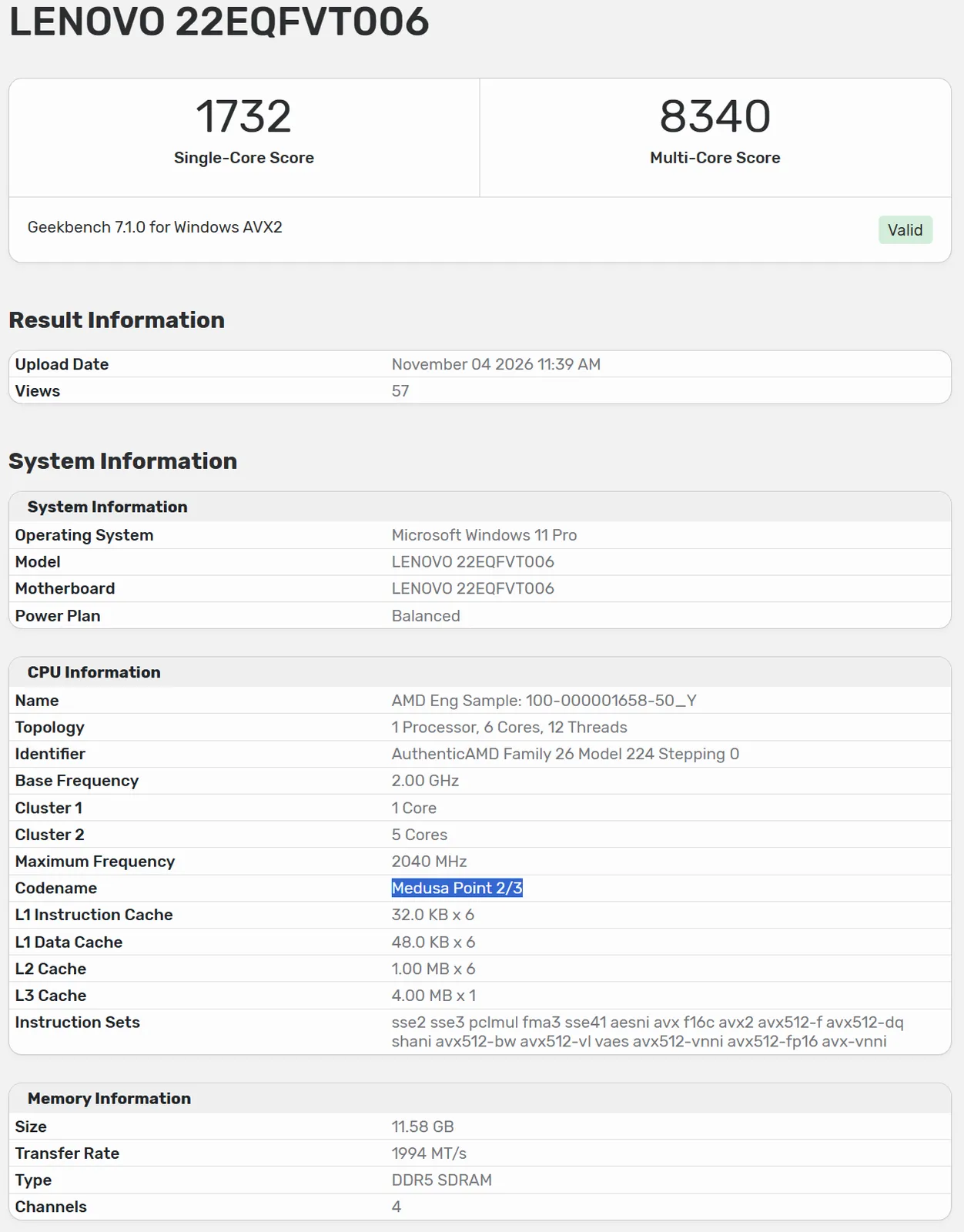
Two Medusa Point 2/3 engineering samples, an 8-core and a 6-core, both report CPU model E0h and were tested on Lenovo systems in Geekbench 7.
| Medusa Point 1 | Medusa Point 2/3 (8C) | Medusa Point 2/3 (6C) | |
|---|---|---|---|
| CPU cores | 10 | 8 | 6 |
| Threads | 20 | 16 | 12 |
| Clusters | 4+6 | 2+6 | 1+5 |
| L2 cache | 10 MB | 8 MB | 6 MB |
| L3 cache | 16 MB | 8 MB | 4 MB |
| CPU model (hex) | 81h | E0h | E0h |
| Geekbench 7 single-core | 3,100 | 2,889 | 1,732 |
| Geekbench 7 multi-core | 18,313 | 15,099 | 8,340 |
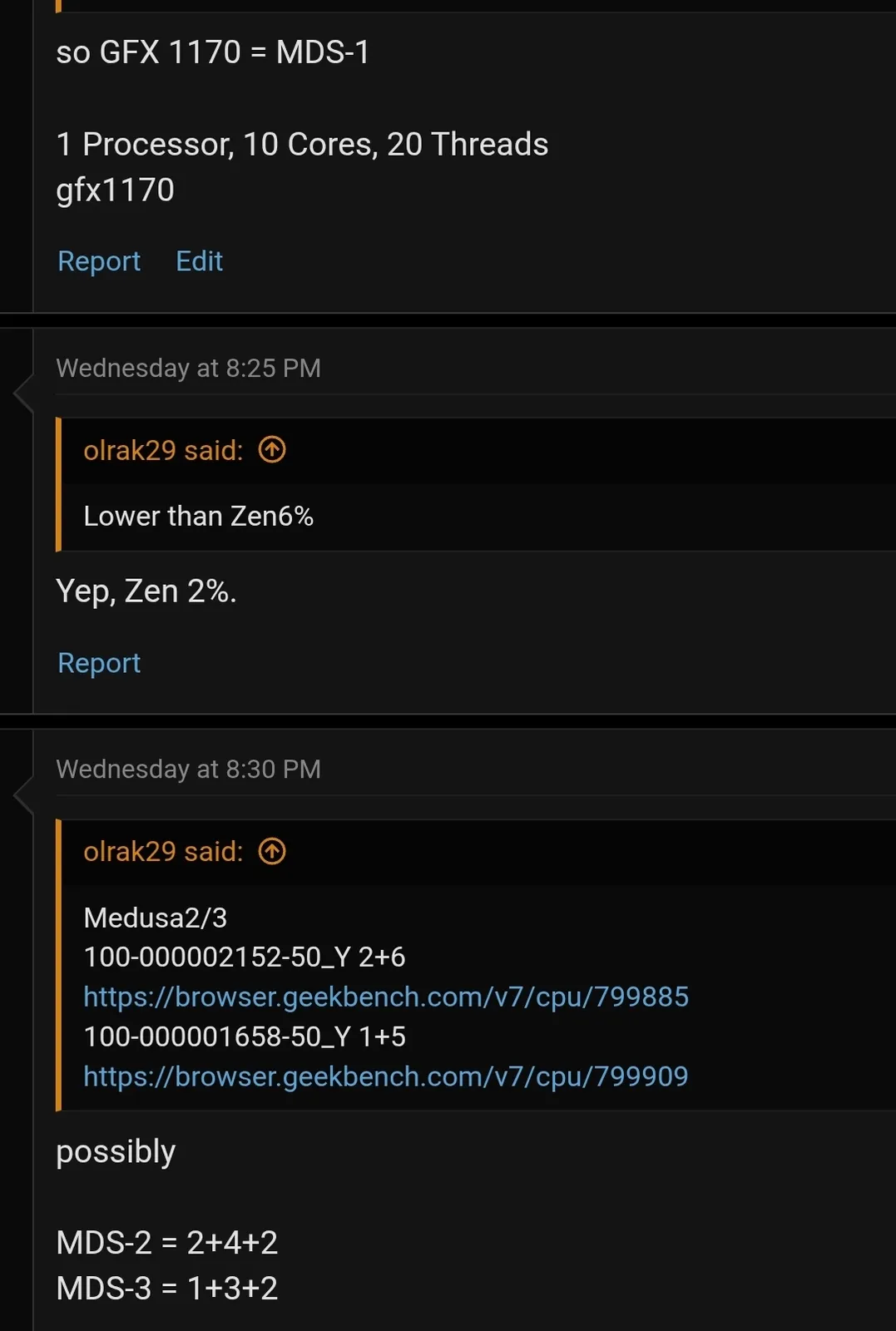
The 8-core sample 100-000002152-50_Y lists 16 threads in a 2+6 cluster split with 8 MB of L3, and the 6-core sibling 100-000001658-50_Y lists 12 threads in a 1+5 split with 4 MB of L3. Both carry Family 26 Model 224 Stepping 0 and CPU model E0h, while the 10-core Medusa Point 1 uses model 81h with 16 MB of L3. The VideoCardz table places all three on Lenovo systems.
The shared E0h identifier means the 6-core and 8-core are configurations of one die, not two. That constrains the fab: AMD trims cores from a single Medusa Point 2/3 mask rather than spinning a second. Cluster topology is contested. VideoCardz reads 2+6 and 1+5; Mareeswj reads 2+4+2 and 1+3+1. The 1+3+1 sum is five, not six, so that reading fails on arithmetic. The 2+4+2 sum is eight and works, but it implies three clusters where VideoCardz sees two. Until a production SKU ships, the L3 sharing topology is undetermined. Frequency on the same 8-core SKU runs from 2.17 GHz to 5.28 GHz across two Geekbench runs. No number in this table is a production clock.
TDP, memory type, channel count, die size, process node, and per-core L1/L2 breakdown are absent from every document in this set. The production cluster layout and final stepping are not confirmed.
The shared E0h model identifier means the 6-core and 8-core are die configurations, not separate masks, which constrains AMD to yield-trimming on one Medusa Point 2/3 die. The contested cluster topology (2+6 versus 2+4+2) determines L3 sharing, and no production clock or TDP exists in this set.
TDP, memory type, channel count, die size, process node, per-core L1/L2 breakdown, production cluster layout, and final stepping are absent from every document in this set.
E0h unifies the 6-core and 8-core under one Medusa Point 2/3 die. The 2+4+2 reading implies three clusters and a different L3 partition than the 2+6 reading. Frequency spread of 2.17–5.28 GHz on the same SKU confirms engineering silicon. No TDP, memory config, or production stepping is documented.
After x.com. We did not report this. The pictures, if any, are theirs.