Nvidia opens Flora robotics labeling suite
Nvidia's Flora suite labels 200,000 hours of data per day on 512 GB300s and is roughly 125 times cheaper than GPT-6 Astra.
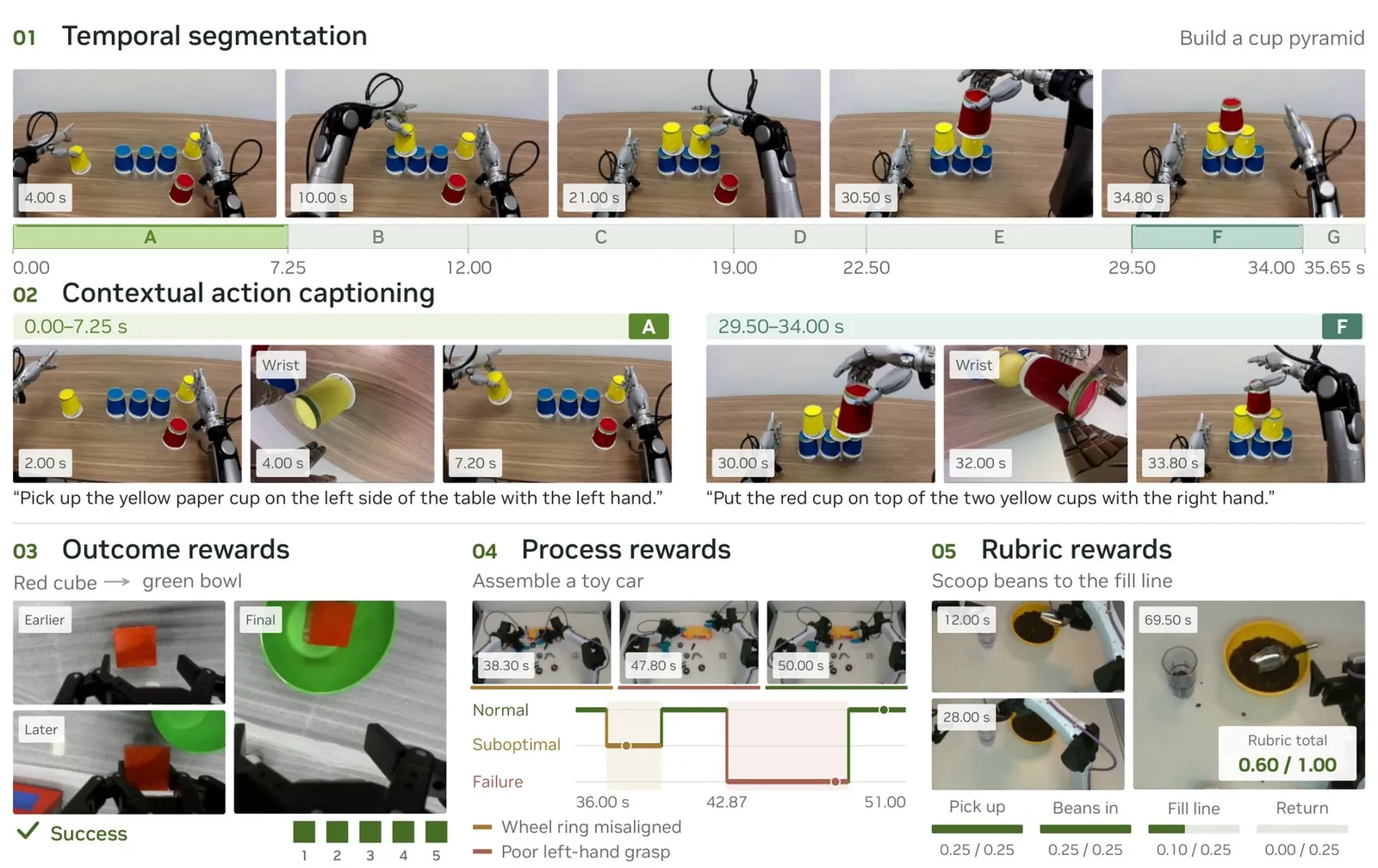
| Flora | GPT-6 Astra | Claude Opus 5 | |
|---|---|---|---|
| WGO-Bench Gold-window accuracy | 64.7 | 77.4 | 50.6 |
| WGO-Bench Joint semantic [email protected] | 34.5 | 39.0 | 16.7 |
| RoboReward MAE | 40.0 | 55.4 | 68.2 |
| Robometer OOD Kendall | 72.0 | 82.3 | 63.5 |
| DenseCaptionBench Human100 subset Segmentation F | 54.6 | 44.2 | 21.1 |
| DenseCaptionBench Robot200 subset Segmentation F | 66.9 | 71.9 | 41.2 |
| DenseRewardBench Macro F1 | 46.2 | 40.7 | 31.2 |
| RubricBench Pooled L1 error | 6.5 | 3.6 | 15.6 |
Flora labels 200,000 hours of data per day across 512 GB300s. That number does not prove a measured cost per video hour, an energy draw, or a license that lets a buyer reproduce the run. The GEAR page pairs the scale claim with a roughly 125x price gap against GPT-6 Astra, but the gap is a vendor comparison, not a production invoice.
API label buyers are the constrained side. If a robotics lab can rent or own GB300s, the open suite shifts spend from per-token pricing to GPU-hours and gives it outcome, process, and caption labels in one pipeline. Benchmark rows still leave Astra ahead on WGO-Bench Gold-window accuracy and joint semantic [email protected], so the suite is not a blanket quality win.
No production cost, energy draw, license terms, cumulative hours, or overall WGO-Bench score appears in the document yet.
The 200,000-hour figure proves a large internal labeling pipeline, not a buyer-ready price. It changes the cost model for labs that can run GB300s, while leaving API-dependent teams exposed to per-token pricing.
The document leaves out measured production cost, energy draw, license terms, cumulative hours, and an overall WGO-Bench score.
Flora turns label generation into a GPU-hour workload on 512 GB300s, so the economic constraint moves from API tokens to cluster availability. The benchmark table still shows Astra ahead on WGO-Bench Gold-window accuracy and joint semantic [email protected], so quality is not uniform.
After research.nvidia.com. We did not report this. The pictures, if any, are theirs.