ASUS ProArt P14 H7407: RTX Spark, 128 GB ceiling, no price
The ProArt P14 H7407 pairs a Blackwell GPU with a Grace CPU under 128 GB of unified memory, and the ASUS Canada page lists no price for it.
| ProArt P14 (H7407) | |
|---|---|
| Model | H7407 |
| Thickness | 13.9 mm |
| Weight | 1.48 kg |
| Memory | up to 128 GB unified |
| GPU | up to 6,144 CUDA cores (Blackwell) |
| CPU | up to 20 cores (Grace) |
| Battery | up to 90 Wh |
| AI performance | up to 1 petaflop FP4 |
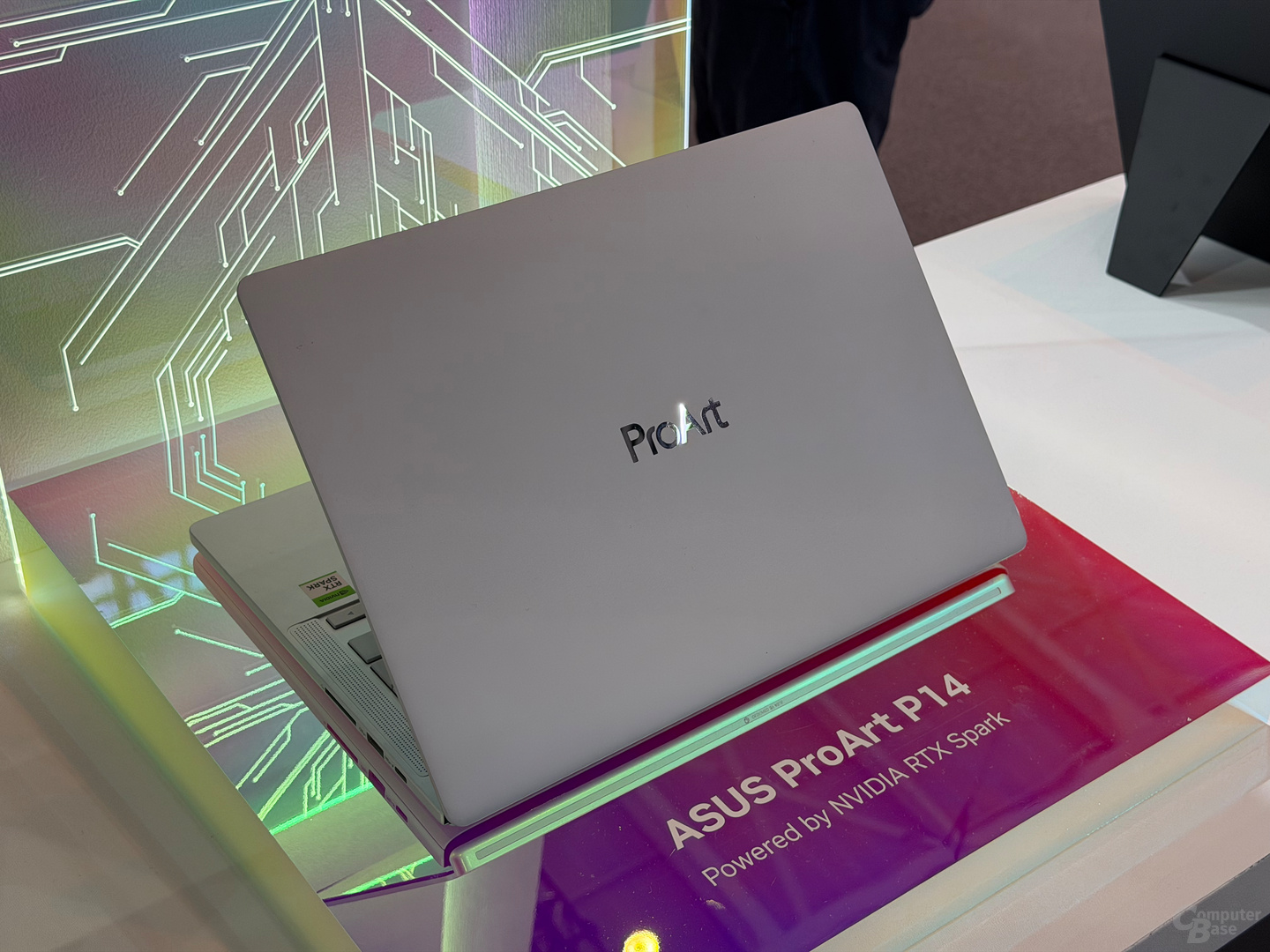
The ProArt P14 carries the vendor number H7407, and the ASUS Canada product page lists no price for it. The page at asus.com/ca-en/laptops/for-creators/proart/proart-p14-h7407/ states the configuration as "up to 128 GB unified memory" and "up to 1 petaflop of FP4 AI performance," but the price field is empty. That absence is the first thing a buyer encounters, and it is not a typo. The page simply does not carry a number, and the TechPowerUp wire that announced the global launch on October 7, 2026, does not supply one either. The wire is a press release filing, and it inherits the same gap.
The RTX Spark superchip is the mechanism that defines this machine. It pairs an NVIDIA Blackwell RTX GPU with up to 6,144 CUDA cores against an NVIDIA Grace CPU with up to 20 cores, joined by NVLink-C2C interconnect and fifth-generation Tensor Cores that support FP4. The 1 petaflop figure is a theoretical peak stated in FP4, and the Tensor Core generation implies sparsity is part of the calculation. The document does not separate a sustained throughput from the peak, and it does not state whether the 1 petaflop figure assumes sparsity or dense operation. That distinction matters for anyone modeling cost-per-token on this hardware, because the gap between dense and sparse FP4 throughput on fifth-generation Tensor Cores is not trivial. The NVLink-C2C interconnect is the path between the Grace CPU and the Blackwell GPU, and it is what makes the unified memory pool physically possible rather than merely architectural.
The memory configuration is the stretch that separates the headline from the purchase. The "up to 128 GB" figure describes the maximum configuration the page advertises. The base configuration the starting price would buy is not stated anywhere in the packet. The unified memory lets CPU and GPU workloads share one pool, and the page says this supports LLMs with up to 120 billion parameters and a 1-million-token context window. Those are the numbers that sell the machine. The configuration a buyer actually receives at the lowest price tier is not named, and the page does not list a second memory tier. The 120-billion-parameter claim assumes the full 128 GB is available to the model, which means the base configuration, if it carries less, cannot run that model at full precision. A buyer who needs to run a 70-billion-parameter model with a long context will need to know the actual memory tier before committing.
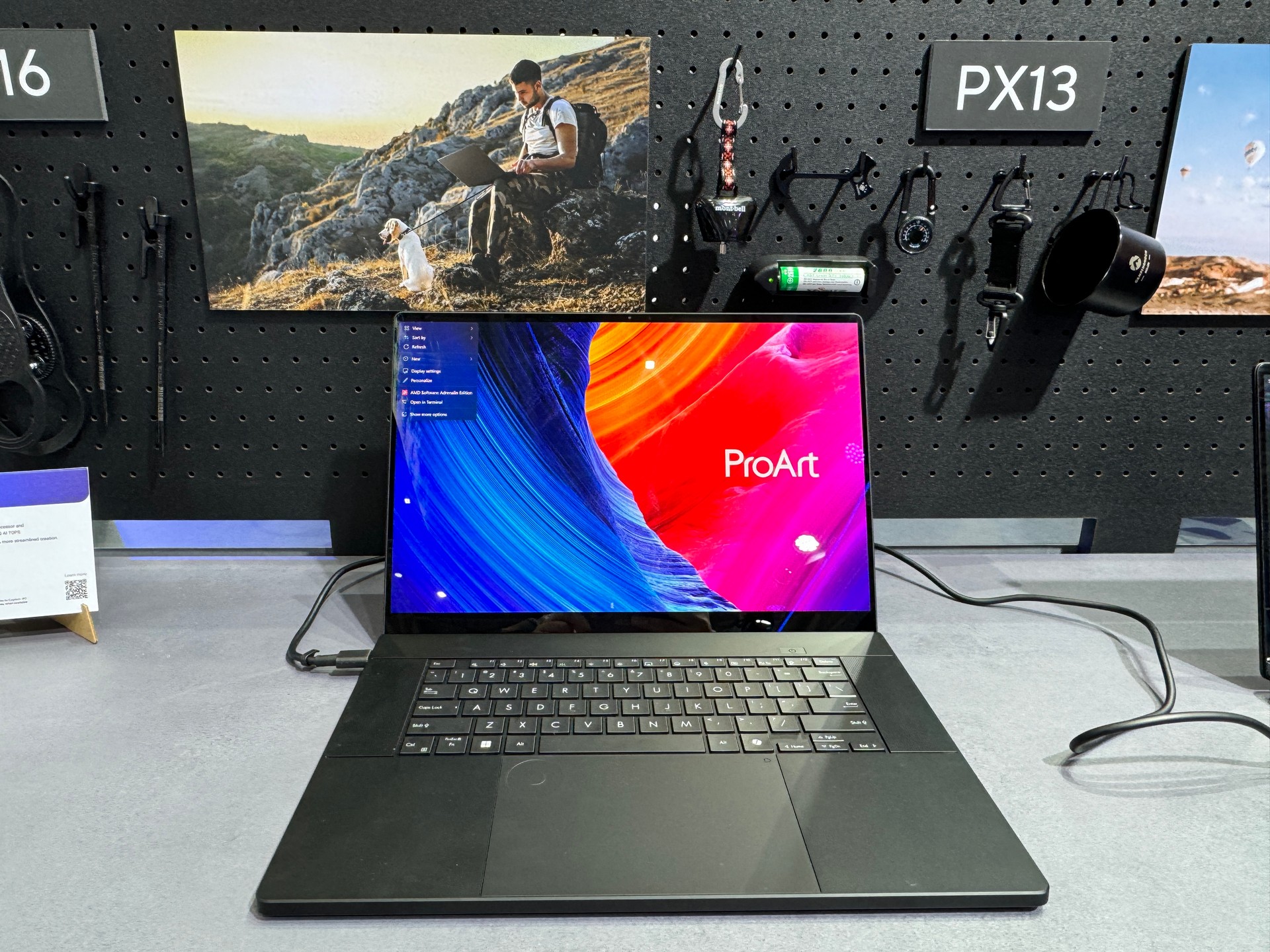
The chassis is 13.9 mm thin and 1.48 kg, which the page calls the lightest ProArt laptop ever. The display is a 3K OLED panel from the ASUS Lumina Pro line, though the page cuts off before stating a Delta E value or a refresh rate. The two color options are Nano Black and Neo White, and the page describes a "specialized sandblasting process" for the Neo White finish. The operating system is Windows 11 Home. The page claims the machine is optimized for agentic AI locally, and it names 1,000+ accelerated apps, tools, and games as the CUDA ecosystem target. The page also references ASUS-exclusive StoryCube and MuseTree as part of the local AI workflow, but it does not describe what those tools do or what they require in terms of memory or compute.
The ProArt P16, the 16-inch sibling, is 12.9 mm and 1.77 kg with a 99.9 Wh battery and a 4K panel, but that is a different machine and gets its own filing.
The TechPowerUp wire from October 7, 2026, collapsed all three machines into a single announcement paragraph and attributed the 128 GB and 1 petaflop figures to the family rather than to each individual SKU. The wire does not state which configuration the P14 ships in by default, and it does not separate the P14's 90 Wh battery from the P16's 99.9 Wh. A reader of the wire alone cannot tell which battery belongs to which laptop, and the wire's use of "up to" across all three machines obscures the fact that the P14 and P16 carry different battery capacities. The wire also quotes two external CEOs, Dillon Rolnick of Nous Research and Yoland Yan of Comfy, but neither quote contains a number that the ASUS page does not already state. The quotes serve as social proof, not as specification.
The desk's judgment: the buyer is constrained by the absence of a price, a memory bandwidth figure, and an exact GPU model name. The document says "NVIDIA Blackwell RTX GPU" but does not name the specific die. It says "NVIDIA Grace CPU" but does not fix the core count as a specification, only "up to 20 cores." The 128 GB figure is a ceiling, not a floor. A buyer who needs to know whether the base configuration carries 64 GB or 128 GB cannot answer that question from this document. The fab question is equally open: the page does not state the process node for either the Grace CPU or the Blackwell GPU, and the NVLink-C2C interconnect is named but not banded. The Arm-based design is mentioned in passing on the P16 page, which implies the Grace CPU is Arm, but the P14 page does not repeat that statement. What the buyer can know is that the machine is a Windows 11 Home device with a unified memory architecture, a Blackwell GPU, and a Grace CPU, and that the 128 GB ceiling is the maximum the page will commit to. The buyer cannot know the price, the bandwidth, or the thermal envelope, and those three gaps are the ones that determine whether this machine is a tool or a toy.
What the document left out: no price, no memory bandwidth, no exact GPU or CPU model designation, no display refresh rate, no Delta E measurement, no process node, no thermal envelope, no sustained power draw, and no benchmark. The 1 petaflop figure is a peak, not a measurement. The 128 GB number marks the top of the range, not a fixed spec. The buyer still cannot know what the machine costs, what it draws under load, or what the base memory tier is.
The buyer is constrained by three gaps the page will not close: no price, no memory bandwidth, and no exact GPU die name. The 128 GB figure is a ceiling and the 1 petaflop figure is a peak, so the machine's actual cost-per-token and thermal behavior remain unmeasured.
No price, no memory bandwidth, no exact GPU or CPU model name, no process node, no thermal envelope, no sustained power draw, and no benchmark appear in any document in the packet.
The H7407 pairs a Blackwell GPU (up to 6,144 CUDA cores) with a Grace CPU (up to 20 cores) over NVLink-C2C, with up to 128 GB unified memory. The 1 petaflop FP4 peak is theoretical and the memory tier is not fixed. Without bandwidth, process node, or price, the buyer cannot model TCO or thermal headroom.
After bsky.app. We did not report this. The pictures, if any, are theirs. Also filed by TechPowerUp, ComputerBase.