Surface Laptop Ultra and the gap between $2,599 and 128 GB
Surface Laptop Ultra opens at $2,599 with a Blackwell GPU, Grace CPU, and up to 128 GB unified memory, but the base configuration is unspecified.

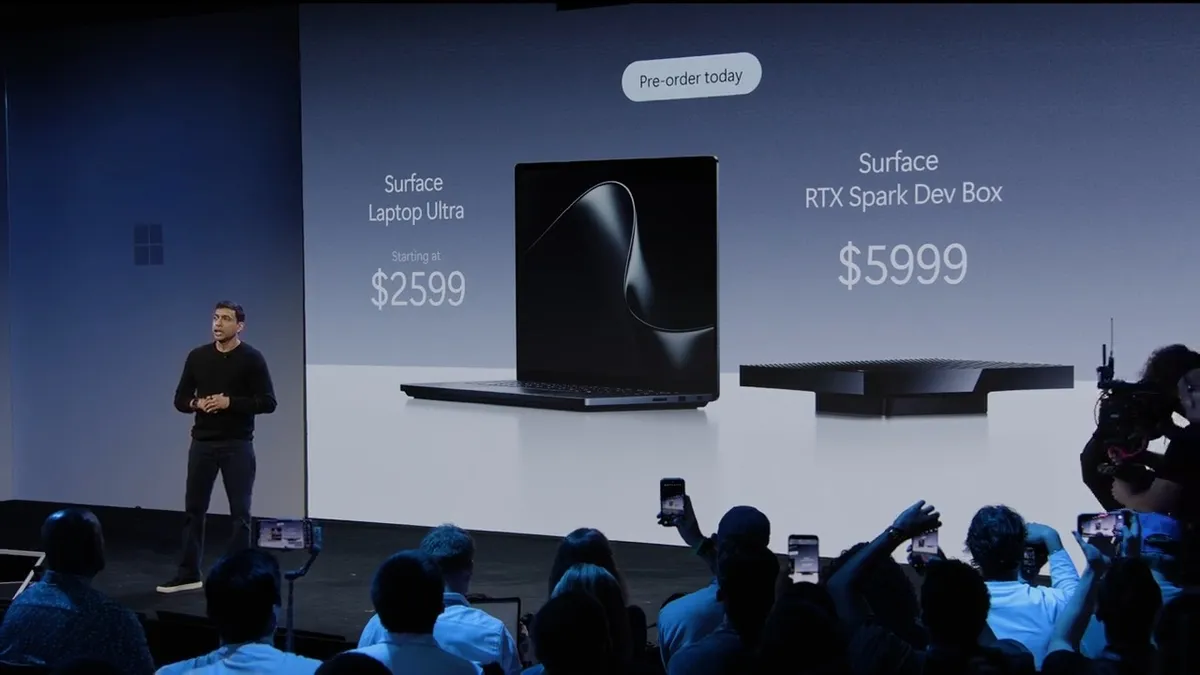
The Surface Laptop Ultra opens for pre-order at $2,599 MSRP on the Microsoft Devices Blog, a vendor filing by Brett Ostrum, Corporate Vice President of Surface, published October 7, 2026. The page is the only document in this packet that carries a price, a date, and a configuration range for the machine. The secondary page, microsoft.com/en-us/surface, lists the device under "All-new" but provides no additional specification beyond what the blog post already states.
The headline configuration pairs a Blackwell RTX GPU with up to 6,144 cores against a Grace CPU with up to 20 cores, all sharing a unified memory pool of up to 128 GB. The 1 petaflop figure printed beside those numbers is a theoretical FP4 peak that assumes the sparsity feature is active. Footnote 2 on the page says so in one line: "Based on theoretical FP4 performance of 1 petaflop using the sparsity feature." That is not a measured throughput. It is the ceiling the silicon can claim under idealized conditions, and the document does not provide a dense FP4 number or a measured sustained figure. The 120B-parameter model claim sits in the same paragraph as the petaflop number, which implies the sparsity assumption carries through to the model-size claim, but the page does not state that explicitly.
The $2,599 entry point does not come with a published core count, memory size, or GPU configuration. Footnote 1 reads "Memory varies by configuration," and that is the extent of the disclosure. The buyer at the starting price is told what the top of the range looks like and is left to infer the gap. The document does not say whether the base unit ships with a reduced Blackwell die, a lower memory ceiling, or a trimmed Grace core count. The stretch between the entry configuration and the headline configuration is the entire story of what this machine costs, and the vendor has not drawn that line. A buyer who needs 128 GB of unified memory to run a 120B-parameter model locally is not told whether that memory is available at $2,599 or at a tier the page does not name.

Thermal design is where the chassis earns its 18-millimeter thickness. Microsoft claims 2.5 times the thermal power capacity of the current Surface Laptop line, which is a relative number against a product the page does not name by model. Under 4.5 pounds, the machine is meant to sustain load without the fan curve of a desktop replacement. The claim is architectural, not a watt figure. No sustained TDP, no thermal throttle threshold, no fan RPM curve appears anywhere on the page. The 2.5x figure is a ratio against an unnamed baseline, and the baseline's own thermal capacity is not stated. The buyer cannot verify the claim without a watt figure or a sustained-load test.
The 15-inch PixelSense Ultra display hits 2,000 nits peak HDR, measured over a 10 percent window with HDR content. Microsoft compares that to the MacBook Pro M5 and says the Surface number is 25 percent higher. Sustained and SDR brightness are lower, per the footnote. The touchpad is 30 percent larger than the Surface Laptop 8th Edition, with haptic feedback. The display is touch-only; pen input is not supported, which is a departure from the Surface line's history and a signal that the target user is a creator who works with a mouse or a trackpad, not a stylus.
The port selection is the most complete Microsoft has put on a Surface laptop. Magnetic Connect, a built-in magnetic USB-C charging port on the right side, is new to the category. Two additional USB-C ports, HDMI, USB-A, an SD card reader, and a 3.5 mm jack round out the panel. The machine can drive up to three 4K external displays. Storage is user-removable, which Microsoft positions as a serviceability feature. The colors are Platinum and Nightfall, available on selected models only, per footnote 10. The magnetic charging cable is included and attaches to the right-side USB-C port, which remains fully functional for video, data, and other USB-C devices.

The platform is Windows on Arm, and the page leans on that for the CUDA story. DLSS, ray tracing, and NVIDIA Reflex are listed as available in supported titles. The page does not name which titles, does not provide a frame-rate figure, and does not say whether the Arm translation layer imposes a penalty on the CUDA path. The 120B-parameter figure is a local inference claim, not a training figure, and the page does not specify which model architecture or precision that number assumes beyond the FP4 sparsity footnote. The CUDA ecosystem access is stated as a fact, not a benchmark. GitHub Copilot is mentioned as a use case for local agentic coding, but no latency or token-throughput figure accompanies that claim.
The Surface RTX Spark Dev Box, also built on the RTX Spark Superchip, is available for pre-order at $5,999 exclusively on Microsoft.com in the U.S., shipping in November. It is a desk-bound small form factor, not a laptop, and it carries the same 1 petaflop and 128 GB headline.
The desk's judgment: the buyer at $2,599 is constrained by a document that describes the ceiling but not the floor. The vendor has published the top of the range and the price of the bottom, and the gap between those two numbers is the entire commercial question. What the document does not prove is whether the base configuration can run the 120B-parameter models locally, whether the thermal headroom at the entry tier matches the 2.5x claim, or whether the unified memory pool at the base tier is large enough to hold a working set for the workloads the page describes. The fab question is separate: NVIDIA is supplying the silicon, Microsoft is supplying the chassis and the OS, and the page does not say which party owns the thermal envelope or the power budget. That ownership determines who absorbs the cost when the machine throttles under sustained load.
What is still unmeasured: no sustained AI throughput, no dense FP4 figure, no base-configuration spec sheet, no thermal wattage, no frame-rate data, no model-specific latency, and no comparison against a competing Arm laptop with a discrete GPU. The page is a pre-order filing, not a review, and the numbers it carries are the vendor's own.
No sustained AI throughput, no dense FP4 figure, no base-configuration spec, no thermal wattage, and no frame-rate data appear in the document.
The base configuration is undisclosed. The 1 petaflop figure is a theoretical FP4 peak with sparsity, not a measured throughput. The 2.5x thermal claim is a ratio against an unnamed baseline. The buyer cannot verify whether the entry tier supports the 120B-parameter model claim or the 128 GB memory ceiling.
6,144 GPU cores (Blackwell RTX) · 20 CPU cores (Grace) · 128 GB unified memory · 1 petaflop FP4 (theoretical, with sparsity) · 2,000 nits peak HDR (10% window) · 18 mm thickness, under 4.5 lb
After blogs.windows.com. We did not report this. The pictures, if any, are theirs. Also filed by MacRumors.