TUXEDO nano pro Gen15 ships panther lake with DDR5 SO-DIMM where Intel says LPDDR5X
TUXEDO's Nano Pro Gen15 pairs the Core Ultra X7 358H with 128GB of DDR5 SO-DIMM, a configuration Intel's own spec sheet does not list for that processor.
| TUXEDO Nano Pro Gen15 | |
|---|---|
| CPU | Core Ultra X7 358H (Panther Lake) |
| Cores | 16 (4P + 8E + 4LPE) |
| iGPU | Arc B390, 12 Xe3 cores, 2.5 GHz max |
| Memory | Up to 128GB DDR5 SO-DIMM, 7200 MT/s |
| Dimensions | 110 × 117.5 × 49 mm, ~1 kg |
| Price | From €1,749 (16GB/500GB) |
| Ship date | Mid-November |
TUXEDO lists the Nano Pro Gen15 at €1,749 including 19% VAT, a price that covers 16GB of DDR5, a 500GB SSD, and TUXEDO OS. The figure comes from the TUXEDO Computers launch page, the source VideoCardz cites for the October 31 announcement. Preorders are open in Germany. Shipments begin in mid-November. The price is approximately $1,960 at current exchange.
The processor is the Core Ultra X7 358H, Intel's first Panther Lake part to reach a retail mini-PC through a European vendor. It carries sixteen cores arranged as four Performance, eight Efficient, and four Low Power Efficient. No CPU clock speeds are stated on the page. No TDP figure appears. The processor is the first Panther Lake silicon in a product that a buyer can order today rather than wait for a laptop or a server platform. The 358H designation places it in the H-class, which implies a higher power envelope than the U-class parts that have dominated the mini-PC segment.
The integrated graphics is the Arc B390, built on twelve Xe3 cores with a maximum GPU clock of 2.5 GHz. That 2.5 GHz figure is a specification, not a measurement. No frame rate, no benchmark, no power draw, and no sustained clock accompany it. The Xe3 architecture is new to the consumer desktop in this form factor. The page provides no comparison against the previous-generation Arc iGPU or against a discrete GPU at a comparable price point.
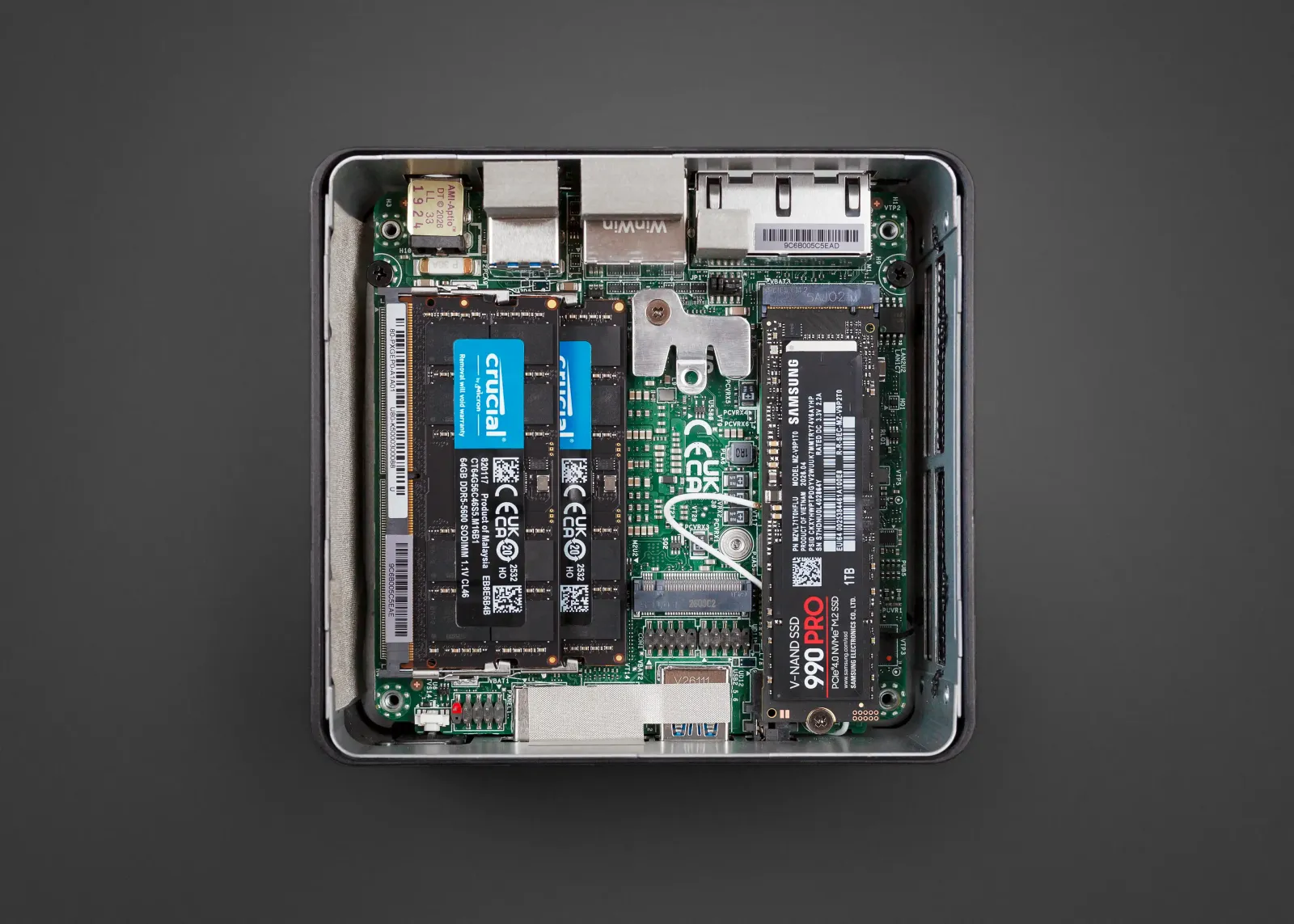
The memory configuration is where the document breaks against Intel's own spec sheet. TUXEDO advertises two DDR5 SO-DIMM slots supporting up to 128GB in dual-channel at speeds up to 7200 MT/s. Intel's published specifications for the Core Ultra X7 358H list only LPDDR5X-9600 support with a maximum capacity of 96GB. TUXEDO has not explained the discrepancy. The buyer is left to assume that the SO-DIMM path works at the advertised speed, or to wait for a clarification that has not appeared on either company's page. The gap between 96GB and 128GB is not a rounding difference; it is a different memory architecture, and the page treats it as a given.
The stretch between the starting configuration and the headline number is not priced on the page. The €1,749 entry buys 16GB and 500GB. The 128GB configuration that gives the product its headline specification is not listed at a separate price point. A buyer who wants the full memory complement must configure through TUXEDO's shop, and the delta between 16GB and 128GB is opaque. The page does not state whether the 128GB configuration changes the price by a fixed amount or by a percentage, and it does not state whether the 128GB configuration requires a different motherboard revision or a different BIOS setting.
The chassis measures 110 by 117.5 by 49 millimetres and weighs approximately one kilogram. Connectivity includes a 40Gbps USB4/Thunderbolt 4 port, a 20Gbps USB-C port, three 10Gbps USB-A ports, dual 2.5GbE Ethernet, and Intel Wi-Fi 7. For a box under one kilogram, the I/O is dense. The dual 2.5GbE ports are notable in a Linux-oriented machine, where network throughput is often the first thing a sysadmin checks. The USB4/Thunderbolt 4 port at 40Gbps is the same interface class found in current MacBook Pro and ThinkPad models, and it is the first time that interface appears in a sub-one-kilogram Linux mini-PC from a European vendor.
Display output supports four simultaneous 4K displays through two HDMI ports and two USB-C connections. Under Linux, TUXEDO specifies HDMI 2.0b operation at 4K 60Hz. Under Windows, the same ports run HDMI 2.1 at up to 4K 120Hz. The Linux limitation is a driver or firmware constraint, not a hardware one, but the page does not say which. A buyer who plans to run the machine headless or with a single display will not notice the difference. A buyer who plans to drive four 4K panels under Linux will be capped at 60Hz per panel, which is a meaningful constraint for video editing or multi-monitor development work.
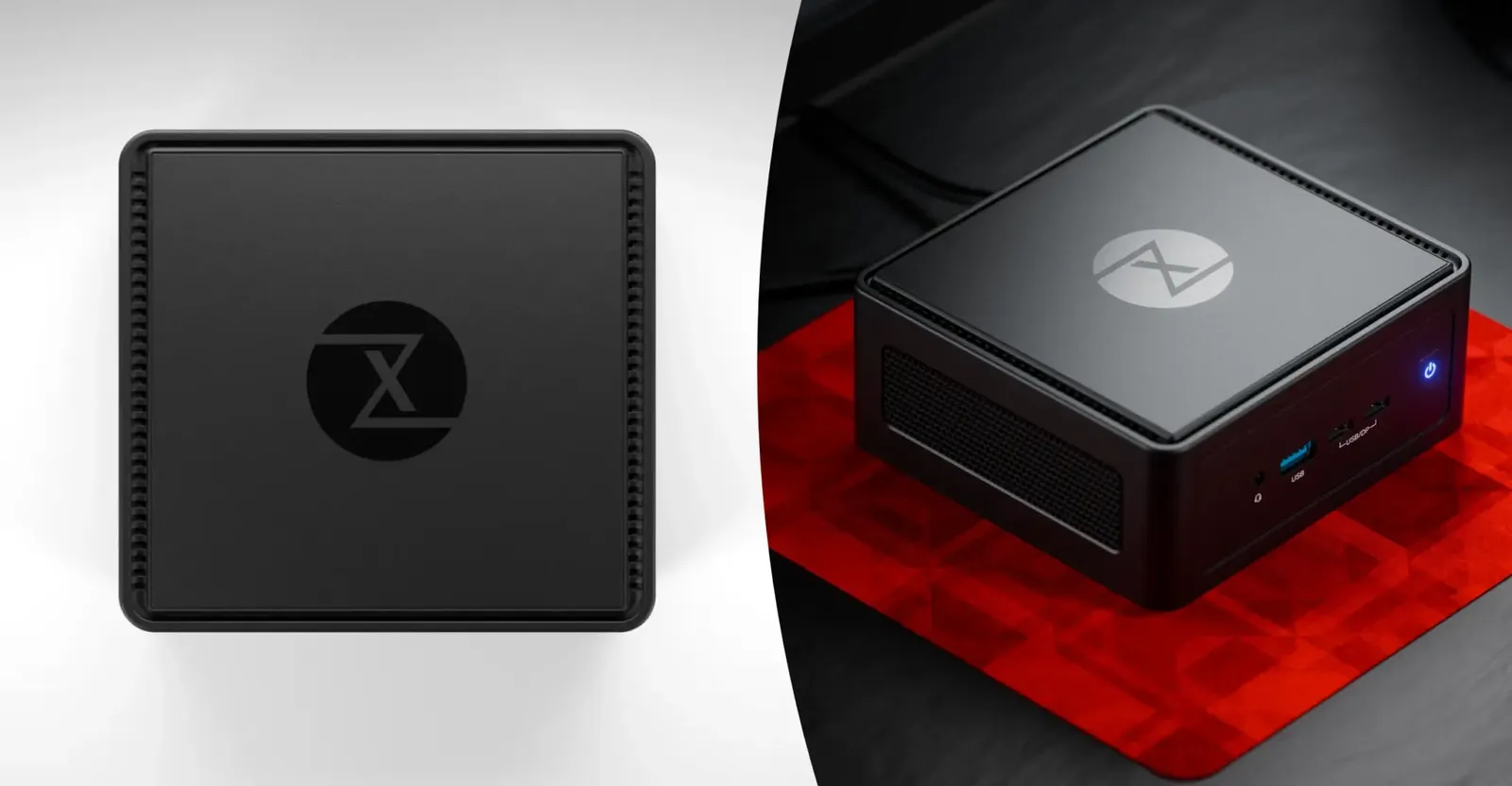
Storage uses two M.2 slots. The first accepts PCIe 5.0 x4 drives in 2242 or 2280 form factors. The second accepts PCIe 4.0 x4 drives in 2242 form factor only. The asymmetry in form factor support between the two slots is a constraint the page states without elaboration. A buyer who wants two 2280 drives will find that only the first slot supports that length. The PCIe 5.0 slot is the primary storage path; the PCIe 4.0 slot is a secondary path for overflow or a secondary OS.
The system ships with TUXEDO OS or Ubuntu, with Windows 11 available as a paid option. TUXEDO's Control Center utility provides fan controls. The software layer is thin: no benchmark, no thermal profile, no sustained-load figure, and no power consumption data appear on the page. The machine is sold as a Linux desktop, and the page treats that as a given rather than a selling point that needs proof.
Another Panther Lake mini-PC announced the same week uses fanless AirJet solid-state cooling and runs below 21 dBA, a different thermal philosophy in a similar chassis class.
The buyer who wants a Linux mini-PC with Panther Lake is constrained by two things the document does not resolve. First, the memory path: TUXEDO is selling DDR5 SO-DIMM on a processor whose official spec sheet lists only LPDDR5X, and no one has published a test that confirms the 128GB configuration actually runs at 7200 MT/s. Second, the Linux display ceiling: 4K 60Hz on HDMI under Linux is a 40% frame-rate reduction compared to the Windows path on the same hardware, and the page does not say whether that is a kernel limitation, a driver limitation, or a firmware limitation that a future update will close. The fab question is separate: Intel's Panther Lake was designed around LPDDR5X, and TUXEDO's SO-DIMM implementation means the memory controller is being exercised in a mode Intel did not publish. Whether that mode is stable at 7200 MT/s is the number the buyer still cannot know.
No thermal data, no sustained-load clock, no power draw, no memory bandwidth measurement, and no display latency figure appear on the page. The 2.5 GHz GPU clock is a ceiling, not a sustained state. The 7200 MT/s memory speed is a specification, not a verified transfer rate. The product ships in mid-November, and the first independent measurements will follow.
The 128GB DDR5 SO-DIMM configuration is not backed by Intel's published spec for the 358H, which lists only LPDDR5X-9600 at 96GB maximum. The buyer is purchasing a memory path that no one has measured.
No thermal data, sustained-load clock, power draw, memory bandwidth, or display latency figure appears on the page.
TUXEDO is exercising the Panther Lake memory controller in a SO-DIMM mode that Intel did not publish. The 7200 MT/s figure and the 128GB capacity are unverified against Intel's LPDDR5X-9600/96GB specification. The Linux HDMI 2.0b ceiling at 4K 60Hz is a 40% frame-rate reduction versus the Windows path on identical hardware, and the cause is not stated.
After videocardz.com. We did not report this. The pictures, if any, are theirs.