Gorgon Halo's Time Spy gain is a 120-watt memory and clock refresh
Cooling sets the ceiling for the Ryzen AI Max+ PRO 495's Time Spy result, where a 120-watt run moved the total from 10.499 to 11.743.
| Ryzen AI Max+ PRO 495 | Ryzen AI Max+ 395 | |
|---|---|---|
| cores/threads | 16/32 | 16/32 |
| clock | 3,1-5,2 GHz | 3,0-5,1 GHz |
| graphics | Radeon 8065S RDNA 3.5, 40 CUs, 3,0 GHz | Radeon 8060S RDNA 3.5, 40 CUs, 2,9 GHz |
| L2+L3 cache | 80 MB | 80 MB |
| TDP | 45–120 W | 45–120 W |
| NPU | 55 TOPS | 50 TOPS |
| tested memory | 192 GB LPDDR5X | 128 GB |
| Time Spy total | 11.743 | 10.499 |
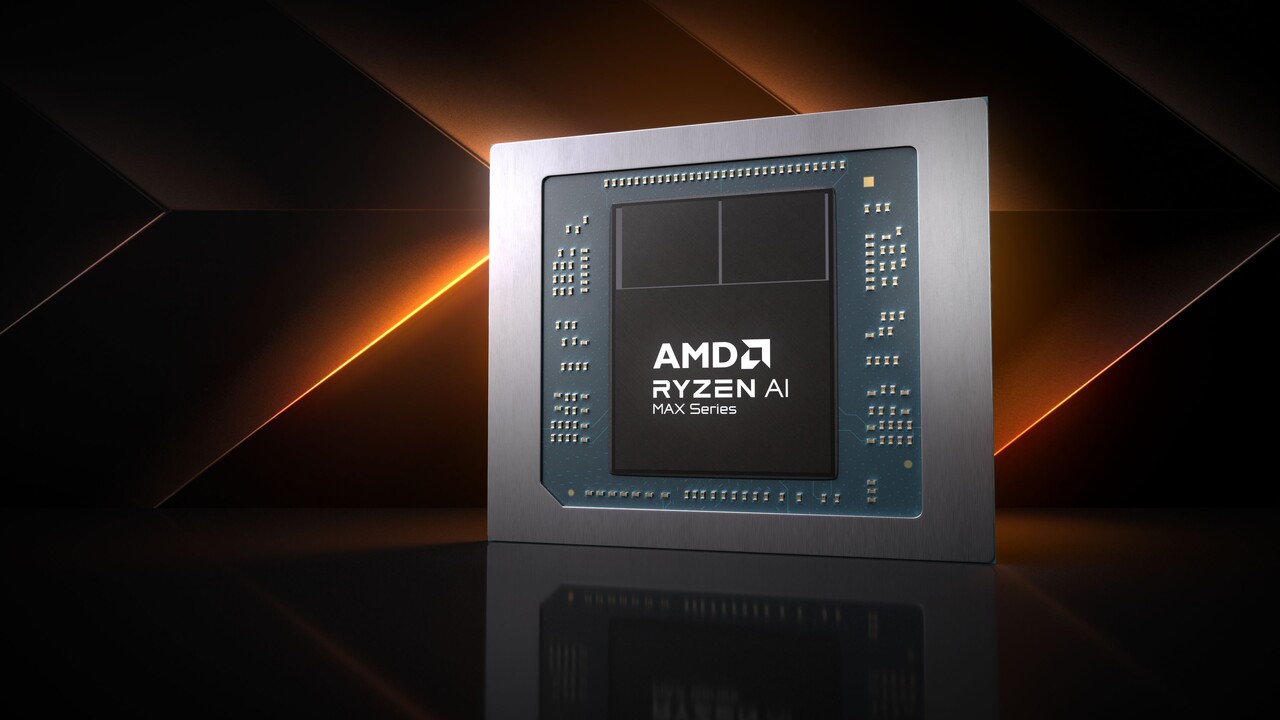
ETA Prime compared GMKtec EVO-X5 Pro and EVO-X2 systems at a 120-watt limit. The Ryzen AI Max+ PRO 495, the Gorgon Halo successor to the Ryzen AI Max+ 395 Strix Halo, scored 11.743 in 3DMark Time Spy against 10.499 for the older part. That is an 11.8 percent gain inside the same power limit, below the rounded 12 percent figure.
The Radeon 8065S keeps 40 compute units, and the CPU keeps 16 Zen-5 cores. The GPU clock rises by 100 MHz. The tested EVO-X5 Pro carries 192 GB of LPDDR5X, while the EVO-X2 carries 128 GB, giving more memory bandwidth and capacity for inference rather than a new raster architecture.
The ComputerBase page does not list process node, launch price, release date, socket, die size, or NPU benchmark performance. It also does not establish that the 11.8 percent Time Spy gain holds under another power limit, another cooling stack, or a board outside GMKtec. An NPU rating is present, but local-model throughput is absent from the table.
The result is a memory and clock refresh rather than a new raster step. Cooling and memory capacity constrain the buyer, and thin systems must hold 120 watts.
Treat the 11.8 percent Time Spy gain as a power-limited, board-specific result, not a general architecture leap.
After computerbase.de. We did not report this. The pictures, if any, are theirs.