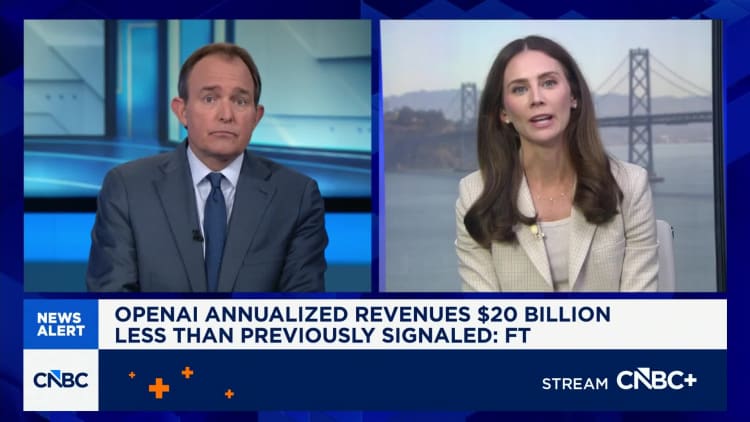
OpenAI revenue gap is an accounting question, not a demand collapse
The market is pricing an accounting gap: OpenAI's roughly $50 billion annualized revenue rate at the end of September sits below the earlier $70 billion figure, while the company negotiates at least $30 billion in new capital.
| OpenAI | |
|---|---|
| annualized revenue | roughly $50 billion |
| earlier reported figure | nearly $70 billion |
| expected end-2026 revenue | at least $70 billion |
| Q3 run-rate growth | 77 percent |
| enterprise run-rate growth | 107 percent |
| new capital target | at least $30 billion |
| pre-money valuation | $1.4 trillion |
| weekly ChatGPT users | 1.2 billion |
The gap between the two revenue lines is an accounting one. The earlier $70 billion figure counted partner sales differently, so it does not prove that gross demand for compute has slowed. Chip stocks moved on the number.
The investor is the constrained party, because the net revenue line no longer matches the gross partner-sales figure. The $50 billion net run rate still supports a $30 billion raise at a $1.4 trillion pre-money target, but it weakens the case that every partner dollar is OpenAI's own. Chip and cloud suppliers now face a market that prices the accounting definition, not just the growth rate.
Spend-side data is missing here. The revenue line is a definition, not a full picture of compute demand, because data-center bills, GPU utilization, and the partner-share split are not present.
Leads with market reaction and accounting gap.
After cnbc.com. We did not report this. The pictures, if any, are theirs.