Apple Watch Series 12 moves heart-rate sensing to continuous five-second cadence
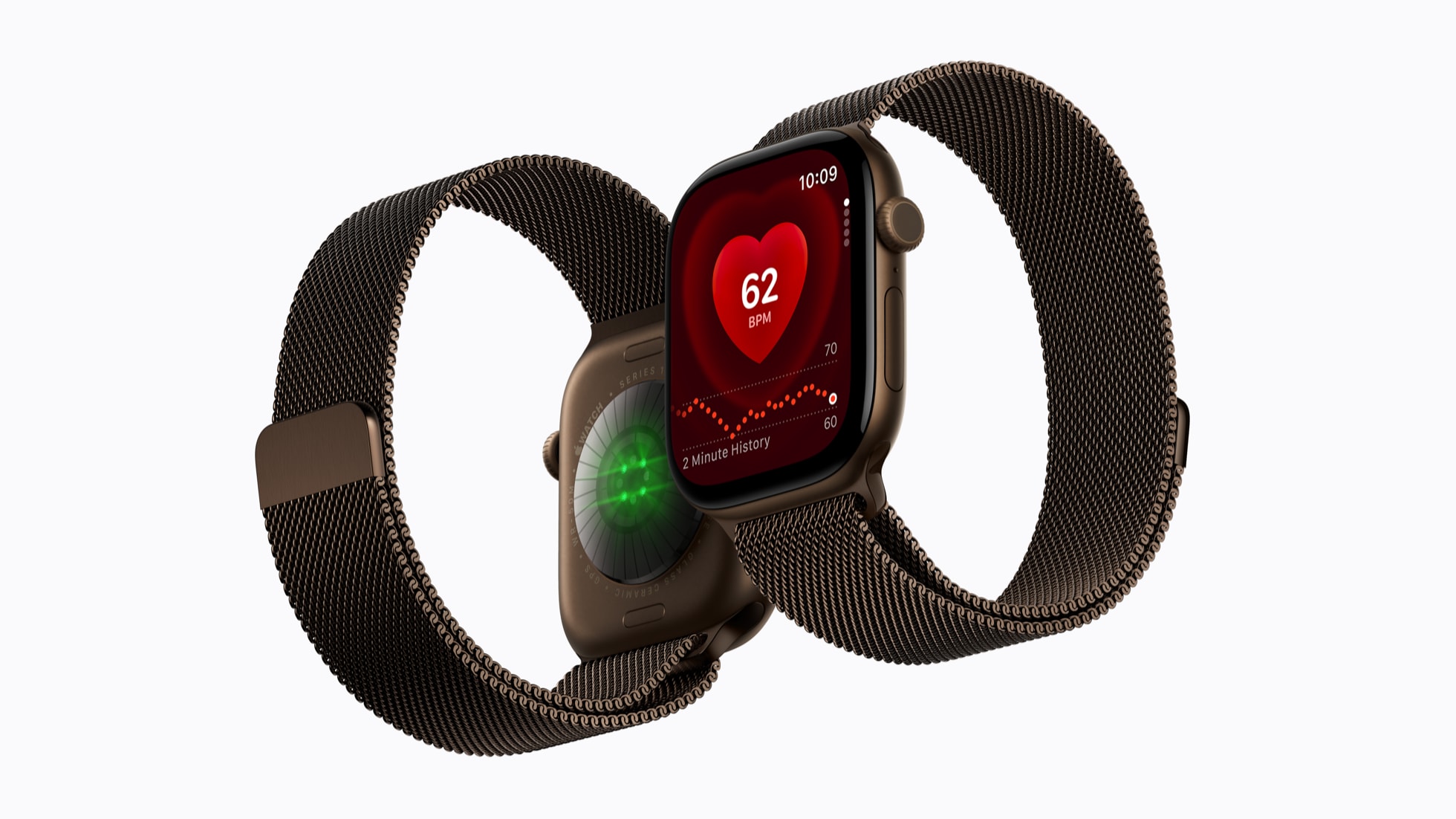
Apple's newsroom page dated September 9, 2026, introduces the S11 chip and a Health Sensing System that samples heart rate every five seconds, all day.
| Apple Watch Series 12 | |
|---|---|
| Heart rate sampling | every five seconds |
| HRV measurement frequency | up to 24× more often |
| Everyday battery life | up to 24 hours |
| Workout battery life | up to 10 hours |
| Quick-charge (15 min) | up to 12 hours |
| Glass toughness vs. Ion-X | 60 percent tougher |
| Availability | September 18, 2026 |
September 9, 2026, is the date stamped on the Apple newsroom page that introduces Apple Watch Series 12. The page names two new components: the S11 chip, called Apple's most powerful wearable silicon, and the Health Sensing System, which pairs new optical and electrical heart sensors. The spec table below carries the figures that page states. The prose does not repeat every cell.
The page claims the highest heart-rate accuracy across devices, citing a study of over 1,000 participants, but it does not publish the comparison set, the error margins, or the statistical method. The 24× HRV figure is a ratio against the previous model, not an absolute sampling interval, so a reader cannot derive the actual measurement cadence from it. The readiness score's algorithm weights activity, training load, vitals, and sleep score, but the page does not disclose the weighting or the validation cohort beyond the Apple Heart and Movement Study.
Continuous five-second heart-rate sampling, 24× HRV, and a redesigned pedometer with new machine-learning algorithms all draw from a wrist-sized cell that still claims 24 hours of everyday use. The 25 percent workout-battery gain and the 50 percent quick-charge gain are the numbers that say Apple re-architected the power budget rather than simply stacking sensors. The S11 is called "most powerful wearable chip" with no process node, no core count, no clock frequency. That silence is the gap a buyer or a fab engineer would want closed before the September 18 shelf date.
Ceramic Shield 2 is described as 60 percent tougher than Ion-X, a materials figure, not a drop-test result. The page does not state glass thickness or substrate composition. The $119 lab panel at roughly 2,000 Quest Diagnostics locations ties the watch's sensor data to a clinical pipeline, but the page does not detail which of the 50-plus biomarkers map to which watch metric, or whether the panel requires a watch reading or accepts standalone samples.
Price, exact SKU numbers, battery capacity in watt-hours, charging wattage, and sensor dimensions are not in the document. The page is a launch announcement, not a datasheet. What it proves is that Apple moved the sensing cadence from periodic to continuous and then had to redesign the power path to keep the 24-hour claim intact. What it does not prove is whether the S11's headroom is enough for the Audio Intelligence features arriving later this year, or whether the readiness score holds up outside the Apple Heart and Movement Study cohort.
The 25 percent workout-battery gain and 50 percent quick-charge gain are the tell: Apple re-architected the power path to absorb continuous sensing without cutting the 24-hour claim. The S11's absence of process-node and clock data means the fab-level story is still closed.
Price, S11 process node, core count, clock frequency, battery capacity in watt-hours, charging wattage, and sensor dimensions are not stated in the document.
Continuous five-second optical sampling plus 24× HRV plus a new ML pedometer stack on a wrist cell that still ships at 24 hours. The 25% and 50% battery deltas imply a power-management redesign, not just a bigger cell. S11 specs are undisclosed; no node, no core count, no frequency.
After apple.com. We did not report this. The pictures, if any, are theirs. Also filed by AppleInsider, MacRumors.